converging, fragmenting, podcasting, streaming

Netflix’s Next Move? Video Podcasts – And Why Marketers Need to Be Ready

Business Insider reporting this week suggests that Netflix is exploring deals with prominent podcasters. According to sources ‘familiar with Netflix’s strategy’, “Netflix insiders had warmed to the idea of tapping podcasting talent to host a talk-based video show, after previously expressing scepticism that the format could work on the platform.”

The availability of the podcast in video form has been surging of late. Most notably on YouTube – where prominent podcasters have been streaming their conversations for a good while now – but also on Spotify, where earlier this year I was surprised to see Alistair and Rory of the popular The Rest is Politics podcast pop-up within my Spotify app in video form.

Rory Stewart and Alastair Campbell, hosts of Britain’s biggest podcast The Rest Is Politics, popping up in video form on Spotify

Spotify pivoting to become a video streaming channel is just one part of a wider – and sizable – convergence into the video format, which in many ways represents one of most significant shifts in media and content consumption of recent times.

Forces of Fragmentation and Consolidation

When the industry initially debated fragmentation in the media landscape it was, generally, in reference to channels. Back in olden days when I started planning you basically had TV, print (both newspapers and magazines no less), radio, outdoor – plus something we called ambient media (out of home contextual ideas that popped up to generally surprise and delight urban audiences).

Digital was nascent, and streaming was still way over the horizon (I still have the presentation I gave to a major UK TV broadcaster client in around 2005 communicating the existence of a website I thought they should be paying attention to, called YouTube).

Since then, one of the seismic forces shaping media planning and strategy has been fragmentation. But it wasn’t channel fragmentation – which has been more than countered by consolidation within digital platforms over the last two decades.

2024 global advertising revenues surpassed $1 trillion. Major technology companies—specifically Alphabet (Google), Meta (Facebook), Amazon, Alibaba, and ByteDance — collectively accounted for over half of this expenditure source. EMarketer reports that in the US, Amazon, Apple, Meta, Microsoft, and Alphabet last year attracted nearly two-thirds of digital advertising dollars. The media landscape has many issues, platform fragmentation is not one of them.

What has fragmented is attention. The platforms that now dominate media have distributed audiences – which poses an ongoing challenge for brands looking to leverage Ehrenberg Bassian principles to reach as many light and non-buyers of their products in advance of an many purchase occasions as possible.

Advertisers are chasing, and demanding, scale … which is where Netflix’s potential foray into podcasts comes in. The streamer announced last year that it would stop reporting quarterly subscriber numbers from Q1 2025 – a sign interpreted by many in the industry that future growth from more subscribers was expected to plateau. Growth for Netflix must come next from driving increased time spent on the platform: in particular amongst subscribers to the ad-tier where a consistent source of advertiser-friendly audiences in a strategic priority.

Netflix’s Podcast Move

Enter podcasts … a potentially dreamy next step in their ongoing conquering of the video landscape. Let us count the ways in which Netflix must be salivating over the potential of the video podcast:

• Low barriers to entry and production costs
• In-built reach from influencer hosts (I find it significantly more useful to think of – and plan – podcasters as influencers and creators, rather than hosts) – which at the head drives scale, and into the tail offers relevance for selling on to advertisers
• Long dwell times, creating consistent high volumes of impressions and platform engagement (remember some podcast episodes are longer than the average movie run time).

Netflix are uniquely placed to take advantage of the opportunity. Video content platforms have always largely divided along two lines: professionally-created content (Netflix, legacy broadcasters offering BVOD etc, legacy conglomerates such as Disney+ and Paramount+ etc), and creator content (such as YouTube and the majority of video on social platforms). The former have never really wanted to do the latter, and the latter have struggled to do the former.

Netflix can genuinely move to deliver both professionally-created, and now premium creator content via high-reaching quality podcasts. I’d be stunned if Kara Swisher and Scott Galloway – who are currently in renewal negotiations with Vox Media for the home of their wildly successful Pivot podcast – weren’t talking to Netflix about taking the show to the streamer … opening the opportunities for the Pivot brand itself to expand into a range of video formats and series on the platform.

Kara Swisher and Scott Galloway – of the Kara and Scott Universe – hosts of the wildly popular Pivot podcast … a move to Netflix would make strategic sense

What This Means for Marketers

For marketers – this is all upside. Yes, it will mean more of that fragmented attention being sucked behind the Netflix walled garden, but if packaged up right it opens large swathes of addressable audiences in one targetable place – as well as scale, along with depth and diversity, of those audiences.

To succeed, marketers will need big proprietary data sets to create effective audiences to buy from Netflix, the agency support to build significant and meaningful partnerships and JVPs with the streamer (as well and others) that gets access to the best talent on the platform, and – most importantly – have an idea that can travel.

Because my hunch is that if Netflix push the podcast video door open, and if they can scale it and commercialise the audiences, then it’s the brands with clear, big (sorry) ideas that can be co-owned and co-created with Netflix’s creator community – that will be the brands that succeed. It would be such a shame for Netflix to sit astride a converged platform offering video podcast shows created by such talented influencers – only for brands to spot-buy their way into the party.

Standard
advertising, broadcasting, buying, machine learning, marketing, television

AI vs. AI: Why the Real Battle of Super Bowl LIX Wasn’t on the Field

The Super Bowl isn’t just America’s biggest sporting event—it’s the world’s most expensive marketing battleground. And in 2025, the message was clear: AI is no longer the future; it’s the present. In a year where ChatGPT, Gemini, and Llama competed not just for our attention but for market dominance, AI wasn’t just in the ads—it was the story.

It was December 2009, during my first full month living in Australia, that I penned a post commenting on the fact that Google was using broadcast (paper!) print to advertise to Britons the existence of its Chrome browser. At the time, the albeit new browser was sitting around at 3% (yes, 3%) market share versus Firefox’s 23% and Explorer at almost 60%.

How times have changed. Chrome did just fine in the end (perhaps too fine, as time will tell), and Google never did lose the broadcast advertising bug – yesterday taking part in one of the biggest broadcasts of them all.

Google clearly want to own the workspace. The tech giant used the Super Bowl to launch its “50 States, 50 Stories” campaign, showcasing how small businesses across America are leveraging Gemini within Google Workspace. The campaign features 50 businesses (including a now infamous Wisconsin Cheese Mart) – one from each state – highlighting their use of Gemini as well as Google’s commitment to supporting small businesses through AI integration.

They weren’t alone.

Super Bowl ads give us so much. One of the more valuable aspects is a snapshot of where the world’s largest economy is at when it comes to the evolution and adoption of technology. If in 1984 it was the little Mac that could, and in 2000 it was ecommerce, and if 2022 was very much the Crypto Bowl – then this year resolutely belonged to AI.

Super Bowl LIX saw a host of tech companies compete to showcase their latest artificial intelligence products.

OpenAI made its Super Bowl debut with a 60-second commercial titled “Evolution of Technology.”, using pointillism-inspired animation to depict humanity’s technological progress, from the discovery of fire and the invention of the wheel to modern AI applications like ChatGPT.

Under the direction of new CMO Kate Rouch, the ad aimed to present OpenAI’s technology as a transformative yet accessible tool for everyday life; and in doing so cement its position as the market leader in the space.

Meanwhile Meta made a play for fun and accessibility, promoting their new AI-integrated smart glasses in a spot featuring Milano alumni Chris Pratt and Chris Hemsworth, alongside Kris Jenner. The ad depicted Pratt and Hemsworth admiring then eating an expensive banana artwork in what at first, appears to be a museum.

After an eight-year hiatus from Super Bowl advertising, GoDaddy returned with a commercial promoting their AI-powered tool for small businesses, GoDaddy Airo. The ad featured actor Walton Goggins portraying various roles, emphasizing how GoDaddy Airo assists entrepreneurs in building and managing their online presence efficiently.

Taking a different approach, Perplexity AI ran a contest in which a lucky user could win $1 million. Eschewing the traditional commercial, they invited users to engage with their AI chatbot for a chance to win the jackpot. Participants were required to download the Perplexity mobile app and ask at least five questions between 1500 and 1930 PT during the game. This distinctive approach was clearly designed to more specifically boost user engagement and app downloads by leveraging the Super Bowl’s massive audience.

Whilst Perplexity seems to have taken the more direct route, all the AI advertisers in this year’s ad-fest are playing the same game – user adoption and usage of generative models and their evolving interfaces. The arms race now well underway by the owners and significant customers of LLMs may seem expensive – with a 30-second spot this year hitting a cool $8 million – but the rewards to the winners of the AI game far surpass that – just ask Google Chrome!

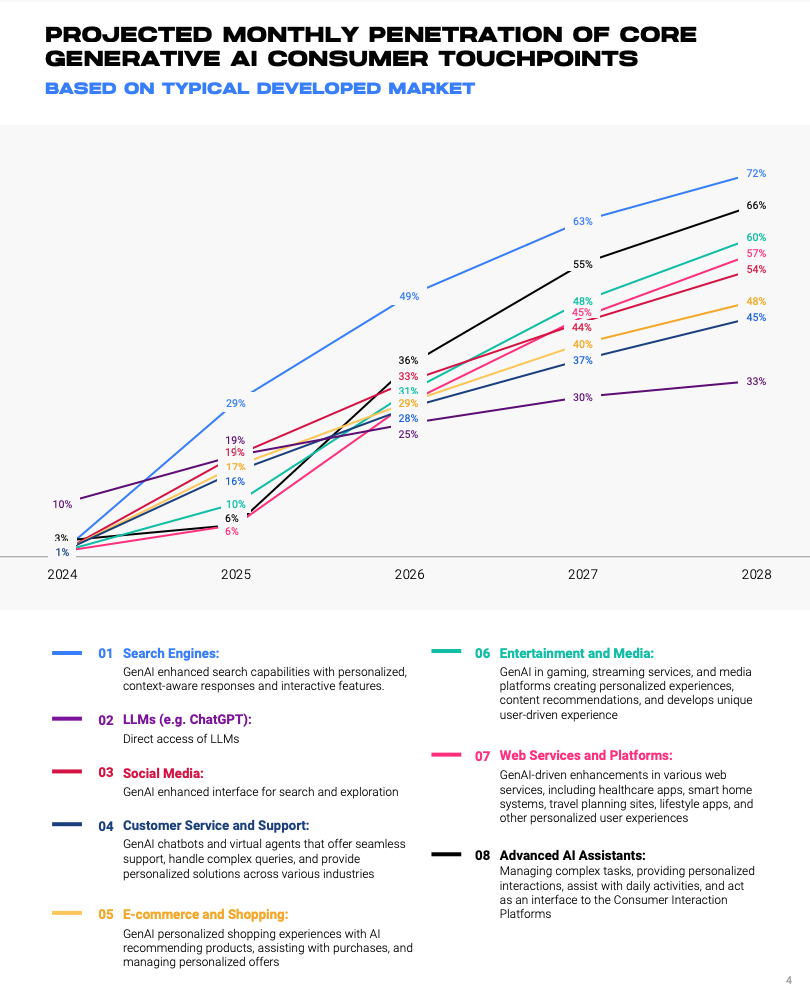
OMG projections led by the awesome JP Edwards (shout out to JP!) published in November demonstrated the huge potential for generative technologies and applications over the next three years. The Coming Wave: Generative AI (Gen AI) report projected the growth of core Gen AI services in a typical developed market from 2024 to 2028. Using expert predictions, it analysed current penetration rates, identified growth potential, and forecast key inflection points where market forces accelerate adoption.

Source: OMG’s ‘The Coming Wave: Predicted Penetration of GenAI Development 2024-2028’ Report – available to download here

This is the real game – and what Super Bowl LIX’s ads demonstrated was just how intense the competition is. My prediction is that whilst this year the models (Gemini, ChatGPT, Llama, Perplexity) took centre stage – by the start of 2026 we’ll be 12 months further into the Cambrian explosion of new utility now underway.

Expect next year’s Superbowl to be full to the brim not of the models, but new and emerging products and services vying for our adoption and usage. The question for brands and marketers won’t be just how they use AI – it’s how they will stand out in an AI-saturated world. Super Bowl LX won’t be about who has AI; it’ll be about who wields it best.

Buckle up people, we’re just getting started.

Standard
conferencing, innovating, machine learning, marketing, retailing, trending

Embracing the Agentic Age: What Mobility Commerce tells us about the Future of Marketing

AI in Everything, Everywhere, All at Once

Walking the convention floors at CES last month, it was impossible to ignore the bigger, brighter screens, smarter cars, more intelligent home devices, and increasingly agile robots. There was a bit more of everything, everywhere, and – because of the impact of AI – it’s all happening at once.

Technologist Shelly Palmer has suggested that “2025 is the year of the realization of AI’s promise,” and it’s hard to disagree. Artificial Intelligence has shifted from hype to reality, becoming deeply embedded in consumer electronics, interactions, and commerce.

Samsung’s SmartThings appliances displayed on the showfloor at CES

Samsung’s SmartThings Automotive now seamlessly connects EVs to broader smart ecosystems, while Richtech Robotics’ autonomous delivery robots are redefining service efficiency. Meanwhile, LG’s AI home hub and Samsung’s Home AI System illustrate how intelligent agents are integrating into everyday life, transforming how we live, work, and move.

But the most pivotal force behind this revolution is Nvidia. At CES, they launched their RTX 50 GPUs, pushing AI-driven gaming and content creation to new heights. They also introduced the Cosmos family of foundational AI models, designed to train humanoid and industrial robots, as well as vehicles for autonomous mobility. The era of agentic AI is here.

The Emergence of the Software-Defined Vehicle

The automotive industry is undergoing a fundamental shift, evolving from hardware-driven machines into software-defined experiences. Nvidia’s Cosmos AI model is at the forefront of this transformation, enabling advanced self-driving capabilities. Trained on 20 million hours of human activity footage, it generates photorealistic simulations that help self-driving cars better understand and navigate real-world environments.

By leveraging synthetic data, developers can train AI systems more efficiently and cost-effectively, reducing reliance on real-world testing. Companies like Uber are already using Cosmos to accelerate their autonomous driving efforts, while Waymo expands its self-driving taxi operations and Honda’s ASIMO OS introduces “ultra-personalized” vehicle interfaces powered by over-the-air updates.

This shift has given rise to the software-defined vehicle (SDV), where traditional metrics like horsepower and acceleration take a backseat to comfort, connectivity, safety, and sustainability. SDVs—along with their supporting ecosystems—were everywhere at CES, signaling a future where cars are more than just a mode of transport; they are destinations in themselves. Think relaxation spaces, content hubs, gaming centers, and even commerce platforms on wheels.

The New Marketing Canvas of Mobility Commerce

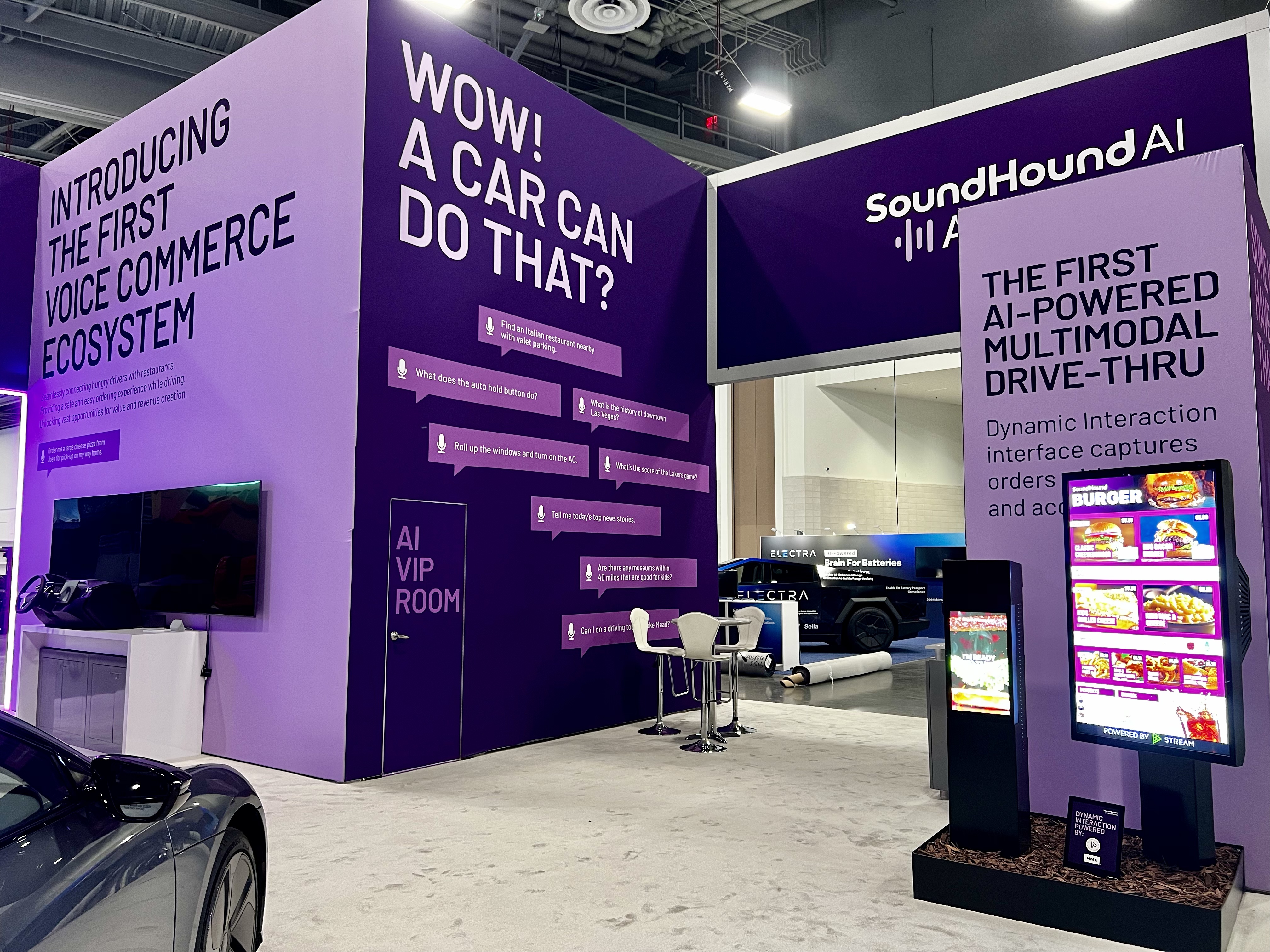
Mobility commerce is fast becoming a frontier for innovation, and CES showcased the technologies set to power it. Take SoundHound AI’s voice-based commerce platform, for example—it allows drivers to order food, pay for services, and access real-time data directly from their car’s infotainment system.

The SoundHound booth at CES demonstrated a custom voice commerce ecosystem

AI-powered interfaces like these go beyond convenience; they enhance the ownership experience while unlocking new revenue streams, increasing the lifetime value of car owners. As vehicles become personalized media and commerce hubs, they create fresh opportunities for brand engagement.

In-car voice assistance is also evolving into richer, multidimensional conversational experiences. The private environment of a vehicle provides a unique space for seamless content consumption and commerce through natural voice interaction. This not only enhances the driving experience but also presents new possibilities for marketing—delivering contextual recommendations and unlocking new monetization models.

Marketing in the Agentic Age

The SDV is just one example of how the agentic age—a world navigated and intermediated by AI agents—is taking shape. The marketing implications are profound.

With AI automating interactions across search, content discovery, and customer service, consumer journeys are increasingly shaped by AI-driven recommendations. Whether through home assistants, automotive voice interfaces, or AI-powered search engines, customers will increasingly rely on digital agents to make decisions for them.

For some categories and brands, this means marketing directly to AI agents. Yet, human engagement remains critical. Brands now have unprecedented tools to create Generative AI-enhanced marketing experiences, from producing high-impact advertising that was previously cost-prohibitive to delivering hyper-personalized web experiences.

AI-powered assistants and avatars can guide potential buyers through product discovery, offering dynamic, customized interactions. The ability to generate tailored content at scale will be a major competitive advantage in this new era of AI-first marketing.

The Evolution of Search and Brand Discovery

Search is evolving at an unprecedented pace, moving beyond keyword-based queries to AI-driven, solution-focused interactions. Consumers are shifting from traditional search engines to AI assistants, social commerce, and e-commerce platforms for discovery.

According to Omnicom Media Group, nearly 40% of consumers in key markets now use LLMs like ChatGPT for search, while 76% rely on platforms like Amazon. Even smart TVs are emerging as search engines, enabling users to browse content via AI-powered voice commands. Meanwhile, consumers no longer rely on a handful of trusted reviewers; they can query and analyze reviews across multiple platforms using AI.

This shift demands a fundamental rethink of visibility strategies. Traditional SEO is no longer enough—discovery now happens across a fragmented ecosystem, from social video platforms to generative AI assistants. Brands must focus on “share of model” (how often they are referenced in AI-driven search results), deploy LLM-specific tracking, and optimize structured comparison data for AI crawlers.

Transforming the Marketing Experience

The shift from SEO to GEO (Generative Experience Optimization) is just one part of a larger marketing transformation, which was on full display at CES. As homes, vehicles, and workspaces move from smart to intelligent, the entire landscape of brand discovery, purchase, and experience is evolving.

2025 is set to be a landmark year for AI, search, creator-led marketing, and innovation. As these trends redefine consumer expectations, brands must adapt their marketing strategies to align with a world where AI, personalisation, and digital-first experiences drive engagement and growth.

Standard