advertising, awarding, celebrating, co-creating, collaborating, content creating, creating, marketing

Crafted to Win: Four Approaches That Delivered Media Lions at Cannes 2025

In my most recent post I shared some thoughts on the vibe from last week’s Cannes Lions festival, and noted that: “Along La Croisette and in the Palais and everywhere in between was an industry grappling not with the future to come, but with a future that now lies behind us. The current source of unfair advantage is being able to marshal your resources – be they marketing, agency, creator, or anything in between – to leverage better than your competitors the world around you.”

That idea of marshalling what’s possible to gain unfair advantage was on full display in the awards category perhaps closest to my heart – media.

Cannes 2025’s Media Lions recognized 66 pieces of work from over 2,000 entries, with the Grand Prix awarded to Dove’s “Real Beauty Redefined for the AI Era” from Unilever. The campaign tackled AI-driven beauty standards by retraining Pinterest’s algorithm to prioritize inclusive representations, delivering brand lift and widespread engagement.

Beyond the Grand Prix, twelve Gold Lions were awarded to campaigns that the jury believed best demonstrated what’s possible with media – showing contextual understanding, innovative media thining, and platform-native creativity.

My personal highlights include Streaming Bars by Heineken, which turned Netflix ads into real-time bar experiences; Coupon Rain for the formidable Mercado Livre by the equally impressive Gut, São Paulo, which transformed news coverage into shoppable coupon moments; and the Redditor Edit for Skoda by agencies including PHD (hurrah), which co-created car features with Reddit superfans. As well as Vaseline’s Verified campaign which co-opted creators to be part of the brands marketing by verifying and rewarding their hacks, and Waitrose’s Sweet Suspicion, by agencies including MG OMD (hurrah again), which leveraged some festive whodunnit storytelling to cut through the Christmas foodie clutter.

Overall, 2025’s winning media work signals a shift toward media experiences that blur entertainment, utility, and advocacy – where effectiveness is derived from earned engagement, tech-enabled storytelling, and brand bravery in reimagining how media is planned, shaped, and shared.

Across the Grand Prix and Golds, four themes emerge. They don’t just tell us where media thinking is now – they hint at what’s possible for brands and agencies aiming to gain competitive advantage by understanding and leveraging platforms, content, and communities.

So, let’s talk about

  1. Native Platform Innovation
  2. Media-as-a-Service (MaaS)
  3. Culture Hacking
  4. Collaborative Storytelling

Native Platform Innovation

This year’s highest-awarded Media Lions work didn’t just use media space – they re-engineered the platforms they were using.

Dove’s Grand Prix-winning campaign didn’t run ads on Pinterest; it partnered with the platform to rebuild its algorithm around inclusivity. Skoda used the upvote mechanic on Reddit, enabling users to collaboratively and collectively design a car. Heineken made Netflix ad breaks contextually relevant by mirroring the show you were watching.

What these ideas all have in common is that they don’t just think of platforms as media – but as media environments with logic, language, behaviours, and levers to be understood and hacked.

Dove Real Beauty Redefined for the AI Era (Grand Prix)

Redditor Edit for Skoda by PHD, London and Leo, London

Streaming Bars for Heineken by LePub, São Paulo

Want some of the action? Don’t think in terms of ‘placements’ but in terms of ‘platform logic’. Winning in contemporary media means understanding how people behave within platforms, and building the interventions that leverage, shift, or enhance those behaviours. If the media plan doesn’t ask, ‘What can this platform uniquely do for the idea?’ – there’s a danger that you’re undercooking the opportunity.


Media-as-a-Service (MaaS)

Many of the Gold Lion winners this year didn’t just run communications – they used those comms to deliver functional value. Coupon Rain transformed football coverage into real-time discount delivery. Ziploc dynamically revalidated expired coupons if the product was in a shopper’s cart. Tata’s Rewards Bag doubled as a QR-enabled shopping assistant.

In all cases, media wasn’t a message – it’s a service, a utility layer. These campaigns served value, solved problems, and made the experience deliver something of tangible value.

Coupon Rain for Mercado Livre by Gut, São Paulo

The Rewards Bag for Tata by VML, Montevideo

Preserved Promos for Ziploc by VML, New York

https://www.vml.com/work/preserved-promos

So, some ways in to building MaaS. Media that does something is more persuasive than media that just says something. Especially in an attention-fragmented world, marketers should treat media as a delivery system for value – not just as visibility for a message. Ask yourself: how can your media plan reduce friction, add convenience, or embed utility? Consumers increasingly reward brands that solve, not just sell.


Cultural Hacking

From Heinz’s Deadpool x Wolverine mashup to Skol’s retroinfluencer Instagram hack, many of this year’s big media winners didn’t wait for cultural permission – they inserted themselves into it. These campaigns exploited timing, tone, and trends to become instantly relevant and shareable. They were less about crafting traditional narratives, and more about inserting brands into the stories that culture was already telling, and cared about.

Can’t Unsee It for Heinz Ketchup & Mustard by Rethink, Toronto

Retro Influencers for Skol by Gut, São Paulo

https://gabimarcatto.work/retro-influencers

Sweet Suspicion for Waitrose by MGOMD, London and Saatchi & Saatchi, London

So, how to hack into culture? The opportunity here is no longer in owning the narrative – but in engineering and earning relevance. How can you build teams and approaches that pay attention to, are curious about, and have a point of view on culture? Ensure that your thinking and activities are explicitly reacting to or riffing off the current vibe. Equip teams – as well as senior leadership decision-makers with the tools and confidence to listen to and react to communities and ideas.


Collaborative Storytelling

Some of the strongest Golds this year weren’t broadcast ideas – they were co-performances. Vaseline co-opted into their marketing over 450 content creators who had created Vaseline hacks. Rocket Mortgage turned a Super Bowl ad into a live singalong experience. In Colombia, an insurer let viewers buy insurance for fictional characters – with real-world policy results. These ideas weren’t passive; they required something of the audience, and rewarded participation with narrative ownership or tangible rewards.

Vaseline Verified for Vaseline by Ogilvy, Singapore

First Ever Live Commercial Crossover for Rocket by Zenith, New York, Mirimar, Los Angeles

Fictional Insurance for RCN/Prime by DDB Colombia, Bogotá

So, how to you encourage collaboration with audiences and communities? The key is in building out engagement architecture. Brands that unlock collaborative storytelling build media experiences that invite audiences in, not just push messages out. Ensure that your approach includes moments where the audience can ‘play their part’, and are rewarded for doing so.


Awards are, of course, always subjective. You might agree with this year’s juries – or see things differently. Let me know in the comments below. Ultimately, it’s part of an important process that I once described as the industry’s ‘engines of objectivity’.

Because what matters is not so much what wins what (there, I said it), but rather that we are able to collectively surface and celebrate the thinking and ideas that inform, inspire, and empower us to do the best work we can. That’s the work of Cannes.
Standard
awarding, content creating, creator-ing, streaming, trending

The Future’s Behind Us: Dispatches from Cannes Lions 2025

I love the Cannes Lions Festival of Creativity.

There. I said it.

I’ll admit that I’ve had my moments of scepticism over the years, but we need Cannes – perhaps now more than ever.

We need it for the celebration of the work. For the ideas. To shape and focus the industry agenda. We need it to logistically get people in one place at one time. For the opportunities to reconnect with old colleagues and friends – and make some new ones. Because it reminds us of what we do when we’re at our collective best. We need it for all those reasons, and many more besides.

I used also to think that we needed Cannes to show us the future – but I don’t think that’s the case anymore. Because the future has arrived already. We are living inside it.

My take on the vibe at Cannes Lions 2025 was of an industry not bracing for a future to come, but rather one wrestling with the reality of its arrival. It was a thought that dawned on me Tuesday whilst I was talking with a long-time industry acquaintance; that the future has moved from being something rushing towards us – into something that now lies behind us. It simply moved faster than our ability to keep pace with the changes it wrought. And now we’re playing catch up.

And so here we were. Navigating together the shared reality of our transformed world.

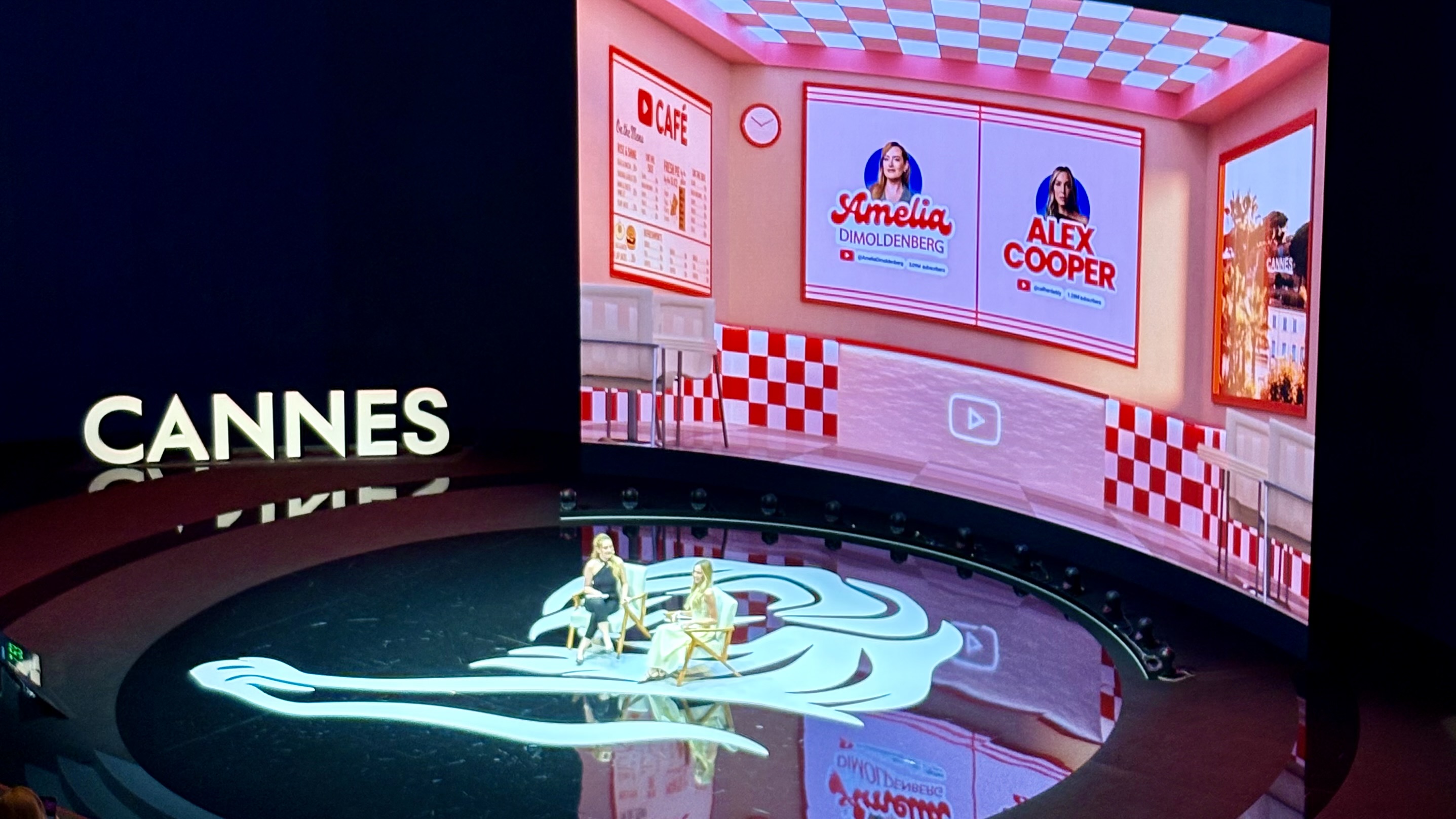
There was no better example of this new reality than YouTube’s presentation in the Palais des Festivals cavernous Lumiere Theatre. Less a presentation than a victory lap, the streaming platform’s CEO Neal Mohan shared with the audience that a billion hours of YT are watched daily on television sets – YouTube is the new TV. With Kaizen – the story of Inoxtag’s Everest climb – he suggested that YouTube creators are also now the new Hollywood start-ups.

Alongside creator content’s expanding influence over the industry is the halo of fan content that accompanies it – often in podcast form. Mohan shared that 1bn people watch a podcast every month on YouTube, noting the power of the connection between creators and fans – observing that “fans don’t follow culture, they shape it … fandom itself is a form of creative expression”.

Brands need not miss out on the action. Chicken Shop Date’s Amelia Dimoldenberg and Call Her Daddy host Alexandra Cooper were on hand to announce the launch of ‘open call’ – a new feature powered by YouTube BrandConnect, which enables brands to discover and partner with creators.

In a blog post, YouTube notes that “Open call gives creators of all sizes the opportunity to pursue new relationships with brands. And brands can lean on the relevance and trust of YouTube creators to get more from their social strategy on YouTube.”

Amelia and Alex put it more bluntly: creators can “take the middlemen out” and work directly with brands.

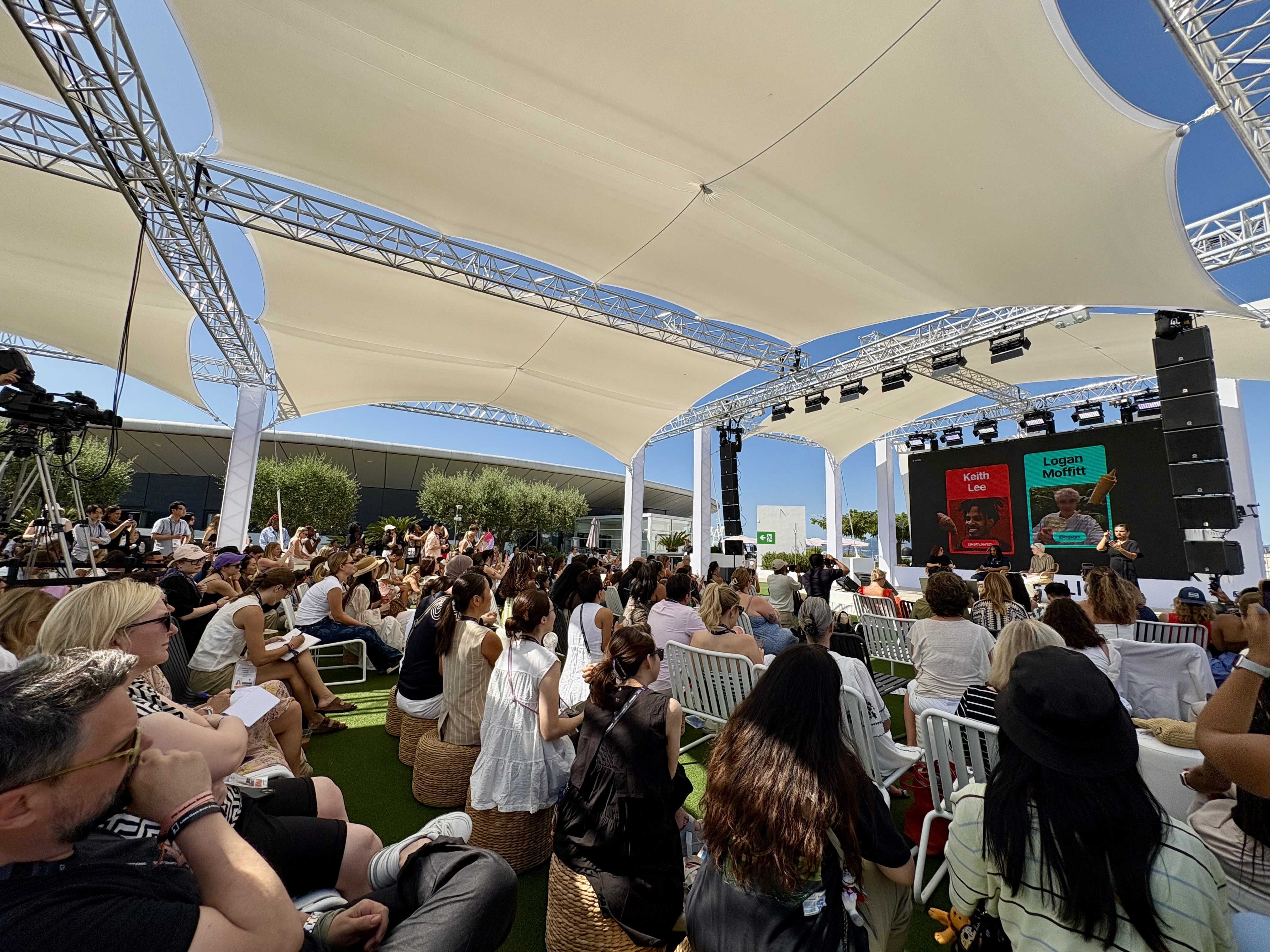
I was left in no doubt about the popularity of creators as the audience began to swell on the Palais’ Terrace Stage Wednesday, not for the excellent daily festival lowdown from Contagious’ Alex Jenkins and Chloe Markowitz – but for the following session featuring TikTok’s Global Head of Business Marketing and Commercial Partnerships Sofia Hernandez in conversation with creators Keith Lee and Logan Moffitt – the latter rocked to fame earlier this year with this viral cucumber salads.

It was bedlam.

Again, that sense that I was sat in a future that had already arrived.

We’re living and working in a world in which creator culture has supplanted the advertising model, in which streaming distribution has overtaken the broadcast model, in which clicks from search engines are declining as the foundations of search evolves – all of it powered by the invisible hand and accelerating force of AI (I got 650 words in without a mention, people).

In response, brands and marketers have changed their strategies and approaches to media and marketing.

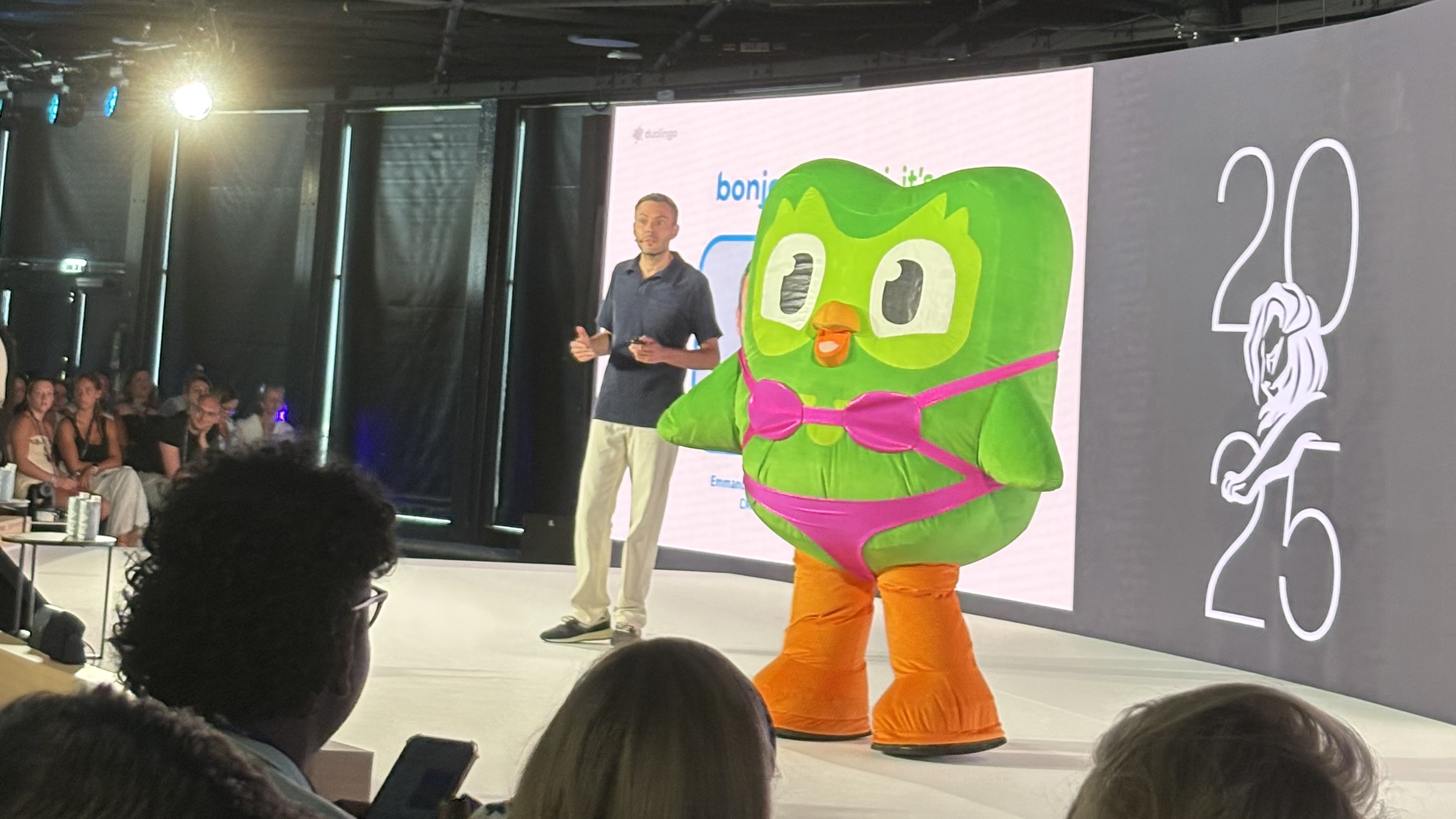
Duolingo’s Emmanuel Orssaud described how the platform eschews the conventional integrated model (too expensive, trying to do too many things, doesn’t get people talking) in favour of a social-first model where 30% of all spend is focussed not on proven effective comms but on “figuring out what else will work”. They’re expanding next into long-form content with a Duolingo Gameshow, and an anime series.

It echoes Liquid Death CEO Mike Cesario’s comments on last year’s Cannes Lions Creative Impact stage in which he shared the brand’s category-redefining approach to marketing. The brand focusses on standing out and being entertaining. The only game in town for Liquid Death is capturing attention, because “if you can get people to stop and look at your product, you’re already ahead of 99% of the market”.

Even the vibe of the awards competition this year felt like a body of work negotiating with itself. The customary smorgasbord of brands’ ideas and innovation were competing with – and often losing out to – their own past body of work.

New campaigns for Apple competed with ten years’ worth of the ‘Shot on iPhone’ campaign’, while Dove’s 2025 entries vied for metal with ‘Real Beauty for Dove’ – a 20-year-long body of work for the brand.

As Contagious’ Alex Jenkins put it – it’s a bit like bringing a gun to a knife fight.

One juror in a post-panel discussion shared with me that brand campaigns competing with the whole back-catalogue of others caused a fair bit of debate. I bet it did. The same juror indicated that they would be referring the issue to Cannes Lions. I can’t imagine it will be allowed to happen again.

So it turns out that the hero of Cannes Lions 2025 wasn’t innovation or ideas, nor was it comms platform vs tactical campaigns, or creativity vs tech or ads vs content or anything vs anything else.

The hero of Cannes 2025 was change itself.

Along La Croisette and in the Palais and everywhere in between was an industry grappling not with the future to come, but with a future that now lies behind us. The current source of unfair advantage is being able to marshal your resources – be they marketing, agency, creator, or anything in between – to leverage better than your competitors the world around you.

It’s tempting to suggest that it was ever thus; but we all know, deep down, that it’s never before been like this.

On stage in the Omnicom Space, Malcolm Gladwell noted that “There is a nobility in failure. [and that] the stories of failure are the most compelling stories that are not being told. The costs of trying crazy shit are not nearly as high as people think. This is exactly the moment to be trying crazy shit and failing!”

Or as Mercado Libre CMO Sean Summers puts it, “The industry is facing a tsunami. The biggest risk, is not taking a risk.”

//

I’ll be publishing more thoughts and perspectives from last week’s festival. Subscribe to catch the rest as soon as it drops.

Standard
awarding

The Engines of Objectivity: Media Awards Shows … and the necessity of the Faustian pact by which we are judged

another week another round of award entering and ceremony attending. or at least so it seems. this week’s PHDcast is a debrief from last week’s MFA Awards … we discuss the events of the night, the winners, the fall out, and the very point of awards themselves. what exactly, are awards good for anyway?

the growth in local and international awards reflects the fragmentation of media itself. here in Australia we have the Mumbrella Awards, B&Ts, Adnews, and of course the MFAs from last week. regionally you get the Spikes, Campaign Asia, but also Festival of Media … and globally Cannes, the Internationalist, (more) Spikes and Festival of Media … I could go on (there’s a rich seam of digital awards to mine I haven’t touched on), but the point is I think made, that award entering could pretty much be a full-time job.

the growth extends to more categories within an individual award platform; each year see’s more and more categories at Cannes, and the MFAs this year had an additional two categories in which contenders could do their thing.

all this means more resource in agencies to fuel the fire of award entering and competing – a point very elegantly made by Zenith’s Ian Perrin in a guest post on Mumbrella back in August. in the rather provocatively entitled ‘Let’s end the awards obsession and stop putting our dollars in the hands of publishers’, Perrin referred to a conversation with a CMO, who commented:

“I am so sick to death of being asked to submit our work into bloody award festivals that nobody has ever heard of, or cares about. If I went into a board presentation and declared that we had won a bronze in a Tasmanian advertising awards festival, I would be fired on the spot. And yet all my agencies seem to care about is entering these awards” he said. “Who cares if the Tasmanian’s loved my print ad, when I still have stock on the shelf at Coles?”

unnamed prominent and influential CMO

the comment thread (bitching a trolling aside), pretty much gets to the nub of the issue: award shows are big business … EMAP, which bought the Cannes Advertising Festival (now the Cannes Festival of Creativity) in 2004 and manages it under it’s i2i brand, last year returned to profit in no small part due to the healthy return it generates from the event and others like it.

“The star performer has been events division i2i grew revenues about 10% year on year in the first half to £71m, thanks to its Spring Fair retail event at the NEC centre and advertising event Cannes Lions in France, with underlying earnings up 16% to £33m. The division accounts for half of Top Right’s revenues and 70% of underlying profits.”

source, the Guardian, July 2012

70% of underlying profits coming from events. that’s probably something that isn’t too far from the reality of a lot of former publishers (I say former as many have now well and truly diversified their businesses and incomes to combat the decline of print ad revenues – no more elegantly than Mumbrella). awards are a pretty good way for publishers to make money, so what’s ultimately in it for agencies?

well rather a lot …

a showcase for the work, the work, the work (as one agency puts it). and not just the work you would like to be rewarded and acknowledged but rather the work that has been peer reviewed by your industry colleagues, which leads to:

acknowledgement of the results you are delivering for your clients … awards are tangible demonstrations of how an agency is helping clients grow their brands and generate return for their investment in your strategies and ideas, which leads to:

a reputation for thinking and work that is, crucially, acknowledged by your peers. you don’t just say you rock – you have a subjective benchmark to say just how much you do, actually, rock. which in theory leads to:

getting onto more pitch lists, clients respect your thinking and want to explore how you can deliver for their brand and business. so awards are ultimately (of course) about growing your business.

we’re not, I think, alone. across other industries in which the success or outcome of the product is inherently subjective (design, architecture, literature) awards are prevalent. awards are like objective engines … transforming the subjectivity of opinion into tangibility of proof. of course they’re still essentially subjective (the Effies perhaps aside), but not all subjectivity is, I suppose, created equal.

and so we’re left with a rather Faustian pact; publishers build the engines of objectivity that agencies need … and we feed them. relentlessly.

which is no bad thing … especially in an awards platform like the MFAs, throughout which (as entrant, judge, and attendee) I’ve seen nothing but professionalism and careful consideration and judgement. indeed they have created and been the forum for important debates – like the one Nic and Stew describe from their judging room (in the PHDcast above). and you also get to have a bit of fun on awards night.

so a big congrats again to all the winners, especially team PHD for their ANZ nomination and PepsiCo win, Steady for his induction into the MFA Hall of Fame and Initiative for their Grand Prix win. you can view all the winners here. see you next year for more of the same.

MFA Awards 2013 1

MFA Awards 2013 2

MFA Awards 2013 3

Standard
awarding, conferencing, debating, printing, publishing

Celebrating the end of the Party: Why dumping the junket is exactly what The Caxtons needs

hamilton-island

so I’ve just returned from The Guardian Australia’s launch drinks, but before I call it a night I thought tonight’s happy event made it timely to throw some thoughts down about yesterdays shock report in Adnews that “The Caxtons’ famed jamboree to an exotic location will not happen this year. But the awards will. And next year the junket could be back.” … furthermore “Tasmania has been mooted.”

well phew. heaven forbid that in the midst of the biggest systemic shift in print advertising in several generations we miss the chance to junket it up somewhere exotic.

I should declare an interest; I was honoured and privileged to be asked to speak at last year’s Caxtons – on Hamilton Island, above – so last year I very much enjoyed the benefit of giving a presentation in Adnews’ mourned-for sunny climes.

I have to be honest though; I didn’t wholly enjoy my presentation. and I’ve spent a lot of time thinking about why.

the truth is that I wasn’t at my best … it wasn’t the most focused of talks, and that’s my bad. but I think it was also a lot to do with the room; a mix of mainly newspaper staffers, ad agency people, journalists and some flotsam and jetsam like me. you see sometimes when you present the room is with you, and if you’re like me that makes you better. but sometimes the room isn’t with you, and that makes some people stronger, but if you’re like me it makes nagging doubt creep in … perhaps I’m wrong? perhaps I’m a crazy person for even suggesting this!? and when your presentation to a bunch of creatives pivots around your (my) belief that “the worst thing that ever happened to advertising is adverts” you can see how that would affect your (my) performance.

I’ve gotten pretty good at reading rooms, and I think the reality is that whilst I wasn’t, by my full admission, at my best … a lot of people in the room just didn’t want to absorb the message: that the time had come to change.

my audience, perhaps quite rightly, wanted to get on with what the Caxtons are there to do: celebrate creativity in newspaper advertising. who the freak was I to turn up and rain on such a brilliantly orchestrated parade? people’s hearts and souls and time and effort had gone in to organising that celebration. people much better than me had created ingenious and awesome presentations to delight and entertain and stimulate.

the words of Maya Angelou echoed in my head that night and many nights since: “People will forget what you said, People will forget what you did, But people will never forget how you made them feel” (source) … and I think that is why I failed that day on Hamilton Island – when the words and actions were long gone, I had made that room feel no better about the situation I believe press advertising is in. I hadn’t followed-though my dark night to deliver a dawn. I’d attempted, but it hadn’t landed.

so why the confession? well, yesterday’s Adnews report that – essentially – the party was over, filled me with nothing but sheer optimism. because the party is over, and that’s what I so desperately tried but failed to say last year. but the party being over makes it all the more important that the celebration continues. because what I experienced on that island, that energy and passion and creativity shouldn’t be lost because of some crazy perception that the Caxtons is a junket … what I witnessed was much more than that. the Caxtons isn’t living the vida loca in some exotic location, its an idea … an idea shared by some staggeringly creative and passionate people.

the Caxtons, like print advertising, must reinvent itself … and that is a conference (in the truest sense of the word) that has never been more urgent nor necessary. this is the Caxtons’ opportunity to fight for its own future, I believe that it’s more than up to the task.

featured and above image via trip advisor

Standard
awarding, celebrating, cinema, community-building, imagining, innovating

A Counterpoint for Cannes: Lessons from the Sundance Film Festival

Sundance-film-festival

so I was listening, as is my want, to Simon Mayo and Mark Kermode’s Movie Review Podcast (which is very good btw) as they were live from The Sundance Film Festival which was visiting London. they were interviewing John Cooper, Director of the SFF who described how the festival first came about:

“Sundance … was created to find a safe haven for artists to become better and to make better cinema … then we started this thing … we called labs, which were basically workshops where filmmakers come and work on their scripts with mentors and there’s a whole mentoring process … very quickly after that [we] were making movies but they weren’t getting seen anywhere so we needed to create a platform and that was the Sundance Film Festival and that’s how it started” (source)

the festival has seen the likes of Paul Thomas Anderson, Alexander Payne and Tarantino all hone and develop their skills in an environment where risk-taking is encouraged and protected; a very different environment to Cannes or the Oscars … where the focus is on subjective judgement by peers and winning awards.

I couldn’t help but think and wish that there was a Sundance equivelant for our industry. the Cannes Festival of Creativity (which will soon see the great and good head off to the south of France for the annual networkathon) is basically our Oscars, and it has its place.

but there doesn’t seem to be a counterpoint? we don’t have a Sundance.

certainly in Australia the Media Federation Awards, like the B&T awards and Adnews awards, all follow the Cannes / Oscars template … glitz and glamour as the campaigns and ideas judged to be the best allow the people who submitted them to have a fully deserved 15 seconds in the glare of the lights.

how awesome would it be if the above quote read:

“Incubator … was created to find a safe haven for planners to become better and to generate better innovations … then we started this thing … we called labs, which were basically workshops where planners come and work on their ideas with mentors and there’s a whole mentoring process … very quickly after that [we] were creating innovation but they weren’t getting seen anywhere so we needed to create a platform and that was the Incubator Ideas festival and that’s how it started”

how awesome? very.

Standard