advertising, awarding, celebrating, co-creating, collaborating, content creating, creating, marketing

Crafted to Win: Four Approaches That Delivered Media Lions at Cannes 2025

In my most recent post I shared some thoughts on the vibe from last week’s Cannes Lions festival, and noted that: “Along La Croisette and in the Palais and everywhere in between was an industry grappling not with the future to come, but with a future that now lies behind us. The current source of unfair advantage is being able to marshal your resources – be they marketing, agency, creator, or anything in between – to leverage better than your competitors the world around you.”

That idea of marshalling what’s possible to gain unfair advantage was on full display in the awards category perhaps closest to my heart – media.

Cannes 2025’s Media Lions recognized 66 pieces of work from over 2,000 entries, with the Grand Prix awarded to Dove’s “Real Beauty Redefined for the AI Era” from Unilever. The campaign tackled AI-driven beauty standards by retraining Pinterest’s algorithm to prioritize inclusive representations, delivering brand lift and widespread engagement.

Beyond the Grand Prix, twelve Gold Lions were awarded to campaigns that the jury believed best demonstrated what’s possible with media – showing contextual understanding, innovative media thining, and platform-native creativity.

My personal highlights include Streaming Bars by Heineken, which turned Netflix ads into real-time bar experiences; Coupon Rain for the formidable Mercado Livre by the equally impressive Gut, São Paulo, which transformed news coverage into shoppable coupon moments; and the Redditor Edit for Skoda by agencies including PHD (hurrah), which co-created car features with Reddit superfans. As well as Vaseline’s Verified campaign which co-opted creators to be part of the brands marketing by verifying and rewarding their hacks, and Waitrose’s Sweet Suspicion, by agencies including MG OMD (hurrah again), which leveraged some festive whodunnit storytelling to cut through the Christmas foodie clutter.

Overall, 2025’s winning media work signals a shift toward media experiences that blur entertainment, utility, and advocacy – where effectiveness is derived from earned engagement, tech-enabled storytelling, and brand bravery in reimagining how media is planned, shaped, and shared.

Across the Grand Prix and Golds, four themes emerge. They don’t just tell us where media thinking is now – they hint at what’s possible for brands and agencies aiming to gain competitive advantage by understanding and leveraging platforms, content, and communities.

So, let’s talk about

  1. Native Platform Innovation
  2. Media-as-a-Service (MaaS)
  3. Culture Hacking
  4. Collaborative Storytelling

Native Platform Innovation

This year’s highest-awarded Media Lions work didn’t just use media space – they re-engineered the platforms they were using.

Dove’s Grand Prix-winning campaign didn’t run ads on Pinterest; it partnered with the platform to rebuild its algorithm around inclusivity. Skoda used the upvote mechanic on Reddit, enabling users to collaboratively and collectively design a car. Heineken made Netflix ad breaks contextually relevant by mirroring the show you were watching.

What these ideas all have in common is that they don’t just think of platforms as media – but as media environments with logic, language, behaviours, and levers to be understood and hacked.

Dove Real Beauty Redefined for the AI Era (Grand Prix)

Redditor Edit for Skoda by PHD, London and Leo, London

Streaming Bars for Heineken by LePub, São Paulo

Want some of the action? Don’t think in terms of ‘placements’ but in terms of ‘platform logic’. Winning in contemporary media means understanding how people behave within platforms, and building the interventions that leverage, shift, or enhance those behaviours. If the media plan doesn’t ask, ‘What can this platform uniquely do for the idea?’ – there’s a danger that you’re undercooking the opportunity.


Media-as-a-Service (MaaS)

Many of the Gold Lion winners this year didn’t just run communications – they used those comms to deliver functional value. Coupon Rain transformed football coverage into real-time discount delivery. Ziploc dynamically revalidated expired coupons if the product was in a shopper’s cart. Tata’s Rewards Bag doubled as a QR-enabled shopping assistant.

In all cases, media wasn’t a message – it’s a service, a utility layer. These campaigns served value, solved problems, and made the experience deliver something of tangible value.

Coupon Rain for Mercado Livre by Gut, São Paulo

The Rewards Bag for Tata by VML, Montevideo

Preserved Promos for Ziploc by VML, New York

https://www.vml.com/work/preserved-promos

So, some ways in to building MaaS. Media that does something is more persuasive than media that just says something. Especially in an attention-fragmented world, marketers should treat media as a delivery system for value – not just as visibility for a message. Ask yourself: how can your media plan reduce friction, add convenience, or embed utility? Consumers increasingly reward brands that solve, not just sell.


Cultural Hacking

From Heinz’s Deadpool x Wolverine mashup to Skol’s retroinfluencer Instagram hack, many of this year’s big media winners didn’t wait for cultural permission – they inserted themselves into it. These campaigns exploited timing, tone, and trends to become instantly relevant and shareable. They were less about crafting traditional narratives, and more about inserting brands into the stories that culture was already telling, and cared about.

Can’t Unsee It for Heinz Ketchup & Mustard by Rethink, Toronto

Retro Influencers for Skol by Gut, São Paulo

https://gabimarcatto.work/retro-influencers

Sweet Suspicion for Waitrose by MGOMD, London and Saatchi & Saatchi, London

So, how to hack into culture? The opportunity here is no longer in owning the narrative – but in engineering and earning relevance. How can you build teams and approaches that pay attention to, are curious about, and have a point of view on culture? Ensure that your thinking and activities are explicitly reacting to or riffing off the current vibe. Equip teams – as well as senior leadership decision-makers with the tools and confidence to listen to and react to communities and ideas.


Collaborative Storytelling

Some of the strongest Golds this year weren’t broadcast ideas – they were co-performances. Vaseline co-opted into their marketing over 450 content creators who had created Vaseline hacks. Rocket Mortgage turned a Super Bowl ad into a live singalong experience. In Colombia, an insurer let viewers buy insurance for fictional characters – with real-world policy results. These ideas weren’t passive; they required something of the audience, and rewarded participation with narrative ownership or tangible rewards.

Vaseline Verified for Vaseline by Ogilvy, Singapore

First Ever Live Commercial Crossover for Rocket by Zenith, New York, Mirimar, Los Angeles

Fictional Insurance for RCN/Prime by DDB Colombia, Bogotá

So, how to you encourage collaboration with audiences and communities? The key is in building out engagement architecture. Brands that unlock collaborative storytelling build media experiences that invite audiences in, not just push messages out. Ensure that your approach includes moments where the audience can ‘play their part’, and are rewarded for doing so.


Awards are, of course, always subjective. You might agree with this year’s juries – or see things differently. Let me know in the comments below. Ultimately, it’s part of an important process that I once described as the industry’s ‘engines of objectivity’.

Because what matters is not so much what wins what (there, I said it), but rather that we are able to collectively surface and celebrate the thinking and ideas that inform, inspire, and empower us to do the best work we can. That’s the work of Cannes.
Standard
co-creating, collaborating, community-building, content creating, creator-ing, realtiming

Streaming’s Next Decade: From Ads to Audiences – and Why Creators are Set to Win

I evaluated in my previous post some media and marketing predictions I made in late 2014. Netflix had announced their arrival in Australia for the following March. My expectation that content would win out over channel, that ability to deliver on desire for choice on-demand would determine growth, and that programmatic would swallow huge swathes of the industry – have all proved I think, largely, true.

My prediction however that the industry would largely fall out of love with the ‘ad’ didn’t come to pass as expected. Adverts have remained the predominant unit of currency for paid branded messaging.

Instead, the group that capitalised on the opportunity as I saw it – to create “platform-neutral content strategies that can adapt to platform and context more quickly – generating more relevance for brands’ comms” were not brands, but creators. The “native content in video form” that I foresaw becoming predominant in video did come to pass, but with a generation of content creators – rather than brands – at the helm.

For many brands and marketers, success is now dependent on engaging and fuelling this generation of content creators – who intermediate between products and services on one hand, and customers and consumers on the other.

Last week saw two awesome examples of this now established marketing model in practice.

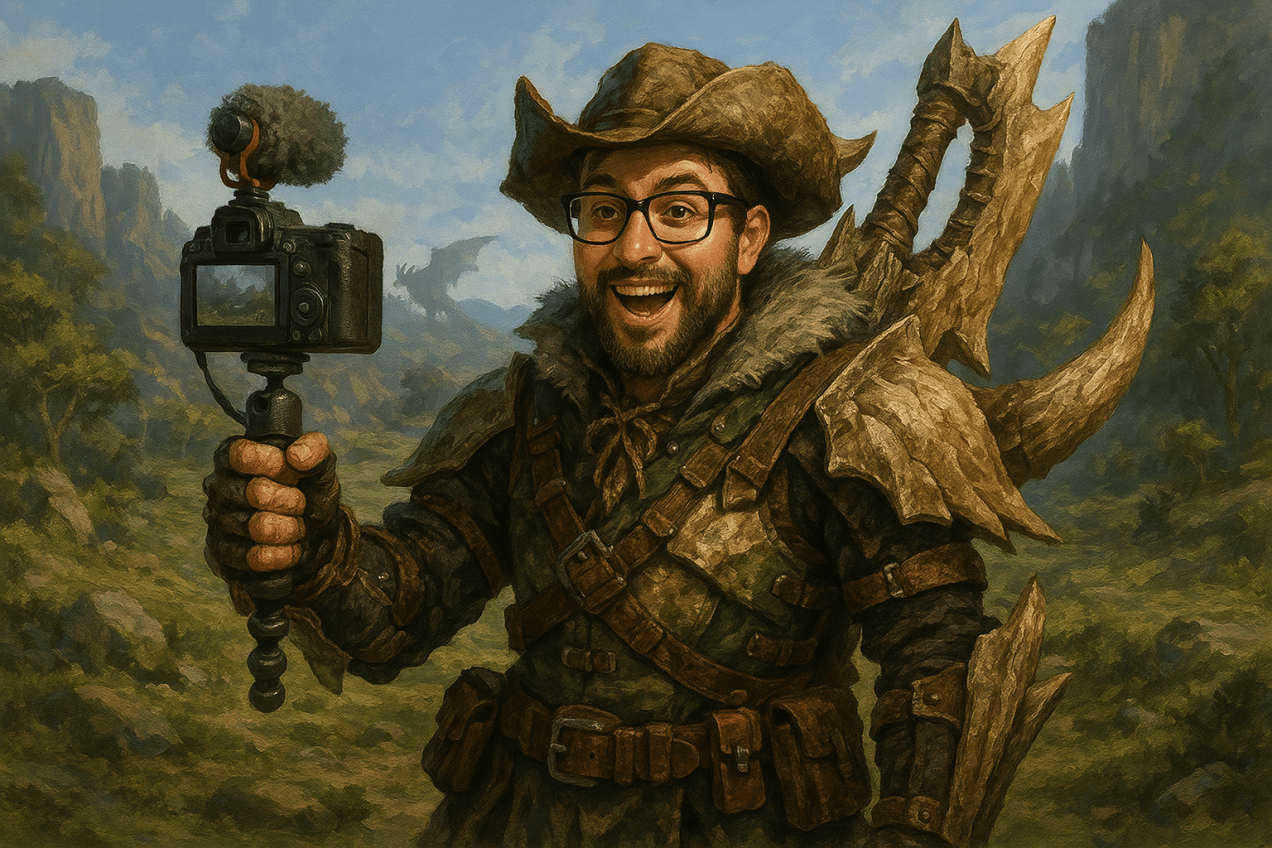
How Capcom Inspire an Army of Creators to Fuel Monster-Hunting

Monster Hunter Wilds, which released worldwide on February 28, has had a great launch. Within the first three days, the game sold over 8 million copies (it’s now over 10m), setting a record as Capcom’s fastest-selling title. On Steam it attracted more than 1.3 million concurrent players shortly after launch, securing a position among the platform’s top 10 most-played games by concurrent users.

Whilst this success wouldn’t be possible without a great product – Wilds has been critically well-received, earning 90 out of 100 on Metacritic with reviewers praising engaging combat, impressive creature design, and innovative gameplay features – its success is also down to a determined effort to engage audiences thru the game’s affiliated army of creators.

Last Tuesday’s Monster Hunter Wilds Showcase, hosted by producer Ryozo Tsujimoto, revealed the first free update, which is scheduled for this coming Friday. The content is relevant of course for people who play the game (declaration: I’m 49 hours in and counting), but I’d suggest that’s not the primary audience for this content.

Rather, Tuesday’s content was designed and deployed not primarily for the game’s 10m players, but for creators. The update had more than enough new information to fuel new content, but enough details held-back and teased to allow room for all-important speculation and prediction. This video from the awesome Khraze Gaming channel is a great example.

There’s now a very established – and mutually beneficial – relationship between the Monster Hunter Wilds dev team and the game’s content creators. The game’s owners are supporting their community of content creators, who in turn are producing content to build their community of subscribers.

This isn’t all one-way. There’s been plenty of pushback from hardcore fans of the series, critical that the game is too easy. But the devs aren’t shying away from this. They are embracing this community feedback, in an open letter this week announcing that:

“We would also like to thank you for the many comments, thoughts and feedback we have received since the game was released.

The development team has been reading your feedback, and we are encouraged by it. We are also using the comments and feedback we have received to help us plan our future actions.

Future updates will see more Tempered Monsters (★8) added to the game … And for even more of a challenge, Arch-tempered monsters will make an appearance. These are even stronger versions of tempered monsters.”

Another masterful example of a marketing team engaging and fuelling content creators was from Marvel.

How Marvel Inspired Creators to Create with a Five-Hour Plus Livestream

In this even more astonishing and finely-tuned example of the marketing-to-creators model, Marvel revealed the cast of the now-in-production Avengers Doomsday via a five hour plus live-stream – with a new cast member being revealed on the back of a director’s chair every 12 minutes. The announcement concluded with Robert Downey Jr. – who will play Doom in the strategically crucial film for Marvel – walking out to sit in the final chair and asking the audience to be quiet on set.

Just to reiterate in case you read that quickly – the Avengers Doomsday cast reveal announcement video was a panning shot of 27 director’s chairs … which lasted five and a half hours.

This clearly is content designed not to be watched by audiences. Rather – just like Monster Hunter Wilds – its content precision-made for creators. Content machine-tooled to be poured-over in crazy detail in real-time by an army of creators (many of whom are of course huge fans).

Creators like The Breakroom team, who scrambled into their studio to livestream their discussions and reactions to the Avengers announcement video, in real-time. A livestream of a livestream. Marvel designing and deploying content for creators.

This is the new and now established model. Content from brands tailor-made for creators, designed to fuel the production of content for their audiences. Creators are the intermediaries and amplifiers of brand messaging. Communities are maintained and managed not directly by brands, but by a team of creators the literal job of who is to drive engagement with audiences for brands; either because they are fans, or their income depends on it – and in reality, usually and probably both.

This is what will underpin brand success over the next decade of video.
This is a model about to be supercharged by next-generation AI production capabilities.
This is what marketing precision at scale really looks like.

Standard
branding, co-creating, content creating, marketing, planning, publishing, user-generating

Context and Content: Communication lessons from African Drums and Harry Potter

African_drums
Yoruba ceremonial drums, Nigeria.  picture from here.

so the lovely Emily got for me a signed copy James Gleick's The Information for my birthday (thanks Emily) and whilst I'm only a couple of chapters in, its already proving to be a bit of a treasure trove.  the first chapter discusses the African Drums.  when 18th Century Europeans first heard the drums, they had no idea that they were conveying information.  yet the drumbeats contained detailed and what seemed to be superfluous information.

"Instead of "don't be afraid," they would say, "Bring your heart back down out of your mouth, your heart out of your mouth, get it back down from there" … the drums generated fountains of oratory"

the explanation for the elaboration is fascinating.

"in mapping the spoken language to the drum language, information was lost.  the drum talk was speech with a deficit … the drum language began with the spoken word and shed the consonants and vowels.  that was a lot to lose … consequently … a drummer would invariably add "a little phrase" to each short word.  Songe, the moon, is rendered as songe li tange la manga – "the moon looks down at the earth" … the extra drumbeats, far from being extraneous, provide context"

James Gleick, The Information, Chapter One

there's a beautiful parallel with the world and brands and communication.  the moments in which brands connect with people are fleeting and becoming more so.  there is a very narrow opportunity in which a marketer can convey information.  messages need context, and brands provide it.

so rather than someone hearing "we make cars" (the message) they hear "we make Jeeps" (the branded message).  this context takes the message from a simple "this is what we do" to a more richly imbued communication embodying all the associations someone recalls when they hear "Jeep's cars".

this context is crucial … "we make cars", becomes:

we make Jeeps

Jeep_ad

we make Toyotas

Toyota_ad

we make Hondas

Honda_ad

it's a useful thinking framework – to separate the context and the content.  marketers work in challenging times.  the potential opportunities to make meaningful connections with people have never been greater; but with opportunity has come complexity.  how are communications cutting-through?  how to create the most distinctiveness in market?  how and when to engage audiences through media beyond which that I buy?

separating context and content helps to address some of those challenges.

creation of context is the creation of brand meaning.  what does my brand stand for?  why does it exist?  what are the associations I want to create (or reinforce) when someone recalls my brand.  this is a long-term process, and it's contribution to a brand's business not always easily measurable.  but it's crucially important context – and the marketer is responsible for continuously creating it.

creation of content is the creation of the message.  we're having a sale this weekend.  new model now available.  we've improved our fuel efficiency.  the role of content is to influence and stimulate an action or a response.  these are shorter term, and the extent to which they permeate and become salient in market are very measurable.  they can also be spread with huge efficiency by media other than that which is bought.

separating these two elements helps navigate increasingly complex waters.  how can I – as marketer – create context for my brand?  a context unhindered by the need for immediate ROI in market.  what platforms (through owned media) can I create to hold and communicate this context?

…and how can I efficiently and effectively deploy my messages into market?  how can I inspire and encourage people to pass-on that message on my and their behalf?

the combination, like the African drums, are simple messages imbued with the richest of context … so that the content is un-mistakenly attributed to its brand.  the add the pieces together you first have to separate them.

which brings us, of course, to Harry Potter – and this week's announcement that the upcoming Deathly Hallows Part 2 won't be the end of the Potter franchise.

Potter as brand is now established.  seven books and eight movies have communicated the narrative and its characters, all of whom are now familiar memes in our culture.  like Star Wars before it, Potter – because of the human stories it tells – is now firmly embedded in the popular psyche.  but context and content have hereto been one and the same; the experience absolutely binding the two together.  books and movies as one-directional communication of story.  around this controlled narrative a user-generated culture arose, but it never penetrated back into nor influenced the context or content coming from JKR, Bloomsbury and Warner Bros.

that's about to change.  Potter is about to undergo a context content split.

Potter as a brand is now evolving to have two distinct streams.  the context will continue to be provided by JKR and co.  both the ideological: what are the rules and conventions of the Harry Potter universe?  and the physical: in the form of the Pottermore owned-media platform (which will also be the sales platform for HP eBooks).

but content will now, for the first time, be created by JKR and anyone else with the passion and energy to contribute.  the long-term building of the Potter brand co-existing but separate to the short-term creation of Potter content.

the evolution is already apparant … the above announcement inviting and teasing its audience to "follow the owl" – an ARG element signalling a shift in the Potter brand to one that is co-created, crowdscourced and owned by everyone.

we're all drummers now.

Standard
brand extending, branding, campaigning, co-creating, community-building, connecting, earning, gaming, owning, praising, social media-ising, user-generating

Big Planning and Big Thinking: How Bendigo and Adelaide Bank use owned & earned media to deploy a little utility into the world

Got a big idea that you want to bring to life? Create a plan, share it and make it happen with help from the PlanBig community

so the lovely and awesome Zaac posted a link to my wall of the above effort from Bendigo and Adelaide Bank.  it's called PlanBig and, in it's own words, its…

"… a way for people to get together to make things happen and make a difference.  We [Bendigo and Adelaide Bank] believed that there was some real value in giving people the chance to come together in one place to talk about ideas, share inspiration, offer advice or help make things happen for themselves or someone else.  PlanBig brings together the experiences, knowledge and expertise of people with different skills from all walks of life and all ages to help each other get ideas kick started."

it's a delightful and instinctively attractive platform, which elegantly ticks a range of boxes including – amongst others – socialisation, co-creation, crowdsourcing and gamification.  it also has a elegant and seamless execution that connects with the Book and other social platforms…  the badges-as-reward effort has been borrowed from FourSquare, as has the Book's Like concept (in fact the functionality is a bit like a social network functionality greatest hits, which isn't a bad thing – better to use functionality with which we're familiar … makes it more, well, functional).

as the site observes, "Bendigo and Adelaide Bank feel so strongly about helping people realise their dreams, they’ve been doing it in local communities for over 150 years" … so this platform is just a natural extension of a brand proposition that's been in market for over a century.

it's also another example of the owned and earned media combo (note the absence of bought media) to create (1) utility (2) meaningful connections with a community of people and (3) content ripe for the amplification – if even a few of these ideas get big it will be marketing gold-dust.  all of which makes a great deal more sense to me than buying a shedload of ads telling people what competitive lending rates you have.

this genuinely feels like a brand / product extension with sociable and marketable assets built in from the ground up.  it's a communication for people, by people, and its infinitely better for it.  good on 'em.

Standard
advertising, blogging, broadcasting, co-creating, engaging, planning, remixing, social networking, user-generating

Thinking from a different place – the rewards of letting go: what happened when Vizeum debated who exactly is in control?

TFADP_II but what does it all mean?: Hook, Grant, Bailie, McClary and Corcoran with chair Chris Maples debating at Vizeum this evening

who's in control?  that was the theme of this evening's Thinking From A Different Place debate at Vizeum.  do brands make what customers want or do customers determine what brands make?  do creative agencies still control creation of the best ideas, or are the crowd now creating and aggregating the best content?

a panel, consisting of Vizeum's Matthew Hook, We Are Social's Robin Grant, Martin Bailie of Glue, Michael McClary from Microsoft and Andy Corcoran from MTV all awesomely debated a range of subjects from the decline of the newspaper industry to the impact of technology, taking in the future of media agencies and the nature of brands and advertising on the way.

it's easy to summarise such a debate by saying that its all getting more and more complicated and more and more difficult and we all need to move faster and faster and be better and better to stay ahead; but a few interesting comments steered the debate in a more illuminating direction.

Martin pointed out that we focus too much on the next big technology, or on the specifics of what people are doing with technology now, rather than focusing on two millennia of human psychology to point us in the right direction.  as he put it, if we "get the basics right you're 80% there" – produce interesting stuff that's based on a interesting point and view and land it in the laps of as many of the right people as possible.

the question of listening to customers was numerous times, in particular by McClary who observed that there's a "danger in highlighting [and responding to] only the loudest voices".  Hook agreed, observing that whilst you can engage 1,000s in a conversation, many brands are interested in talking to and influencing millions.  Corcoran reminded us of the Henry Ford quote that "If I'd asked my customers what they wanted they'd have asked for faster horses".

but it was the nature of control that caused the most interesting debate.  Grant: "historically brands were more in position of control"; Hook: "marketers desperately want control, they do everything they can to create predictability [of the result of their actions]"; Bailie: "it doesn't matter – no one controls brands; get rid of the idea of control"

for me its about maintaining a balancing act; about knowing when to keep and when to let go of control of what a brand does and how it does it.  would you ever let the crowd determine your core creative idea or brand positioning? …almost certainly not.  would you let them create content inspired by it? …yes.  should you let them make your products? …no.  should you le them choose the ingredients? …of course.

a point was made about the recent successes of Facebook and Twitter, with a question being raised about what business they're in.  they are – of course – in the business of aggregating audiences.  that's the media business.  the point of whether or not they can monetise that aside (big aside I recognise but run with it), part of their success is down to the fact that they capitalise on the fact that one of the best ways to grow an audience is to get your current audience to do it for you.

giving away control – of your product, or whatever is appropriate – is a particularly effective way of getting an audience to do just that.  give them ownership, give them reasons to talk about you brand, its point of view and its products and services.  but most of all give them a reason to come back, to stay part of the conversation with you.  because its those conversations that are the most valuable bit of media real estate of all.

Standard
co-creating, planning, targeting, user-generating

A new lore of averages: what Clay Shirky and the Coney Island Mermaid Parade can teach us about defining target audiences

Means_comparison_mermaid_pics insight after insight from Clay Shirky’s Here Comes Everybody.  the above chart is copied from chapter five which covers collaborative production. it shows contributors to the Coney Island Mermaid Parade Flickr site ranked by the number of photos they contributed.  a couple of users contributed the most whilst the most users contributed only a little.  Shirky observes that:

“…the imbalance is the same shape across a huge number of different kinds of behaviours.  a graph of the distribution of tags on Flickr is the same shape as the graph of readers-per-weblog and contributions-per-user to Wikipedia.  the general form of a power law distribution appears in social settings when some set of items – users, pictures, tags – is ranked by frequency of occurrence”

that there’s a massive imbalance between people who contribute in collaborative projects we know.  but its something that we don’t often enough plan for in a media world where we increasingly ask (the audience formerly known as) consumers to user-generate and co-create on our behalf.  Shirky goes on to point out that:

“…the imbalance drives large social systems rather than damaging them.  fewer than two percent of Wikipedia users ever contribute, yet that us enough to create profound value for millions of users … the spontaneous division of labour driving Wikipedia wouldn’t be possible if there were concern for reducing inequality rather than limiting it … large social systems cannot be understood as a simple aggregation of the behaviour of some nonexistent ‘average’ user”

and there you have it.  he said it.  there’s no such thing as the average user.  we all know this, and yet we still struggle to capture the targets for our advertising campaigns in neat tangible soundbites.  the demographics of old have (thankfully) long gone, but whilst they’re been replaced by more contemporary means – attitudinal or usage based targeting – our one-dimensional thinking too often remains…

we are still, by and large, expected to think of and present ‘one’ target audience.  an ‘averaged’ person or group based on some attribute of attributes that are most relevant to the brief.  but look again at where the mean ‘average’ sits in the above chart… it not only fails to capture the few individuals who would be super-involved in what we have to say or ask them to do, but massively over-estimates the extent to which most people will commit attention to our branded projects.

we need a new lore of averages for our targeting-think.

when we describe target audiences we should be thinking of them as sitting along the above spectrum.  how do we plan on one hand for the very few but valuable super-attention givers from whom a lot of the effectiveness of the media investment will derive?  whilst on the other hand plan for the ‘mode’ individuals, the vast majority who will contribute the smallest amount of attention to what we have to say?

this spectrum, this logarithmic curve of attention, exists at whatever level you aggregate.  be it a population, or an age range, or any segment no matter how – whether attitudinally or behaviourally – it is defined.  there is no average user, no average consumer, no average contributor, co-creator, or co-collaborator.  let’s stop kidding ourselves and clients otherwise.

Standard