buying, careholding, planning, responding

When Waitrose dumped Fox: why its right for brands to cede control of their media schedules

Glenn_beck
Fox's Glenn Beck's controversial comments cost the channel ad revenues

Waitrose has responded to an unreported number of complaints and removed Fox News – which is carried on Sky – from its media schedules.  the move comes in response to comments by the station's Glenn Beck who in July called US President Obama "a racist" with "a deep-seated hatred for white people or the white culture" after the president said that police had "acted stupidly" in arresting the distinguished professor Henry Louis Gates.

a spokesman commented that:

"We take the placement of our ads in individual programmes very seriously, ensuring the content of these programmes is deemed appropriate for a brand with our values … Since being notified of our presence within the Glenn Beck programme, we have withdrawn all Waitrose advertising from the Fox News channel with immediate effect and for all future TV advertising campaigns."

the removal of the channel won't see Waitrose's media schedule suffer too much as a result of the move; but its a giant leap for transparency and – more crucially – the involvement of customers in a brand's activity…

I've posted thoughts previously about the idea of careholders.  and suggested that brands, as well as being responsible to and addressing the wants and needs of shareholders, should also treat customers as careholders…  as partners with a right to a say in how that brand behaves.  the logical conclusion of this is the crowd-managed brand, but there's a myriad of ways in which brands can each day demonstrate how they're listening, engaging and responding to careholder concerns.

but it doesn't have to be a negative defensive play.  I've thought a few times before when planning comms how much fun could be had in letting the people we're trying to talk to help place our ads…  and there's a lovely positive feedback loop in the form of people looking out for the ad placements they voted for or wanted.

but for the moment a big shout out to Waitrose, who listened and responded.  their media schedule is the better for it.

Standard
blogging, measuring, planning, social networking, targeting, user-generating

Measuring the Groundswell: how Forrester are identifying and quantifying groups and behaviours in the social media space

Groundswell_cover

so I've started reading Groundswell, a book about how social technologies are transforming business, by Josh Bernoff and Charlene Li.  some of its early content is a little objectionable, for example "some people were using Twitter in some pretty silly ways … giving hourly updates on what they had for lunch or what meeting they had just entered … that gets pretty insipid after a very short while".

tell that to the kids behind scanwiches – who've created an awesome space which displays cut profiles of globally inspired sandwiches accompanied by simple ingredient captions.  the point is that its not our place to judge.  the world is evolving, and what's a great more important that deciding whats insipid or not is working out how to help brands enter and thrive in a world of social medias.

fortunately then that the authors get beyond this to very usefully classify six groups according to the different activities and applications that people use in the Groundswell; the "social trend in which people use technologies to get the things they need from each other; rather that from traditional institutions like corporations".  the classifications are:

  • creators – publish blogs / content, maintain a web page, upload content
  • critics – who react to other content online, postings comments, ratings or reviews or editing wikis
  • collectors – saving URLs and tags or using RSS, collecting and aggregating the internet
  • joiners – participating thru maintaining profiles on social networking sites
  • spectators – who consume what the rest produce
  • inactives – the nonparticipants

all well and good, but  here's the cool bit.  they've created and made public their Social Technographics tool that allows you to profile a group of people based on age, country and sex against these six behaviours.  you can then index them against the general population, allowing you to plan and build social media strategies based on the kinds of behaviour people already demonstrate.  which in Mediation's book is pretty darn cool.

so the profile of 25-34 year only men in the UK looks like this:

Forrester_social_tech_profile

with the most predominant behaviours being spectating and joining (66%  and 59% of 25-34 UK men doing those respectively).  but what's interesting is the likelihood of them being collectors, indexing 183 against the all adult population.  the list obsession so loved of the lads mag genre re-invented for the social media space.

does this tell you what your social media strategy should be?  no.  does it help you identify and quantify the predominant behaviours of the people you're trying to target?  yes.  and that's important.  I've sat in two many sessions where the phrase 'we'll get people to create content for us' has been thrown out.  it of course may be the right suggestion, but a little objective rigeur and analysis never hurt anyone.  even if it was about what you had for lunch.

Standard
IPA|ED:final - existing customers, planning, praising, researching

Going beyond a Wing and a Prayer: How Guardian Media Group’s efforts to measure the extent and effect of Word of Mouth should improve the quality of planning for us all

GMG_WOM_intro a very illuminating visit from Guardian Media Group this morning, with Chris Pelikarno and Mia Barnes coming into Vizeum towers to talk us through their recent Word of Mouth research.  the study, which follows on from their exposure and engagement research pieces, sets out a framework for identifying and measuring the extent of influence of individuals' propensity to propagate messages and information via word of mouth.

so Gladwell so good.  but the study went a great deal further than this, GMG have not aggregated significant amounts of existing research and information into this area, but have then gone on to fuse the data onto BRMB's TGI so that anyone with access can tangibly integrate WOM analysis into their planning.

GMG_WOM_experts 

GMG_WOM_ACTIVE_2

in a nutshell the research identified three traits and abilities make one person more influential than another… "Weak Ties, Bridging Capital and the Status Bargain are the core of what makes a person influential.  When combined these factors allow people to access and spread ideas and opinions faster and more persuasively than others".  the research then used Emmanuel Rosen's ACTIVE theory as a framework in both qualitative and quantitative research as a way of measuring the extent to which people have Weak Ties, Bridging Capital and are likely to make Status Bargains.

what was really smart about the research was the recruitment method for respondents…  ten individuals were selected and interviewed, as well as being asked to rate themselves on ACTIVE measures.  those individuals were then asked to recommend other people GMG should talk to.  they were then interviewed – including rating themselves and the person who have recommended then on ACTIVE measures – and asked to recommend more people and so on and so on till the research panel was 350 people strong with ten networks running throughout.  ten networks available for measurement and analysis of the extent to which different individuals and the traits they demonstrate affect the levels of WOM through the networks.  fuse this onto TGI via a recontact survey of 1,359 people and Bob's your uncle you have an integrated WOM analysis planning tool.

GMG_WOM_weak_ties 

GMG_WOM_TGI

the research – of course – achieved the task of demonstrating that Guardian readers are more influential than the average newspaper reader, but its achieved much more else besides.  by investing in both the aggregation of existing WOM theory and then following thru into practice with real people in real networks, GMG has advanced the agenda of one of the most important topics in planning of the moment.  as Mediation has commented previously, we too often plan brand communications with the ambition and expectation that people will talk about it, but its too often on a wing and a prayer…  we're planning blind, with fingers crossed that the right people will talk enough about what we put out there to propagate our message and – as the IPA have shown – increase the effectiveness of or efforts.

but the real story of this research has only just started.  in handing over control of the data and putting into potentially every planner's hands, GMG will see their efforts propagated far beyond the number of presentations they can give to media agencies.  this could and should help change planning culture: going beyond the crudity of awareness and reach measures and allowing planners to plan in and around the reason advertising actually works.  we're all better off for GMG's investment and generosity.  other research studies could learn a thing or two.

Standard
advertising, blogging, broadcasting, co-creating, engaging, planning, remixing, social networking, user-generating

Thinking from a different place – the rewards of letting go: what happened when Vizeum debated who exactly is in control?

TFADP_II but what does it all mean?: Hook, Grant, Bailie, McClary and Corcoran with chair Chris Maples debating at Vizeum this evening

who's in control?  that was the theme of this evening's Thinking From A Different Place debate at Vizeum.  do brands make what customers want or do customers determine what brands make?  do creative agencies still control creation of the best ideas, or are the crowd now creating and aggregating the best content?

a panel, consisting of Vizeum's Matthew Hook, We Are Social's Robin Grant, Martin Bailie of Glue, Michael McClary from Microsoft and Andy Corcoran from MTV all awesomely debated a range of subjects from the decline of the newspaper industry to the impact of technology, taking in the future of media agencies and the nature of brands and advertising on the way.

it's easy to summarise such a debate by saying that its all getting more and more complicated and more and more difficult and we all need to move faster and faster and be better and better to stay ahead; but a few interesting comments steered the debate in a more illuminating direction.

Martin pointed out that we focus too much on the next big technology, or on the specifics of what people are doing with technology now, rather than focusing on two millennia of human psychology to point us in the right direction.  as he put it, if we "get the basics right you're 80% there" – produce interesting stuff that's based on a interesting point and view and land it in the laps of as many of the right people as possible.

the question of listening to customers was numerous times, in particular by McClary who observed that there's a "danger in highlighting [and responding to] only the loudest voices".  Hook agreed, observing that whilst you can engage 1,000s in a conversation, many brands are interested in talking to and influencing millions.  Corcoran reminded us of the Henry Ford quote that "If I'd asked my customers what they wanted they'd have asked for faster horses".

but it was the nature of control that caused the most interesting debate.  Grant: "historically brands were more in position of control"; Hook: "marketers desperately want control, they do everything they can to create predictability [of the result of their actions]"; Bailie: "it doesn't matter – no one controls brands; get rid of the idea of control"

for me its about maintaining a balancing act; about knowing when to keep and when to let go of control of what a brand does and how it does it.  would you ever let the crowd determine your core creative idea or brand positioning? …almost certainly not.  would you let them create content inspired by it? …yes.  should you let them make your products? …no.  should you le them choose the ingredients? …of course.

a point was made about the recent successes of Facebook and Twitter, with a question being raised about what business they're in.  they are – of course – in the business of aggregating audiences.  that's the media business.  the point of whether or not they can monetise that aside (big aside I recognise but run with it), part of their success is down to the fact that they capitalise on the fact that one of the best ways to grow an audience is to get your current audience to do it for you.

giving away control – of your product, or whatever is appropriate – is a particularly effective way of getting an audience to do just that.  give them ownership, give them reasons to talk about you brand, its point of view and its products and services.  but most of all give them a reason to come back, to stay part of the conversation with you.  because its those conversations that are the most valuable bit of media real estate of all.

Standard
co-creating, planning, targeting, user-generating

A new lore of averages: what Clay Shirky and the Coney Island Mermaid Parade can teach us about defining target audiences

Means_comparison_mermaid_pics insight after insight from Clay Shirky’s Here Comes Everybody.  the above chart is copied from chapter five which covers collaborative production. it shows contributors to the Coney Island Mermaid Parade Flickr site ranked by the number of photos they contributed.  a couple of users contributed the most whilst the most users contributed only a little.  Shirky observes that:

“…the imbalance is the same shape across a huge number of different kinds of behaviours.  a graph of the distribution of tags on Flickr is the same shape as the graph of readers-per-weblog and contributions-per-user to Wikipedia.  the general form of a power law distribution appears in social settings when some set of items – users, pictures, tags – is ranked by frequency of occurrence”

that there’s a massive imbalance between people who contribute in collaborative projects we know.  but its something that we don’t often enough plan for in a media world where we increasingly ask (the audience formerly known as) consumers to user-generate and co-create on our behalf.  Shirky goes on to point out that:

“…the imbalance drives large social systems rather than damaging them.  fewer than two percent of Wikipedia users ever contribute, yet that us enough to create profound value for millions of users … the spontaneous division of labour driving Wikipedia wouldn’t be possible if there were concern for reducing inequality rather than limiting it … large social systems cannot be understood as a simple aggregation of the behaviour of some nonexistent ‘average’ user”

and there you have it.  he said it.  there’s no such thing as the average user.  we all know this, and yet we still struggle to capture the targets for our advertising campaigns in neat tangible soundbites.  the demographics of old have (thankfully) long gone, but whilst they’re been replaced by more contemporary means – attitudinal or usage based targeting – our one-dimensional thinking too often remains…

we are still, by and large, expected to think of and present ‘one’ target audience.  an ‘averaged’ person or group based on some attribute of attributes that are most relevant to the brief.  but look again at where the mean ‘average’ sits in the above chart… it not only fails to capture the few individuals who would be super-involved in what we have to say or ask them to do, but massively over-estimates the extent to which most people will commit attention to our branded projects.

we need a new lore of averages for our targeting-think.

when we describe target audiences we should be thinking of them as sitting along the above spectrum.  how do we plan on one hand for the very few but valuable super-attention givers from whom a lot of the effectiveness of the media investment will derive?  whilst on the other hand plan for the ‘mode’ individuals, the vast majority who will contribute the smallest amount of attention to what we have to say?

this spectrum, this logarithmic curve of attention, exists at whatever level you aggregate.  be it a population, or an age range, or any segment no matter how – whether attitudinally or behaviourally – it is defined.  there is no average user, no average consumer, no average contributor, co-creator, or co-collaborator.  let’s stop kidding ourselves and clients otherwise.

Standard
planning

A long tail of icons: how our understanding what maketh the icon is changing as localism goes global

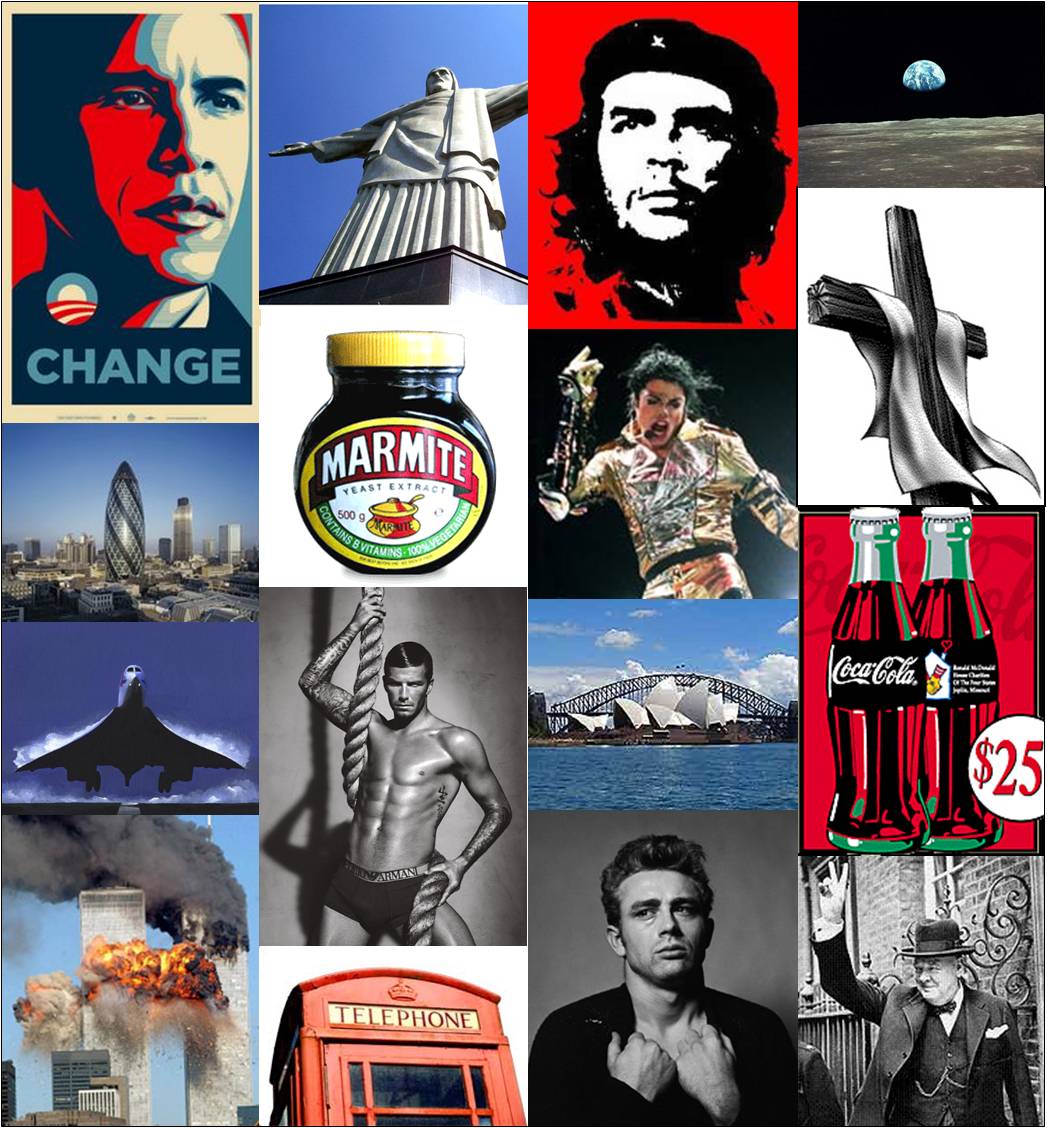
iconic_icons

icons of our ages

so I finally got round to reading Jonathan Meades’ article
in Intelligent Life in which he discusses the pervasiveness of the word
‘iconic’ from Jesus to Obama (via Marmite and Beckham).  great piece
(if a little cynical for mediation’s tastes) which goes on to outline
the four conditions necessary for something to be (or be perceived as)
iconic.

condition one: it affects us whether we like it or not. 
Meades suggests we – delightfully – apply the Victor Hugo test… when
Andrea Gide was asked who was the greatest French writer, he replied:
“Victor Hugo. Alas.”  Meades adds Oprah Winfrey and Paul Daniels
(amongst others) to this list.

condition two: the imagery transcends its subject.
Meades uses the example of the paintings of the Princes in the Tower. 
were they as pretty as the paintings suggest?  probably not.  but it’s
through the paintings that we know them.

condition three: the subject should be legible in a sort of visual shorthand. 
Jesus’ crown of thorns, Napoleon’s hand tucked into the greatcoat,
Churchill’s V-sign – he observes that it helps to own
cartoonist-friendly features.

condition four: immediacy of recognition. 
common in objects – the Coca-Cola bottle, the Eiffel tower, Big Ben –
but because of the demand of immutability less so in humans, unless
they’re dead of course.  Meades asks for “the visual equivalent of an
unmistakable catchphrase, such as … David Owen’s “When I was Foreign
Secretary” or Andie McDowell’s “Because I’m worth it” … if a
catchphrase is a repetitive soundbite, then an icon is a strenuously
rehearsed sightbite”.  lovely.

the lessons for brands and for
communications are clear.  what’s especially interesting however are
the observations that Meades makes at the end of the article.

“in
an age of ever-multiplying media outlets, with images disseminated ever
more easily, there are ever more potential low-key idols … virtual
villages will increasingly make icons of figures that are peculiar to
them, just as real villages did in the distant past when the people in
the next valley paid obeisance to an alien gamut of gods and totems. 
the more the media grow, the less appropriate the prefix “mass”.  the
globalisation of localism and, beyond that, of atomisation will very
likely mean that such niche characterisations as “a living legend among
the vertical matrixing community” [or] “an iconic figure in Gremlin
Pastures” can be made without leaden irony.”

its a fascinating
observation: a long tail of idolism.  the fewer, globally recognised
icons sitting alongside the famous-to-a-few icons of our immediate
communities and social groups.  could it be that the always-on
proximity and ubiquity of the stuff we connect ourselves to is making
icons of the people and places around us?  does the immediacy of a host of personal icons devalue the idea of an icon, or add meaning and value to it?

Standard
decision-making, planning

How we buy what we buy: what McKinsey have learned about our non-linear non-funnel decision-making processes

Funnel Mikhail has pointed me in the direction of a report published yesterday on WARC by McKinsey which articulates what I suspect many of us have know for a long time…  that – in general – consumer purchase behaviour is non-linear and certainly not a funnel.

their study, conducted across three continents and involving qual then nearly 20,000 quant participants, found that purchase behaviour was "changing dramatically" mainly due to an increase in consumer empowerment.  we touched on transparency of product on these pages recently when we had to explain to poor Michael Bay that advertising can't make good products bad, but the extent to which this information is significantly affecting consumer behavior as a whole is now becoming very apparent.

according to David Court at McKinsey, decision making has four stages… (1) ongoing exposure during which time people "see and hear about brands", followed by (2) a trigger which instigates someone to then consider a narrow range of brands and explore and evaluate their options – during the course of which they come across more brands.

notice the reversal of the funnel – it starts narrow and gets wider during the decision-making journey…  brands that seek to reach consumers at the point which will most influence their decision take note.

(3) is the moment of purchase – where the final decision is actually made – and this is followed post-purchase by (4) a loyalty loop.  Mediation is a big fan of research into loyalty and what's brilliant about this study is that it goes beyond purchase to evaluate what happens afterwards.

it identifies active loyalists (our traditional view) who then won't consider other brands, but this person is much less common that one demonstrating passive loyalty – where a brand will be automatically considered next time but not exclusively.  the following diagram from McKinsey sums it all up:

New_consideration_cycle_McKinsey_Quarterly

this is really important for anyone planning media and communications…  I've feared for a while that at the back of a lot of planners (and indeed marketers) heads is the AIDA model telling them that as long as they get enough awareness up front the rest will follow.  this is dangerous thinking.  according to this report media that is always on, as well as on demand play fundamental and ongoing roles on schedules which should be consumer-decision rather than campaign based.

Standard
planning

In search of the ‘right’ media weight: why planners have to be people and idea centric when planning channels

Weight_lifting this is honestly a picture you get on the first page when you Google images for 'weights'  honest.  click here if you don't believe me… (source)

right, I thought I'd share a question I was asked and the answer I gave.  would be interested in what other people thought on this…

question:

"What is the right media weight?"

"Sounds simple enough and when it comes to TV people seem to just know or we have some sort of Excel macro model which will help you put some pseudo science behind it but my main concern is other channels. For example – I’ve seen some stuff on the ppa website which recommends planning weekly GRPs with 30 / week banded around at some point in the article. But what about digital? What about outdoor? Is that right for print? Does it carry through to newspapers?  I suppose what I’m trying to get to is what is the ideal campaign?"

answer:

It’s an impossible question.  theoretically there is probably a ‘best’ weight for a
broadcast media channel (be it AV, print etc), where ‘best’ = most coverage / notice for least investment /
activity.  but there are influencers that will hugely affect and
ultimately change what the ideal weight is…

Creative – how strong or good is it… the better (and
that’s a fat word but run with it) the less ‘media’ you probably need
Brand – popular / loved / sought-for brands (I’d suggest)
get away with lighter weights than the Ronseals of the world
Proposition / offer – attractive propositions or offers
generally need less weight – COI need more than hotly anticipated movies
Competitive context – more competitors (and more aggressive
competitors) will push up the weight you need to plan – eg supermarkets

To a large extent these are factors beyond the control of the media
(although not the comms) plan; there are two other key factors however that lie very much within your control that
determine best and relative weights

Media combination – the channel’s you’re using and the
relative effort in each will determine weights within channels (eg as a sweeping generalisation big TV =
only activation press)

Push versus pull – this is the biggie…  because all of the
above is based on the premise that all media works in the same way (AIDA models etc).  but this isn’t necessarily the case.  online media generally
isn’t pushed (although we’re doing our collective best to saturate the internet with display ads). rather it’s sought, word of mouthed (or moused), demanded,
controlled, aggregated, and of course ignored (depending on how you look at it)…  the weight needed for an amazing bit of content or
application could be two blogs (as it was in a recent bit of Anorak work for a
Madonna single).

What does this mean for media planning?

It means the question has to be turned on its head – rather
than asking what’s right for a media channel, you have to ask what’s right for the person you’re trying to
reach.

to quote (if you'll indulge me) the Vizeum website:

Rather than thinking, “what does the brand want to say?” we begin with: “what do consumers want to engage with?”
Rather than thinking, “what does the media plan look like?” we ask ourselves: “what is the story of engagement that we want to create?”

put simply, we need to turn the media plan on its head.  for too long planners have started with traditional solutions and then tried to
build in interaction and innovation at the back end.  we [Vizeum] start by identifying the defining moment – when people can participate in
and interact with the brand – and then build everything else around that moment

the right media weight is the right combination of weights
that will navigate the right people to that moment when people can and will most readily interact
with a brand.  the right media weight is the balancing act between all the
external and internal forces above.  but above all the right media weight is dependent on the
power of your idea…

Brilliant communication ideas have gravity – they pull
people (who pull other people) towards them.  media weight (and media planning) is therefore not about
being about channel centric, rather it’s about being people and idea centric.  and a good job too – otherwise the world would need a great
fewer media planners

Standard
engaging, outdoor, planning

The importance of maintaining the journey: how the Autism Trust started strong but lost me on the way

Autism_poster
what a wonderful opening gambit.  saw the above poster yesterday in Stockwell.  no brand, no logo, just a message to Gordon Brown on a very public space…  very disruptive and very timely.  so far so brilliant.

so you call the number and you get a voicemail saying "hi this is Polly.  sorry I'm not around to take your call…"  here's where it starts to go wrong.  Pollie shouldn't be expecting me to call.  she should be expecting Gordon to call.  the message should be for him.  opportunity missed to keep the consistency of the consumer journey.

anyhoo you can leave a message or visit a website; theautismtrust.co.uk, where you're greeted with the following screen…

Autism_website

the opening screen asks if I want to see more support for individuals with autism and their families?  well, no.  I'm following a trail of breadcrumbs left for the prime minister.  I'd be more than happy to invest time in learning more, but not when I don't know why I'm on a site for an autism charity.  opportunity #2 missed.

such a shame.  what should have been a brilliant bit of cause-related marketing is reduced to no more than a stunt.  a fraction more investment in the welcome page, combined with a whole lot more strategic join-up, could have created a consumer journey with more impetus than a, well, thing with lots of impetus.  instead, I fear lots of interested people are right now just getting lost on the way.

Standard
advertising, blogging, branding, broadcasting, content creating, converging, engaging, listening, planning, regulating, researching, social networking, user-generating

Fighting the Future: reaching a rose-tinted concensus at the IPA 44 Club’s Future of Advertising in a Networked Society

A short history of marketing from jabi on Vimeo.

the rather lovely above video – by jabi – neatly sums up the collective dilemma of how brands, marketers and, specifically, agencies address the challenge of social media.  the issue was the topic of discussion last night at the IPA 44 Club's inaugural event of 2009:
The future of advertising in a networked society.  quite the session it was… here's the gist:

part one – report findings

  • social media = the online tools and platforms people use to share information, thoughts, opinions, content etc
  • problems is that brands are "crashing the party rather than hosting it" (Russell Davies)
  • many brands are experimenting but not getting traction in the area
  • we need a model of comms that reflects 'ME' as opposed to 'brand'
  • a model that's about conversation and participation rather than interruption and engagement
  • a model that incorporates David Armano's thinking about 'influence ripples'
  • Johnny X by Dare is a cracking example
  • which succeeded in concentrating the feeds into and out of it's online space (64% of upstream and 84% of downstream feeds came from 10 sites each)
  • planning social media should focus on targeting the few, that demonstrate: (1) expansiveness (propensity to chatter), (2) popularity (propensity to filter and target) and (3) reciprocity (likelihood to act)
  • network size is predictable, as is network flow, as is circulation

part two – agency survey

  • brands in a socially-networked world are more responsible for creating and disseminating the right information – brands should be more discretionary in what they produce [Mediation found this less than substantiated and at odds with Clay Shirky's comments at the MGEITF this year on filtering in a content-abundant world being after the fact, ie produce then allow the network to filter]
  • the way to reward brand advocates is not through financial incentive
  • the industry disagrees on two areas: (1) that advertising principles are the same in a networked society and (2) that social media behaves in a fundamentally new way
  • it is believed that most revenue is up for grabs in content creation, then data & insight, then market research & insight gathering (amongst others)
  • these new revenue streams represent £11bn of additional revenue opportunity, with another £5bn potentially
  • …which would be (exactly!) enough to meet the £16bn shortfall in industry revenues by 2016 predicted by the IPA's Future of Advertising and Agencies report of two years ago (£16bn = the difference between the IPA's 'Central' and 'Consumer' Scenarios)

part three – the discussion

I won't bullet this because it's getting late and you had to be there, but this was the better part of the evening with discussion ranging between philosophy of brands in a social media space to the (inevitable) measurement and accountability of such activity.

for me a kind of rose-tinted consensus was reached; consensus that went along the lines of:

  • marketing has always been about great social networking, the challenge is the same – getting the right content in the right place, its just that…
  • (1) people power is more potent (we have 500 networked connections not 50 disparate ones) and (2) we need to react to the context our message are in rather than control the context our messages are in
  • it's brilliant because we can react to real people in real time in the context of a real conversations
  • social media isn't a bolt on, it has to be woven into every brand touchpoint
  • brands need to behave differently, and understand that their relationship with consumers is – to consumers – much less important than consumers' relationships with other consumers

so in a nutshell social media is great because it's as old as the hills, better than the disruption model, measurable …and there's a freak-off big commercial opportunity for the brands and agencies that get it right.

I just don't think that it' that easy.  our industry is woefully
unprepared for the future.  there's some brilliant thinking and debate
going on, but the commercial models, joined-up industry measurement
systems, and marketing best practice principles – from a 'what works'
as opposed to a 'self-regulatory' point of view – just aren't moving
fast enough.

most importantly, not enough consideration was given
to the integration of broadcast and social media.  they're not going to
exist in isolation and broadcast media is going nowhere. iTunes didn't
kill CDs and Amazon didn't kill Waterstones.  social media certainly
won't kill mainstream broadcast media; the same mainstream broadcast
media that in the vast majority of instances provides social media
users with the content they comment on, pass on, or reappropriate for
their own ends.

the other interesting question is how the
behaviour of digital natives will evolve…  we're familiar with the
media 'hubs' that are the current crop of adolescent's bedrooms;
they're multi-tasking away across ten devices and infinite bits of
content.  but what happens when they grow-up?  how much of their social
media behaviour will they take with them into adulthood and how much
will they replace with the aggregated broadcast consumption of their
parents?

we live in interesting times; and I guess we wouldn't have it any other way.

one last word, I urge you to read JVW's post
about the event and specifically his debate on how the IPA can use social media
to get their social media report into more people's hands whilst not
impacting on revenues.  a pleasure and a joy.

Standard