advertising, blogging, broadcasting, co-creating, engaging, planning, remixing, social networking, user-generating

Thinking from a different place – the rewards of letting go: what happened when Vizeum debated who exactly is in control?

TFADP_II but what does it all mean?: Hook, Grant, Bailie, McClary and Corcoran with chair Chris Maples debating at Vizeum this evening

who's in control?  that was the theme of this evening's Thinking From A Different Place debate at Vizeum.  do brands make what customers want or do customers determine what brands make?  do creative agencies still control creation of the best ideas, or are the crowd now creating and aggregating the best content?

a panel, consisting of Vizeum's Matthew Hook, We Are Social's Robin Grant, Martin Bailie of Glue, Michael McClary from Microsoft and Andy Corcoran from MTV all awesomely debated a range of subjects from the decline of the newspaper industry to the impact of technology, taking in the future of media agencies and the nature of brands and advertising on the way.

it's easy to summarise such a debate by saying that its all getting more and more complicated and more and more difficult and we all need to move faster and faster and be better and better to stay ahead; but a few interesting comments steered the debate in a more illuminating direction.

Martin pointed out that we focus too much on the next big technology, or on the specifics of what people are doing with technology now, rather than focusing on two millennia of human psychology to point us in the right direction.  as he put it, if we "get the basics right you're 80% there" – produce interesting stuff that's based on a interesting point and view and land it in the laps of as many of the right people as possible.

the question of listening to customers was numerous times, in particular by McClary who observed that there's a "danger in highlighting [and responding to] only the loudest voices".  Hook agreed, observing that whilst you can engage 1,000s in a conversation, many brands are interested in talking to and influencing millions.  Corcoran reminded us of the Henry Ford quote that "If I'd asked my customers what they wanted they'd have asked for faster horses".

but it was the nature of control that caused the most interesting debate.  Grant: "historically brands were more in position of control"; Hook: "marketers desperately want control, they do everything they can to create predictability [of the result of their actions]"; Bailie: "it doesn't matter – no one controls brands; get rid of the idea of control"

for me its about maintaining a balancing act; about knowing when to keep and when to let go of control of what a brand does and how it does it.  would you ever let the crowd determine your core creative idea or brand positioning? …almost certainly not.  would you let them create content inspired by it? …yes.  should you let them make your products? …no.  should you le them choose the ingredients? …of course.

a point was made about the recent successes of Facebook and Twitter, with a question being raised about what business they're in.  they are – of course – in the business of aggregating audiences.  that's the media business.  the point of whether or not they can monetise that aside (big aside I recognise but run with it), part of their success is down to the fact that they capitalise on the fact that one of the best ways to grow an audience is to get your current audience to do it for you.

giving away control – of your product, or whatever is appropriate – is a particularly effective way of getting an audience to do just that.  give them ownership, give them reasons to talk about you brand, its point of view and its products and services.  but most of all give them a reason to come back, to stay part of the conversation with you.  because its those conversations that are the most valuable bit of media real estate of all.
Standard
advertising, experiencing

The Power of Experience: what Brands can learn from the pressures of supply and demand at Edinburgh’s Fringe Festival

Fringe_09_collage some of Mediation's Fringe highlights, from topish down – Pappy's Fun Club, Showstopper the (improvised) musical, the 80s Movie Flashback, Wolfboy, Private Peaceful, A British Subject, Picasso and Heyton on Homicide

on one hand an abundance of supply, with limited budgets to communicate, and a desperate need to stand out.  on the other a premium on attention where time si the most valuable commodity and the biggest problem is navigating a plethora of choice.

not a crystallisation of the current media paradigm, but rather a description of the annual Edinburgh Festival Fringe, where this weekend Mediation ended his summer break with a frenetic 48 hours taking in a dozen shows.  from WW1 deserters to 80s movie Flashbacks, taking in on the way a Victorian murder mystery and a musical about repressed teenage sexual tension in which one of the protagonists may or may not be a wolf.

that aside, the Fringe provides us with an interesting microcosm of what in many ways is being debated as we negotiate the future of media and communications.  too much supply, not enough time and or attention, and a desperate need to stand out from a vast crowd of other acts…

some principles did however emerge

  • reputation (1).  have one and remind people about it.  in a world of massive choice a reminder of what you've done and why you deserve attention helps a lot
  • reputation (2).  acts that were in bigger and respected venues were much more likely to convert.  an hour is precious in Edinburgh and rightly or wrongly an act getting into an established venue is seen as a pre-filter of quality.  choose carefully where people see you
  • word of mouth.  create some.  by far and away the most important factor that determined what I saw (after the fact that my friend was in it) was recommendation.  we know this to be true…  don't expect it to happen, make it happen…  set up the conditions – Pappy's Fun Club for example have a diverse digital presence all aggregated on their website.  they make it easy for you to recommend them
  • be different.  no matter what the cost.  being right but fading into the background is worthless.  if standing out means taking a risk and / or investing a few dollars then do it and make them count.  in a world of flyers being given a squidgy coffee cup with the name of an act on it was enough to make me remember and want to go
  • facilitate engagement.  make it easy for people to find you.  from thinking about what time you want to be on to shouting the venue on communications made a big difference

but above all I was reminded of how powerful a live experience was.  from a play dissecting British Foreign Policy (and occasional apathy) to nationals imprisoned abroad, to a musical made up on the spot based on audience suggestions; the act of creation in a live space is a powerful way to communicate an idea.  we should be more often planning for brand comms to have this potency of live experience.

Standard
thinking

Our reality defines our expectations, the new time-based contract, and why agencies should be giving more stuff away for free: three things Mediation learned (for free) at the IPA Strategy Group’s GameChangers seminar on ‘Free’

Free great event tonight hosted by IPA Strategy Group, second in a series of events called Game Changers – this one under the banner of 'FREE'.  intro context courtesy of Chris Andersen who was quoted as observing in his new book that in the economy of 'bits' (as opposed to atoms), marginal costs are close to zero and so the concept of 'free' changes, it's no longer a gimmick.  and businesses better learn how to cope with free or die.  four speakers took us through how their changing the terms on which their companies or projects are doing business as a result of free.

Ian Clark, Managing Director of thelondonpaper was challenged on journalistic standards, he commented that "you've got to take us for what we're at … we're not dumming down journalistic standards, we're just adding a different flavour".  that aside, the interesting point he made was that the business model of 'free' and the "vital" audience interaction on which much of thelondonpaper brand is built, are inextricably linked…

this point was backed up by Clive Dickens, COO of Absolute Radio, who (despite being a little salesy – there's such a thing as a free lunch but not a free seminar it would seem) was quite clear that the future for Absolute is in being a digital (he meant online) brand.  he observed that the CPT generated for their premium website content was five times that of the CPT for spot airtime.  it was that – he suggested – that justified giving such a wealth of stuff away for free.

I asked Dickens what his strategy was for competing with everyone (been reading Shirky) in a world where the cost of creating audio content is close to zero.  he answered that Absolute's strategy was in filtering (we select the stuff we think is worth listening to), talent, and live.  much sense talked on that front…  if only the commercial radio industry got their collective heads out of their DAB arses and talked more like that they'd be in a much stronger place with audiences and clients alike.

a remarkable talk by Marc Allera, Sales and Marketing Director at 3 was almost prophetic on the subject that "communication should be unrestricted and it should be free" …3 want to operate in the internet space which offers freedom as opposed to the Telco space which offers only restriction.  a noble aim.  the company offers free calls forever via Skype to Skype calling, and later this year will offer the same thing to customers of other networks.

someone then pointed out that her 3 handset didn't work – at which point I was tempted to observe that we weren't on Watchdog – but then did go on to ask the question we were all thinking – how does 3 generate revenues?  the answer – that people who use Skype for free calls tend to spend more time on the internet via their mobile.  and for that they need to pay 3.  so the more people using 3 for free the better for 3.

finally the awesome Matt Knight, a Creative Technologist at Wieden and Kennedy (and formerly of deconstruct) talked about his Disposable Memory Project, which I previously blogged about here.  brilliant stuff – based on the observation that "instant gratification is [only] instant" and that he "wanted to slow things down a bit".  why do people get involved?  because they want their cameras to succeed, and because of the mystery and the unknown of them doing so.  the thought of thousands of little JJ Abrams mystery boxes sprang to mind.

so what to make of it all?  well, Ian Clark played a brilliant video in which a comedian deplored how quickly we got bored of stuff.  he observed the guy who was appalled that the high speed internet on the plane he was on wasn't working, something that he didn't know existed ten seconds before he started using it.  the fact is that our reality defines our expectations; we come to expect whatever we're offered, and there's no going back once we've got it.

the other clear story from the evening is the new contract between people and business.  the transaction used to be about money – you spend this and we'll give you that.  but the new terms aren't about money but about time…  thelondonpaper and Absolute give people stuff for free so that people spend time with media brands that media businesses can monetise…

what's interesting is that media brands have always known this.  sure the internet is speeding understanding of this realisation up; as Warren Buffett observed "It's only when the tide goes out that you learn who's been swimming naked", but the best media brands and businesses – especially the new ones – understand this new contract.

many businesses and brands are going to have to think like this; they're going to have to think like media brands.  when you think about it though this is in their favour – investment in creating direct time with people means less time on pesky things like advertising; a vehicle designed predominantly for a 20th century broadcast model not a 21st century conversation model.

finally, something Matt Knight said about ideas really struck a nerve; "if you love it, set it free".  in other words don't sit on the ideas you give away (for free) in pitches or to brands that don't buy them – go do them.  what if agencies gave employees time (and if necessary and reasonable) investment to go and make happen the stuff clients don't buy?  what would that say about the agencies that did it?  agencies that were so passionate about the best of their ideas that they didn't give up when a brand didn't want to do it but went and did it themselves?  not sure about you, but that's an agency I'd want to be part of.  although not for free.

Standard
campaigning, targeting

Consumer. I hate the word: why Mediation is adding it’s voice to the call for a banning of the word Consumer

Ban_consumer_shop_therefore_am so on Friday as I was posting about Clay Shirky's logarithmic rules for participation, the always brilliant Neil at Only Dead Fish was busy banning the word consumerWillsh at Feeding The Puppy agreed (and got to grips with some nifty HTML widgeting) and now I've officially added my voice to the chorus via a Twitter post #tagged to #StopUsingConsumer.

consumer?  consumer.  I hate the word.  as I do all words or language that undermine what we do and prevent us as an industry from moving on from basic and retrograde thinking.  the boys have already said much in the posts linked above and I won't repeat.  I'll simply say that too often using the word consumer holds us back in three ways:

1. it leads to thinking that all people do is consume stuff.  this isn't only limiting thought but massively missing the opportunity to engage with PEOPLE on terms beyond them buying stuff.  PEOPLE are talking about, creating for, arguing against, fighting for and remixing brands and branded communications all the time.  don't limit the scope of what we do to PEOPLE consuming what we're selling.

2. it leads to thinking that all PEOPLE are the same.  my post from Friday covered this but essentially my argument was that we are still, by and large, expected to think of and present 'one' target audience…  an 'averaged' person or group based on some attribute of attributes that are most relevant to the brief.  but 'average' not only fails to capture the few individuals who would be super-involved in what we have to say or ask them to do, but massively over-estimates the extent to which most people will commit attention to our branded projects.

3.it looks backwards to world where we bought therefore we were.  rather than forward to a world where brands and brand projects and communications add social as well as just economic value to our lives and communities.  for many brands the idea of giving back won't be an add-on, but rather an intrinsic and expected part of what they do.  giving back will become – as it should be – a cost of being in business.

sold?  join in.  if you believe we should stop using 'consumer', then post a tweet that contains #StopUsingConsumer, and the reason.  For instance: #StopUsingConsumer – cos there's no average user, no average consumer, no average contributor, co-creator, or co-collaborator. live with it.

Standard
co-creating, planning, targeting, user-generating

A new lore of averages: what Clay Shirky and the Coney Island Mermaid Parade can teach us about defining target audiences

Means_comparison_mermaid_pics insight after insight from Clay Shirky’s Here Comes Everybody.  the above chart is copied from chapter five which covers collaborative production. it shows contributors to the Coney Island Mermaid Parade Flickr site ranked by the number of photos they contributed.  a couple of users contributed the most whilst the most users contributed only a little.  Shirky observes that:

“…the imbalance is the same shape across a huge number of different kinds of behaviours.  a graph of the distribution of tags on Flickr is the same shape as the graph of readers-per-weblog and contributions-per-user to Wikipedia.  the general form of a power law distribution appears in social settings when some set of items – users, pictures, tags – is ranked by frequency of occurrence”

that there’s a massive imbalance between people who contribute in collaborative projects we know.  but its something that we don’t often enough plan for in a media world where we increasingly ask (the audience formerly known as) consumers to user-generate and co-create on our behalf.  Shirky goes on to point out that:

“…the imbalance drives large social systems rather than damaging them.  fewer than two percent of Wikipedia users ever contribute, yet that us enough to create profound value for millions of users … the spontaneous division of labour driving Wikipedia wouldn’t be possible if there were concern for reducing inequality rather than limiting it … large social systems cannot be understood as a simple aggregation of the behaviour of some nonexistent ‘average’ user”

and there you have it.  he said it.  there’s no such thing as the average user.  we all know this, and yet we still struggle to capture the targets for our advertising campaigns in neat tangible soundbites.  the demographics of old have (thankfully) long gone, but whilst they’re been replaced by more contemporary means – attitudinal or usage based targeting – our one-dimensional thinking too often remains…

we are still, by and large, expected to think of and present ‘one’ target audience.  an ‘averaged’ person or group based on some attribute of attributes that are most relevant to the brief.  but look again at where the mean ‘average’ sits in the above chart… it not only fails to capture the few individuals who would be super-involved in what we have to say or ask them to do, but massively over-estimates the extent to which most people will commit attention to our branded projects.

we need a new lore of averages for our targeting-think.

when we describe target audiences we should be thinking of them as sitting along the above spectrum.  how do we plan on one hand for the very few but valuable super-attention givers from whom a lot of the effectiveness of the media investment will derive?  whilst on the other hand plan for the ‘mode’ individuals, the vast majority who will contribute the smallest amount of attention to what we have to say?

this spectrum, this logarithmic curve of attention, exists at whatever level you aggregate.  be it a population, or an age range, or any segment no matter how – whether attitudinally or behaviourally – it is defined.  there is no average user, no average consumer, no average contributor, co-creator, or co-collaborator.  let’s stop kidding ourselves and clients otherwise.

Standard
blogging, broadcasting, internet, social networking, user-generating

Learning to advertise without advertising: what Mediation learned when he went along to listen in on The Guardian’s Media Talk Live

Meditalk_live so the latest MediaTalk podcast from the Guardian is up and out, but this week's is a bit special.  one because it was recorded live, but two because Mediation was lucky enough to be in the audience for the recording at Guardian Towers.  the panel – social media expert JD Lasica, reporter Sarah Lacy, blogger Robert Scoble, BBC technology correspondent Rory Cellan-Jones and of course the wonderful Emily Bell – discussed a range of topics focused in and around the changing ecology of media business.

lots of sense talked (mainly by JD "shooting dinosaurs in a barrel" Lasica and Emily "we didn't listen enough to our audiences" Bell), but there was one question posed to wards the end (44 mins and 33 secs in if you're interested) that wasn't answered.  Susan Bratton asked: "there was some conversation about lack of innovation in advertising and sponsorship support, what would you like?".  Sarah Lacy said that it was "like porn – I don't know what it is but I'll know it when I see it"…

JD Lasica observed that interruption marketing would be gone in 10 years, and that you've got find "new models to make advertising that's personalised, customisable to me.  something that's welcome, useful, that I want on my screen".

it's an observation that often goes unsaid.  Mediation has often suggested that the problem with making media business models work in the new ecology isn't advertising.  the problem is adverts.  controlled and crafted packets of what an advertiser wants you to know work fine (brilliant even) in a broadcast model, but they're pretty pants in a conversation space.

in fact you could argue that – to paraphrase Cluetrain – brands are conversations.  in this context the ad format is as dead as a dodo; media business models will kick in again when, and only when, we collectively learn how to monetise advertise without advertising.

you can listen to to the whole podcast here, and read Kevin Anderson's blog post summary of the discussion here.

big thanks to the Guardian having me along.  a joy and a pleasure, if a
bit weird seeing my favourite podcast being recorded.  awesome stuff.

Standard
planning

A long tail of icons: how our understanding what maketh the icon is changing as localism goes global

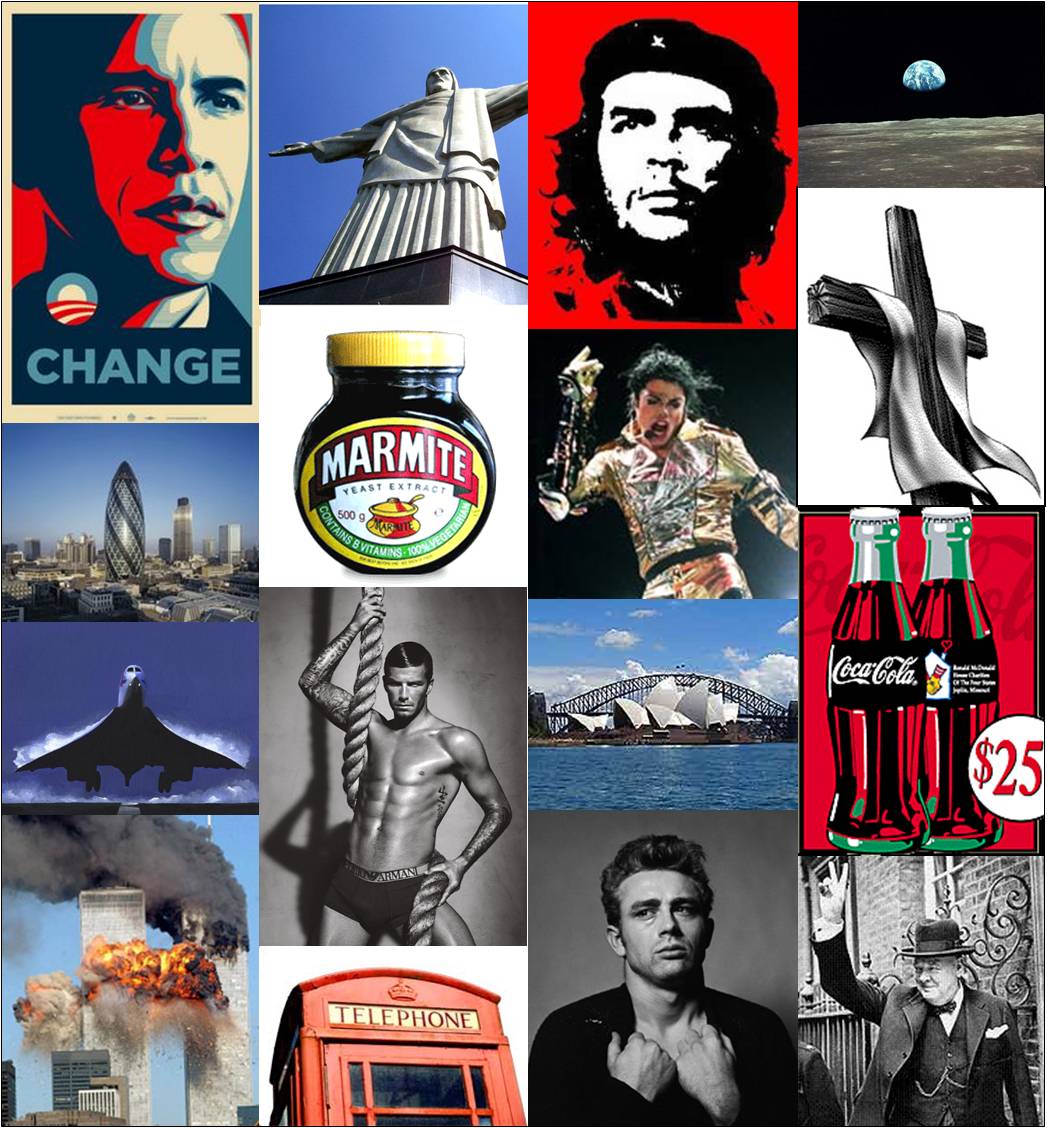
iconic_icons

icons of our ages

so I finally got round to reading Jonathan Meades’ article
in Intelligent Life in which he discusses the pervasiveness of the word
‘iconic’ from Jesus to Obama (via Marmite and Beckham).  great piece
(if a little cynical for mediation’s tastes) which goes on to outline
the four conditions necessary for something to be (or be perceived as)
iconic.

condition one: it affects us whether we like it or not. 
Meades suggests we – delightfully – apply the Victor Hugo test… when
Andrea Gide was asked who was the greatest French writer, he replied:
“Victor Hugo. Alas.”  Meades adds Oprah Winfrey and Paul Daniels
(amongst others) to this list.

condition two: the imagery transcends its subject.
Meades uses the example of the paintings of the Princes in the Tower. 
were they as pretty as the paintings suggest?  probably not.  but it’s
through the paintings that we know them.

condition three: the subject should be legible in a sort of visual shorthand. 
Jesus’ crown of thorns, Napoleon’s hand tucked into the greatcoat,
Churchill’s V-sign – he observes that it helps to own
cartoonist-friendly features.

condition four: immediacy of recognition. 
common in objects – the Coca-Cola bottle, the Eiffel tower, Big Ben –
but because of the demand of immutability less so in humans, unless
they’re dead of course.  Meades asks for “the visual equivalent of an
unmistakable catchphrase, such as … David Owen’s “When I was Foreign
Secretary” or Andie McDowell’s “Because I’m worth it” … if a
catchphrase is a repetitive soundbite, then an icon is a strenuously
rehearsed sightbite”.  lovely.

the lessons for brands and for
communications are clear.  what’s especially interesting however are
the observations that Meades makes at the end of the article.

“in
an age of ever-multiplying media outlets, with images disseminated ever
more easily, there are ever more potential low-key idols … virtual
villages will increasingly make icons of figures that are peculiar to
them, just as real villages did in the distant past when the people in
the next valley paid obeisance to an alien gamut of gods and totems. 
the more the media grow, the less appropriate the prefix “mass”.  the
globalisation of localism and, beyond that, of atomisation will very
likely mean that such niche characterisations as “a living legend among
the vertical matrixing community” [or] “an iconic figure in Gremlin
Pastures” can be made without leaden irony.”

its a fascinating
observation: a long tail of idolism.  the fewer, globally recognised
icons sitting alongside the famous-to-a-few icons of our immediate
communities and social groups.  could it be that the always-on
proximity and ubiquity of the stuff we connect ourselves to is making
icons of the people and places around us?  does the immediacy of a host of personal icons devalue the idea of an icon, or add meaning and value to it?

Standard
creating, remixing

The ultimate video remix?: How Marco Brambilla is bringing civilisation to NYC’s Standard Hotel

a Relentless blog post pointed me in the direction of the above video installation by Marco Brambilla.  it's a video collage featuring 400 video sources molded together into one image which runs the length of the lift shaft of the Standard Hotel in New York.  1920 pixels across and 7500 pixels vertically track your ascent into heaven or descent into hell.  depending on your direction of travel.

it has to be a contender for the ultimate version of the remix.  William Gibson and Lawrence Lessig would be proud.  the efforts of four hundred who have gone before remoulded and melded together to form something new, elegant and utterly mesmerising.

this is the kind of thing that more comms briefs should be delivering; pieces of conceptual art produced for comms objectives that can then be explored online or amplified through broadcast.  starting, creatively, at the end point of the plan (ie the TV ad or the print execution) means you miss the opportunity to think about where those executions come from. rarely have I seen investment of time and effort in the creation of an original piece from which a variety of ad executions (in a variety of media) could then derive.  I hope and expect that to change.

in the meantime click HQ, full screen it, sit back and enjoy…

Standard
affiliating, Mediated

The Fork In The Affiliate Road: Quality Or Quantity? And At What Price?

Mediation is guest Mediated today by James Atherton, affiliate planner at Vizeum.

Affiliate_marketing Since the credit crunch first reared its ugly head, tongues have been wagging around the affiliate world, with one main concern spilling out of people's minds; was the looming cloud of a recession gilded by the sweetest of silver linings?

With every penny ever more precious, with every cent being counted, would the greater focus by merchants on return from marketing spend see an industry seeing significant year on year growth make the shift to a dominant mainstream channel? Or would overall reduced marketing spend mean affiliates would suffer along with press, radio and TV?

For a while it seemed that affiliates were at least safe, and were at best coasting to a better, and richer, future. As one might expect, merchants were increasingly enticed by the idea of a channel that only pays out on a tangible return. However, overall reduced marketing spend has seen a more significant shift as merchants have shifted focus on other media to CPA and ROI targeted campaigns. Aggregators, PPC and traditional display-based advertising are delivering on CPA and ROI based models that have begun to return lower CPAs than affiliates and higher ROI.

There’s a simple lesson to be learnt from this; it is no longer enough to simply drive sales. Whilst this represents a sea change in thinking for many, for affiliates to capitalise on the current economic condition it is imperative that two things are addressed, and soon:

  • Quality of traffic
  • Costing Models

Without a significant increase in the quality of traffic, or the way that traffic is handled, the opportunity that is available to affiliates, that sweet silver lining, is likely to evaporate. By changing the overall perspective of a volume driving channel to one that is linked to profitability, ultimately doors will be opened rather than shut.

This is not to say that fundamental upheaval is necessary. However, publishers need to accept that positioning and potential will need to be increasingly tied to the needs of the merchant rather than CPAs and EPCs as merchants become more educated.

A simple example of this would be loyalty sites, a group that have seen huge successes in recent times, but who have also left a bad taste in merchants' mouths that have been burnt one too many times. Simply by developing offerings that tie into the LTV of a customer – for example an insurance bounty that only pays out on renewal of a policy – they can create a harmonious model that would make significant steps toward realising the huge potential growth for affiliates that is currently available.

The affiliate channel currently sees itself at a fork in the road; partially through its own impressive and intrinsic growth, but also through unforeseen global economic changes. By acting quickly and sagely, it can make the move from being a specialist part of the marketing mix to something that consistently sits at the heart of all merchants’ overall media strategies.

Standard
direct-marketing, popping up

Popping up at Somerset House: How Bombay Sapphire’s Dusk Bar is engaging drikers with it’s botanicals intrinsics story (and mixes a mean cocktail)

Bar_logo so last night Mediation went along to the launch event for Bombay Sapphire's Dusk Bar at Somerset House.  the pop-up – which will have residency at the site for the duration of the summer – is an explosion of illuminated blue plastic and metal, the brief of 'bring the iconic bottle to life' being more than met.

what's was more interesting though was the expression of the product intrinsics at the bar.  all spirits are comprised of 'botanicals' – key flavours and ingredients that contribute to the spirits taste profile.  Bombay Sapphire has ten – all of which were on display in various forms at the event.

the actual botanicals were there in bowls themselves, everything from the juniper berry (natch) to the Orris root and Grains of Paradise amongst others; but beyond this, Bombay Sapphire had asked ten leading mixologists from London's most fashionable bars to each create a cocktail from the bar. each cocktail is inspired by a botanical ie key product intrinsic (Mediation's favourite turned out to be the one with elderflower cordial but I can't remember it's name).

so the question of whether or not Bombay Sapphire and Co. can mix an awesome cocktail aside (they can) there's the bigger question of why do a pop-up bar in the first place?  what's it adding?  who is it for?  and what's the payback?

I put this question to a few bar trade magazine editors who were present, and beyond "it get's Bombay Sapphire talked about" it was hard to track down more of a specific answer.  presumably there's hard and soft measures for this kind of thing…  hard ones along the lines of 'does the bar pay for itself?', how many people do we engage with an experience of the course of the summer?' etc.  these and more like them should pay back in the immediate term.

as always though its the longer term softer effects that are harder to pin down.  does the experience change people's attitude and perception of Bombay Sapphire?  does it help increase their brand reputation scores?  and crucially, will in increase the volume of Bombay Sapphire sold in bar and in future consumption thru supermarkets.  the brand has a lot to do – gin consumption is in free-fall (down 14.5% year on year).

I can't answer any of those questions, but I hope Bombay Sapphire can.  because an investment of this scale, even if it is paying back, should be aligned to a very specific long term strategy and objective.  from my perspective, if it was to communicate the existence and balance of intrinsics, as well as change my perception of gin-based cocktails, it was a job well done.  and that's not just the cocktails talking.

Bar_glasses
Bar_serve
Bar_exterior

the Bombay Sapphire Dusk Bar is popping up at Somerset House until October 2009, for more details see their blog

Standard