it’s in the second episode of ‘Alias’ that JJ Abrams first penned a reference to a random drink called Slusho. the mention – which was to be followed later by cameo in Heroes – was the first of a sustained, ingenious and elaborate viral campaign to promote his next project, the movie Cloverfield.
in doing so, Abrams created more hype than could ever have been generated by broadcast comms. but the approach has been more specific than that… at no point was everything held together in one place… to make sense of the clues, the dots had to be joined together; with seemingly random and stand-alone pieces of communication joining up; not in a script or on a schedule, but in the minds of consumers. thats the kind of headspace that broadcast money can’t buy.
Abrams talked about his approach to all his projects – from Alias to Lost and now Cloverfield – at the always amazing TED last March (click here to watch it). he talked about the idea of a ‘Mystery Box’, a $15 box he bought as a boy with the promise of $50 worth of magic inside. it remains unopened.
to Abrams his unopened box “represents infinite possibility, hope and potential”, he notes that “I find myself drawn to infinite possibility and that sense of potential and I realise that mystery is the catalyst for the imagination … what are stories but mystery boxes?” he describes how in TV the first act is called the teaser, it asks a fundamental question. but as soon as it’s answered there’s another question; another Mystery Box, and another after that…
his point is that the intentional withholding of information is much more engaging than giving someone the whole story… a lesson from which advertising could in many instances learn…
intrigue and the witholding of information in order to engage should more often be at the heart of a comms brief. we more often need to let product intrinsics or resolution within the context of a TV script take a back seat. we need to be creating more mystery boxes. then using media to join the mystery boxes together… a broadcast TV ad with a random link to a website. which has a list of postcodes, each of which has a series of posters. we shouldn’t be afraid of challenging our consumers… what a individual can’t piece together a networked community of individuals can…
in comunications planning we’re too obsessed with giving consumers information, we need to start giving them some questions, some intrigue. as Abrams says, “sometimes mystery is more important than knowledge”.
ITV won a 21% share last night for both of its new Thursday evening offerings Moving Wallpaper and Echo Beach.
much has been written already – both good and bad – about the duo of commissions, with negative comment generally focusing on the quality of the scripts across both.
but I’m not so sure thats such a bad thing… bad TV has a long and illustrious history – some of us just about remember Carol Burnett battling in a raisin power struggle in Fresno… and Sunset Beach’s was doing real time playout a decade before anyone had heard of Jack Bauer. bad TV can be good if it’s knowing, and Echo Beach and it’s partner are both very knowing…
but the real triumph is a very smart bit of commissioning from ITV… there aren’t many precedents of programmes that have been imagined in such a way, with spin-offs or sequels generally being an extension of a successful (or ailing) existing entity. it’s a brave concept that could have been killed-off so many times in development, so kudos to ITV (and Kudos for that matter) for pulling it off.
it’s a shame that an advertiser wasn’t able to capitalise on the opportunity to reflect and play with two different sides of a brand personality. the opportunity to do so remains open…
got to the cinema super early this week and was delivered two bits of commerciality from the BBC.
the first was audio for the Chris Moyles Show, with the man himself chatting to a side-kick as sounds flew around the cinema. lots of "ooohh, I can make this sound go from left to right, listen…".
innovative and interesting use of the capabilities of the media channel’s surround sound.
the next was a trailer for the Doctor Who Christmas Special. the corporation no doubt hopes that Voyage of the Damned, the Tennent / Kylie-fest planned for Christmas Day will be better received by critics than last year’s spiderfest.
a straight-forward TV trailer then, played in a cinema.
one of these two ads was brilliant, the other was irritating and annoying. no prizes for guessing which one…
by the time Moyles and co were halfway through, I was ready to personally pull the speakers off the wall. it was childish and tired; and anyone who thought that playing with sound in a cinema would impress, should check out what Dolby have been doing – consistently and rather elegantly – for years…
the Doctor Who trailer on the other hand was glorious. seeing it on the big screen did justice to the both the quality of the cast and ambition of the plot and effects. a simple piece of media planning that put the right communication in the best of places at the right time.
the lessons here is that sometimes less is more. of the two pieces, the Moyles audio was by far the more customised for it’s environment – it was infinitely smarter; but that didn’t make it better. by contrast the simple act of trailing a TV show on a big public screen rather than a small personal one, afforded it the credibility of a cinema piece with the anticipation of a movie trailer. I know which one I’ll be tuning into.
interesting and entertaining piece putting forward the argument that recent inflation in the value of dot.com sites – notably those of the social networking variety – have all the hallmarks of the 1999-2000 tech bubble before it burst.
notably, this comment against the current interest and investment in web 2.0-ness, is made thru the medium of user generated content uploaded to a file-sharing portal, which is being spread virally via social networks. oh, and I’m blogging about it! so there!
it’s worth pointing out that the value being generated and invested in, isn’t just due to the aggregation of younger audiences that 2.0 delivers (although the ability in a fragmenting world of social networking and 2.0 sites to do this is valuable indeed); rather what’s of massive value to advertisers is the online behavioural and transactional data that comes with these aggregated audiences!
thanks to the rarely-wrong J Smith for the point in the direction of this…
encoding in neural tissue that provides a physical basis for the persistence of memory; a memory trace (1)
E·col·o·gy [i-kol–uh-jee]– noun
branch of biology dealing with relations and interactions between organisms and their environment, including other organisms (2)
I believe the concept of the individual brand engram for the purposes of marketing communications is redundant. I believe that a truer reflection of brands can be found by examining the dynamics of engram herds within a population.
1. The Myth of the Isolated Engram
The emergence of neuroscience has informed us that brands are not definitive established entities. Rather they are ideas. An ever-changing and dynamic concept of meanings and associations held – amongst millions of others (4) – within our minds. As Wendy Gordon puts it, “a brand in memory is a totality of stored synaptic connections between neurones … gradually built up through the combination of many past experiences and ongoing current encounters with a brand” (5). The term engram – coined originally by Richard Semon in 1904 – refers to this ‘memory trace’ (6) within which a brand is held.
Two key properties emerge from this concept:
First, the brand-as-engram is largely malleable and open to influence. Whilst marketers would hold that this gives them remit to leverage this set of associations thru advertising and other means, the reality is quite different;
The stimuli we receive don’t uniformly alter the engram. Daniel Schacter notes that; “our memory systems are built so that we are likely to remember what is most important to us” (7). Not all stimulus is created equal, as Willmott and Nelson observe; “ in a networked society, where people not only have more contacts but rely on them more for advice and support … personal recommendations, and recriminations, have more weight” (8). In other words brand engrams are – by their very nature – most open to influence by other people. Brand engrams are most open to influence by other engrams.
The second property to emerge from the brand-as-engram concept is that because engrams are formed from different experiences in different individual’s heads, no two engrams can be the identical. As Wendy Gordon puts it; “two people can never experience an identical set of encounters with a brand, and therefore their brand engrams will be different” (9).
So brand engrams are mostly open to influence by other engrams, each of which is unique; the concept of the isolated and definitive brand engram is therefore a myth.
Brands aren’t individual ideas, but herds of ideas, within a population. Herds that over time will grow or shrink, become more disparate or move more tightly together, or that become more or less consistent; all as a result of their environment that includes other engrams. It is this latter facet of the engram herd – consistency – upon which this submission will focus.
2. The Importance of the Consistent Herd
Key to successful marketing of a brand is to have a consistent engram herd, with consistent meanings and values associated with a brand. As Wendy Gordon points out, “new entrants to established product categories require an enormous financial investment to build these values, which ensure that a target group of consumers are able to share a similar pattern of specific belief system about a brand” (10).
There are several reasons why consistency of engram throughout a herd is crucial; as a shared language for word of mouth, as a consistent reference for self-identity, and within the concept of transactive memory:
2.1 The importance of consistent herd in Word of mouth epidemics
In The Tipping Point, Malcolm Gladwell describes what he calls ‘the law of the few’ and describes how it was beneficial to the spreading of Hush Puppies from a few individuals in New York’s East Village to the mainstream American malls; “The law of the few says the answer is that one of these exceptional people [the few] found out about the trend and through social connections and energy and enthusiasm and personality spread the word about Hush Puppies” (11).
But what the malls of mainstream America depended upon, what made the spread of the idea commercial on a large scale, was the creation and existence of an engram herd which consistently adopted Hush Puppies as cool. Gladwell’s ‘exceptional people’ may spread a message, but once tipped, it requires consistency of an engram throughout the herd to hold, and maintain it.
And what any individual relies upon when receiving or transmitting messages within a word of mouth epidemic is a consistent frame of reference throughout that herd, a consistent language, a consistent engram on which to build.
The point is backed up by Caroline Whitehall who – in describing tactics to reduce marketing inertia – notes that “most of us are only likely to change behaviour if there is evidence of a larger movement emerging” (12). What this tactic relies upon is a consistent understanding throughout the herd of what that larger movement means; in order to create meaningful understanding of what adopting that group idea or behaviour entails.
2.2 The role of the consistent herd in communicating self-identity
Heath and Potter observe that “what we are all really after is not individuality, it is distinction, and distinction is achieved not by being different, but by being different in a way that makes us recognisable as members of an exclusive club” (13).
This construction of identity is achieved in various ways, the adoption and presentation of brands to others being one. We rely on the meanings and associations of the brands we choose to communicate something about ourselves, what Daniel Dennett calls ‘centres of narrative gravity’ (14).
The creation and communication of identity is wholly dependent on this centre of gravity, this consistency amongst the herd of what a brand means and the associations it therefore imparts to the individual who bears it. Only with consistency throughout the herd, other people carrying the engram are immediately aware of what – for example – wearing a t-shirt from Abercrombie & Fitch, or Armani, or Bathing Ape, imparts to the wearer.
Without consistency of meaning the message is at best diffused and at worst lost; the brand less effectively contributes to identity. Wendy Gordon notes that “A brand is metaphor for a complex pattern of associations” (15). Without consistency of engrams across the herd, that metaphor is meaningless.
2.3 The need for a consistent herd for a functioning transactive memory
A final example of the value of herd consistency is a concept developed by Daniel Wenger of the University of Virginia and described by Malcolm Gladwell in The Tipping Point; that of Transactive Memory. “When we talk about memory, we aren’t just talking about ideas and impressions and facts stored inside our heads. An awful lot of what we remember is actually stored inside outside our brains … we store information with other people” (16).
This ‘outside’ information is encoded within and amongst engrams, many of which will be held within those of brand engrams. For example when we talk about Live Aid with people who also hold that engram, we may be reminded of information about the concert and the events surrounding it that we may have forgotten. We recall that the event happened as well as those specifics most pertinent to us within our own individual engrams, but we expect and require the herd engram to hold the greater body of information and detail of that brand.
It is in many ways a concept analogous to that of the Wisdom of Crowds, and idea James Surowiecki expounds in his book of the same name: “under the right circumstances, groups are remarkably intelligent, and are often smarter than the smartest people in them … chasing the expert is a mistake, and a costly one at that. We should stop hunting and ask the crowd” (17).
The same could be said of a marketer wishing to understand how a brand is perceived; stop hunting a ‘typical’ individual engram; no such thing exists. Start by understanding the nature and dynamics of the engram herd as a whole, in which the greater and truer reflection of the brand can be found.
3. Case Study – Articulating eBay’s engram herd
One brand that has seen a chasm develop within its engram herd is eBay, a brand that is seeing its growth slow (18). Existing heavy users hold very positive associations – both with the complexity of the site and the community around it. But a great many of the engram herd have lapsed from use of eBay, citing that it’s too complicated and riskier than conventional online purchasing (19).
These are two very different centres of narrative gravity. And they’re in direct conflict. I’d suggest that it is partly this conflict within the herd that is resulting firstly in the slowed growth that eBay is currently experiencing, and secondly in decreasingly effective marketing communications. Put simply, communications are failing to reflect, and therefore resonate with, the herd engram footprint.
Saying ‘buy this on eBay’ (20) isn’t indicative of the heavy user positive engram gravity well; to heavy users it feels patronising. Nor does it address the negative engram gravity well typical of lapsed users who feel that eBay is complicated and risky.
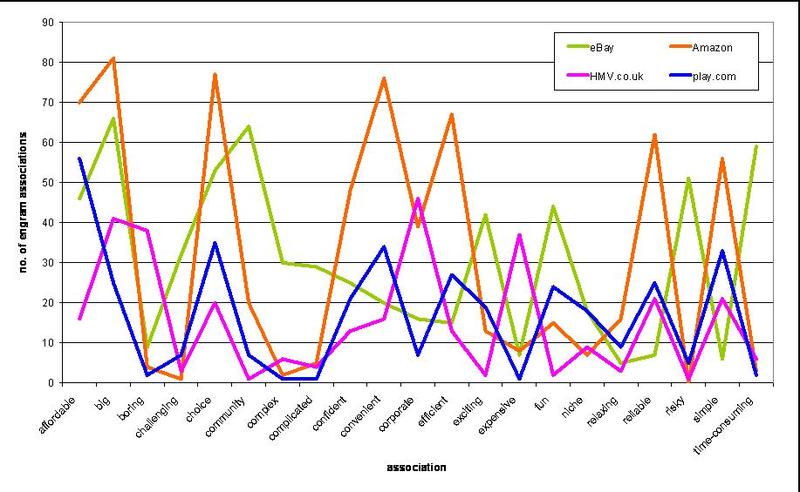
To test this theory, I conducted some proprietary quantitative research amongst 88 randomly selected consumers (from my Facebook friends!) and asked them to indicate whether or not a range of words applied to eBay as well as three other brands within the online commerce space – Amazon, Play.com and HMV.co.uk.
Figure 1 shows the extent to which various associations were made with each of the four brands. So for example across the 88 respondents 70 connected the association ‘affordable’ with Amazon, 56 respondents with Play.com, 46 with eBay etc. By pooling the associations we get an indication of the herd engram footprint for these brands, indicating the extent to which these four brands overlap with each other.
Figure 1: herd engram associations by brand 21
But when each brand is examined individually, a much more distinct herd engram emerges. Figure 2 shows only the eBay data, ranked by association.
Figure 2: eBay herd engram associations ranked strongest first 21
Big, community, choice and affordable emerge top (reflecting the positive gravity well), as do time-consuming and risky (the negative gravity well). In an individual engram this picture wouldn’t have emerged, the gravity well of that individual would have dominated. Only by looking at the herd engram are the range of (in eBay’s case less consistent) associations observed.
But the real indication of the relative strength of herd consistency comes when the brand herd engrams are compared. Figure 3 shows each of the four brand herd engram footprints as ranked by each brand independently of association (i.e. the first point on the x-axis is the strongest association for each of the four brands).
Figure 3 brand herd engram footprints as ranked by each brand independently of association (21)
Amazon’s herd engram footprint has most connections concentrated across fewer associations. In short its herd is the most consistent. Amazon’s herd more easily and implicitly recognise what its individual members mean when they mention Amazon or when it is used as a display of self-identity.
The challenge for eBay is to use its marketing communications to help generate consistency across its herd engram. At present those carrying the engram are forming very different memory traces orientated around different experiences of the product, ensuring that broadcast communications resonate less well with the collective associations of eBay’s herd.
The challenge for all advertisers is to acknowledge the existence of the herd brand engram and accept its truer reflection of the brand as it exists across the memory traces of consumers. Articulate it. Measure its consistency. Identify the foci for the gravity wells that will influence the currents and eddies of the conversations and interactions – the ecology – of the herd engram.
Wendy Gordon. Brands on the brain: new scientific discoveries to support new brand thinking. Kogan Page. P115
Wendy Gordon. Understanding Brands, by 10 people who do. Chapter 2: Accessing the brand through research. Ed Don Cowley. Kogan Page. p36
Malcolm Gladwell. The Tipping Point. Abacus. p21-22
Caroline Whitehall. Inertia is Good. Admap December 2005, Issue 467. p3
Joseph Heath & Andrew Potter. The Rebel Sell: How the Counter Culture Became Consumer Culture. Capstone Publishing. p219
Daniel Dennett. ‘The Self as a Centre of Narrative Gravity’ in Self and Consciousness, ed F. Kessel, P. Cole, D.Johnson. Hillsdale, NJ: Erlbaum, 1992
Wendy Gordon. Brands on the brain: new scientific discoveries to support new brand thinking. Kogan Page. P112
Malcolm Gladwell. The Tipping Point. Abacus. p188
James Surowiecki. The Wisdom of Crowds. Abacus. p xiv-xv
As reported by eBay, specific proprietary data is confidential.
The author. eBay proprietary qualitative research. June 2007
This was – amongst other specific messages eg Trust & Safety – the general message communicated by eBay from circa. 2005 until mid-2007
Independent proprietary quantitative research conducted by the author for the purposes of this paper. Sample on 88 respondents (recruited via Facebook – not nationally representative). September 2007
I caught this treat of a TV ad last night, and it is – for me – by far and away the best of this year’s Chrimbo crop. a simple and elegant piece that taps into our collective sense of Christmas spirit. more celebrities than you know what to do with are on display, but none one of them is trying to sell us groceries or boost their own profile. rather, they’re all doing exactly what they do best – laughing, hugging, loving, crying and – in the case of the Grinch – scowling their way through the festive season.
if I had one critisim, it’s that this ad doesn’t need an end line, or a tag line for that matter. the suggestion that the montage featured movies ‘for the people you love’ is not only implicit, but negates against people drawing their own – and therefore more powerful – conclusions as the what the ad is conveying. and as for ‘get closer’, well that doesn’t mean anything at all!
but it’s absolutely the right move for HMV, who are never going to compete with the
online retailers on price. instead they’re reinforcing their
associations with movies, the objective presumably being that over the
next few weeks, as we all negotiate our ways down our respective frenetic
highstreets, we see that Jack Russell and make a detour into it’s store over
others. time will tell if with this effort HMV manage a Merry little Christmas themselves… I supsect it may just work!
I was shown the above – somewhat delightful – clip at a conference last week. a subsequent forwarding on to a colleague reignited a question I gave pause for thought to a year ago when I asked what is TV? the answer I came to then is the same answer that I stand by now… that TV is the act of consuming aggregated audiovisual content.
I pointed out at the time that this definition implied that, should you run with it, YouTube is television. and I believe it is. in Dec 06 I wrote:
"the aggregation of TV requires content and distribution. technology
has allowed citizens to produce the former, and the internet has
allowed them to do the latter. we are all – should we wish to be –
content aggregators. we are all budding broadcasters. and a
generation is learning to watch TV aggregated by commercial entities as
well as fellow citizens." mediation post Weds 6th December 06
an obvious question then in all of this is – who is to do the aggregation? …commercial broadcasters or – via PVR on TV / subscriptions on YouTube / wall posts on Facebook – viewers themselves? in negotiating the future of media and communications – the aim of this blog – we have to accept the inevitable conclusion that it is of course both.
in the evolving ecology of TV (in both the broad and narrowcasting sense) the question in not who aggregates, but who – at a given moment in time – we want to aggregate for us. its a question of context… Saturday evening on the sofa is very different to 30mins web surfing on a Friday lunchtime. as a viewer, my individual needs vary massively over the course of a day or week.
commercial broadcasters and internet unilateralists continue to be at war over the issue of who aggregates. the battle is pointless. in the year since I wrote my original ‘what is TV’ post, commercial TV has been under what seems to be continuous fire, not from futurologists predicting their demise, but from a media who have witnessed compromise after compromise of viewer trust.
if broadcast TV thinks it needs to win a perceived war against the internet by cutting corners and taking shortcuts in order to be as popular as possible, then it is fundamentally flawed on two fronts. one; there is no war – both commercial and viewer-aggregated TV are here to stay, and two; the role of commercial broadcasters in this new ecology is not compete with YouTube by being as popular as possible, but to inspire it by being as original as possible…
the role of broadcast TV is to be the source of original, intriguing, inventive, surprising and high-quality content. content that demands to sit alongside it’s online counterparts. as Stephen Poliakoff comments in today’s MediaGuardian, "if you commission it, the viewers do turn up."
…just as millions turned up to see Darth Vader in cinemas in Empire Strikes back in 1980 (and on TV and DVD ever since) …and just as millions have turned up to see the clip at the top of this post. together they’re a great example of this new relationship: content originally produced commercially by Fox and Lucasarts as high-quality content, remixed by DoomBlake for fun, as parody, as art.
both are entertaining, and both have their place in the new TV ecology. it’s notable that DoomBlake’s recreative remix is entertaining because of the original context as defined by Lucas’s commercial creative vision. these content siblings need each other – one as source material, and the other as a way to stay contemporary in a changing world.
it one of the great wonders of the modern media world; why mainstream use of mobile phones for broadcast media consumption has never really been adopted – despite some very good reasons…
one; the mobile is ubiquitous. there were well over two billion of them in the world by 2005 (source) and in the UK we have more mobile phones than people (source).
"a cellular phone is distinctly personal … this personal association creates a very powerful attachment … one very close to addiction … European cellular phone companies have coined a name for the new concept, called "reachability" … on the fixed line phones you call a place, on a cellular phone you call a person … reachability is the human need to feel connected … a passive continuous connectedness in case the important call arrives or event happens … reachability is the single most addictive aspect of a cellular phone"
three; it’s already a device we use (in albeit for some a limited capacity) for interaction with other (mainstream) media, as anyone who’s ever voted on a Simon Cowell show can testify. whilst out on Friday night a friend sent a facebook message via his mobile – essentially disintermediating the phone network in the process.
four; unlike the internet, we’re willing to pay for stuff on our mobile phones. a report cited by Dr Jaques Bughin in an essay for IDS’ volume ‘New Language for the New Medium of Television’ (see here for details) found that mobile users would be willing to pay between 5 to 10 euros a month (and up to 15 euros for month).
five; mobile phones have won every battle they’ve taken on. in 2001 global sales for camera phones numbered less than 2 million, with digital camera sales well over ten times that amount. by 2002 camera phones were up to 18 million worldwide, 84 million by 2003. and by 2004 digital phones outsold digital cameras by 4-1. the rest is history. a similar stories can be told for PDAs vs smart phones, and many more people play games on mobile phones than any other platform (source: Ahonen + Moore p49, 55, 68).
but for a combination of reasons – including-but-not-limited-to – lack of a standardised revenue model, downloading capacity and hardware and software limitations, media consumption on the mobile phone just hasn’t happened.
then last week the omnipresent Google – the highest-profile member of the Open Handset Alliance made an announcement.
the Android platform is (arguably) Google’s answer to the i-phone. but it is not – repeat – not, a phone. its software. software that is open to be developed by anyone – including advertisers and brands – who’d like to develop some. the opportunities for brands are multiple and varied – TV access, gaming, retailing (eBay phone application to track your auctions anyone), or bespoke applications that allow consumers integrate and interest with broadcast advertising campaigns… in real time, whereever they are?!
Google have even put $10m up for grabs to those that develop the best applications. as Google point out, the vast majority of stuff that will work on phones isn’t out there yet. what’s new news is that creating that stuff just got a lot more accessible… does it represent a watershed? very possibly.
the mobile phone’s waited longer than it would have liked to become a mainstream media device, and now with Google’s backing, that ambition could soon – finally – become a reality.
I caught the above on Faris’ blog as part of a post on read-write culture. it’s from the brilliant TED, where here Larry Lessig makes the case for a revision of copyright law, in order to negotiate a truce between two sides: on one, the corporations who create original content and seek to protect it in every possible way, and on the other, a new generation of consumer creators who in response are aggressively challenging copyright law and the very nature of copyright itself.
he argues for a private solution that seeks to legalise (and realise the economic potential) of competition between the two sides, and calls for two changes:
1. that artists expect and permit their work to be made more freely available (for example in cases where it’s not for commercial gain)
2. that businesses embrace this opportunity, allowing the ecologies of corporate and consumer creation to co-exist
it’s a theme that any TV channel controller or magazine publisher (and indeed any editor / aggregator of advertiser-funded content) should be familiar with; how to retain a relevant place in the world as audiences fragment not just to other media channels but to content created by other consumers.
but there’s also a clear consequence for advertisers in this evolution. if consumers (especially younger tech-savvy ones) are essentially disintermediating broadcast channels and sharing content to each other via their participatory networks, then it follows that advertisers and the brand communications they deploy must seek to engage with these new cultural read-writers within the networks.
as far back as 1991, W. Russell Neuman observed that "The new developments in horizontal, user-controlled media that allow the user to amend, reformat, store, copy, forward to others and comment on the flow of ideas do not rule out mass communications. Quite the contrary, they complement the traditional mass media" (for more see here). Henry Jenkins in Convergence Culture agrees:
"…convergence culture is highly generative: some ideas spread top down, starting with commercial media … others emerge bottom up from various sites of participatory culture and getting pulled into the mainstream … The power of grassroots media is that it diversifies; the power of broadcast media is that it amplifies."
smart advertisers will utilise and integrate both grassroots diversity and broadcast media to communicate their brands; not only to fundamentally communicate with both broad aggregations of audience, but more importantly to be full participants in this re-emergence of the re-write culture.
we’ve barely begun to scratch the surface – think about Carphone Warehouse’s sponsorship of the X-factor; which populates their idents (broadcast amplification) with audio clips from viewers (grassroots diversity). there’s clearly much further to go, but some brands have started. the question for every other advertiser remains; do you want to participate in the remixed culture or not? it’s not, when you think about it, a question at all.
I’ve seen this latest Guinness effort a few times since it launched on TV last Thursday. it’s a fantastic piece of advertising, as of course it should be for the £10m price-tag that came attached to it. but according to an article by Stephen Armstrong in today’s Media Guardian;
"By the time the 60-second film broke last week … it had already been pieced together and posted on YouTube by thousands of net users across the world in an enormous online hunt for a golden domino … AMV BBDO gave out the first clue on posters, beer mats and websites two weeks ago. Solving each of the 11 clues released a code that revealed a few more seconds of the commercial, with the first to sling the completed film on to YouTube earning the brewers’ version of Willy Wonka’s ticket."
really!? you could have fooled me. not a jot have I seen of it! which is more than a little disappointing.
the investment behind Guinness’s broadcast media (and a £10m ad) should quite rightly take priority in the mix – but to invest so little behind a genuinely interesting and smart piece of consumer engagement shows at best a lack of confidence, and at worst a distinct case of ‘let’s do the consumer engagement bit’ as an add-on. the fact that – as a thirty year old urban alcohol drinker – I didn’t see the golden domino activity could just be accident; the fact that this activity started a mere two weeks before the ad was first broadcast definitely wasn’t.
a case of smart, very smart, thinking just not backed-up by investment. this should and could have been huge, the fact that it wasn’t (96,000 views to the discussion forum just doesn’t cut it), represents a genuinely missed opportunity.
the same article observes that "alarm is growing in the advertising community over the idea that the net allows clients to pay for an ad in one territory and then reap the benefits for free across the globe". the fact that ‘if I paid £10m for something, I’d feel I had the right to do whatever the hell I liked with it’ aside, one way to combat this threat is to ground the ad into a territory with exactly the kind of comms behaviour that golden domino demonstrates so well…
great ads will for a very long time to come have a key part to play in any communication strategy… but a failure to use them as part of a bigger picture, and more importantly invest in that bigger picture, will only contribute to the spot ad’s woes.






 MEDIATION