a Scout Trooper with a fragmentation grenade: has no bearing on the post other than the fragmentation reference but any excuse … source
there’s a very good opinion piece in this week’s Adnews by MediaCom’s head of implementation, planning and investment Nick Keenan. if you’re a subscriber you can track it down here.
Keenan makes the smart observation that ‘fragmemtation’ is an overused and too simplistically deployed term: “It felt that unless you had worked out how to speak the new hybrid tongue of ‘Tradigital’ (my invented language of combined consumers) being spoken across new ‘BIG’ consolidated/integrated networks you as an advertiser were now hopelessly lost and would never see a mass audience again. We were told and believed we now must grapple with using multiple platforms within traditional media to reach the large numbers we once accessed in single channel environments”
source: Nick Keenan writing in Adnews 3.4.12
Keenan goes further, arguing quite correctly that not only do mass audiences exist, but they have more mass than ever before: “Facebook has over 80% of all people 25-54 … Google has 96% of all Australians online … Put simply these examples along with others such as Amazon, YouTube, and eBay have enormous mass audiences, the likes of which we have never seen.”
source: Nick Keenan writing in Adnews 3.4.12
whilst its very true to say that mass audiences still very much exist, and indeed exist with more mass than they have ever had (media consumption is increasing overall), there is a very real and present danger that we fail to recognise that people haven’t just moved (from Nine to Facebook or Ten to YouTube), but that they have very much moved on too …
they are no longer the ‘passive massive’ (as Faris would put it) that they were when mass audiences existed in the broadcast stream, a mass audience on Facebook or YouTube may be as big or bigger than a Nine or Seven audience, but they (1) behave very differently and (2) have very different expectations of brands …
a mass audience on Facebook or YouTube is in control of what they watch, listen, or interact with. it was Clay Shirky (I think) who observed that whilst in the long tail of content the average quality of what gets made goes down, the average quality of what gets consumed goes up. just landing our content in the new mass platforms is no guarantee that they’ll be viewed let alone interacted with or passed on.
our expectations of what we want in exchange for our attention have changed. the old mass contract stated that if you give us 30 seconds of your attention we will entertain / educate / inform you. the new mass contract is essentially the same, albeit with an extended list of services (utility for example), only now we have a lot more to choose from and less attention to give.
so I’d counter that fragmentation is one of the most profound shifts in our industry right now – but its not fragmentation to platforms (big audiences, as Keenan rightly points out, are getting bigger rather than nicher); rather its a fragmentation towards individual moments and decisions … to watch or not, or pass on or not. that’s crazy fragmentation that introduces more than a little chaos into our mass delivery systems.
yes the mass audience has moved, but more importantly … they’ve moved on.
so as a bit of a Chrimbo pressie I took up a year’s subscription to the BBC’s iPlayer offering on iPad. one of the first things that I got my teeth into was a documentary from a couple of years ago on BBC4 about the mathematics of chaos. a particular passage in the above clip, struck me as of particular interest to those of us attending to an ongoing mission of negotiating – of mediating – the future of media and communications.
jump to 3m50s and you’ll hear the following passage:
“the turbulence of the 1970’s convinced the economists, as well as the environmentalists, that their faith in large scale prediction and control was just wrong. they came to accept that they would no more be able to control the economy than the weather. the era of command and control was over. but there was a second more controversial part of the mathematics upon which they fundamentally disagreed.
Ruelle and others had found that even very simple systems … could give rise to highly complex chaotic behaviour; and now as they used these simple systems to explore further, they began to discover the rules of this chaotic world. they found that the more connected and interlinked systems became, the more likely they were to become chaotic and turbulent, and that the more you pumped the system – the faster you ran it – the more chaotic it would become.”
source: High Anxieties – The Mathematics of Chaos, David Malone, last broadcast BBC4 in 2008
anyone currently planning media and communications can’t fail to observe the parallel: the more connected and interlinked systems become, the more likely they are to become chaotic and turbulent – and the faster you run a system, the more chaotic is becomes…
we enter a new year with a media and comms planning landscape that is arguably less certain than it was last (and I would suggest that this has been the case for at least the last several years). we have fewer certainties, fewer guarantees of success, fewer empirical rules of behaviour that can predict what our investments and strategies will achieve.
it is not for the want of trying. Ehrenberg et al at the institute that bears his name – for example – have made huge strides in identifying marketing ‘laws’ … for example the double jeopardy law which states that “brands with less marketing share have far fewer buyers, and these buyers are slightly less loyal (in the buying and attitudes)” … or the duplication of purchase law which states that “a brand’s customer base overlaps with rival brands in line with its market share” (source: How Brands Grow, Byron Sharp)
but these rules have more to do with buying behaviour than they have to do with how and to what extent media and communications planning influences that buying behaviour. for every one of Ehrenberg’s laws there are multiple exceptions that – depending on you point of view – prove or disprove the immutability of those laws.
multiple disciplines indicate that we are habitual creatures, more sensitive to (for example) loss aversion than that of advertising. and yet we know that communications which are disproportionately awarded / rewarded have a similarly disproportionate return for the brands that invest in them. communications work, and generally speaking the better the communications the better they work.
generally speaking.
which is of course fine, generally.
but the fact remains that while we can all of us mitigate uncertainty (thorough research and exploration; an aligned strategy; integrated thinking; proportionate and focused investment; identification, tracking and measurement of KPI ecosystems … to name but a few), what we do sometimes seems to be far from an exact science (which is of course part of the attraction)…
but perhaps chaos has not just a key but an increasingly significant role to play. what if we accept that we are no more able to control how media and comms planning affects businesses that we are able to control the weather? … and what if we accept that an increasingly networked and interconnected media landscape increasingly makes this more not less true?
would such acceptance make us better or worse planners? would it compromise planning or make it stronger? could accepting that there is inevitable chaos in the system provide more realistic and reliable margins and predictions of success? if the only thing we can confidently predict is a degree of unpredictability, perhaps confidently facing up to this reality is the only thing that will truly allow us to move on…
“Several years ago in the video game industry the big buzz word was “transmedia”. it was a term that was coined for original worlds and properties that spanned multiple venues, from the game to the TV series to the movies to the books. everyone was aflutter with this idea; these mega properties were going to dominate the entertainment landscape and change how we consume media.
flash forward to now and it’s clear that very few studios were ever able to pull off this “holy grail” of world development. budgets skyrocketed and very few wanted to take a gamble on building a new world. Ubisoft, however, pulled this off with Assassin’s Creed, and they did it with flying colours.
let’s face it – we live in a digital and connected world. a distracted world. there are always multiple things vying for our attention, be it social media or mobile devices. in this era creatives need to craft games and worlds that gamers “marry” not ones that they casually “date”. there are numerous ways to accomplish this, but one of the best ways to do it is to make a game world that is so extraordinarily deep that it takes an army to sort through all of the facts and details. the world of Assassin’s Creed is one that is easy to get into but can take years to fully understand and appreciate.”
Cliff Bleszinski – Design Director, Epic Games
it’s strange reading the above commentary outside of a media planning text, the parallels are so similar as to be striking … “buzz word was ‘transmedia'”, “change how we consume media”, “a digital and connected world. a distracted world” …
Bleszinski’s comments were written for the prologue to the Assassin’s Creed Encyclopedia, a beautifully designed hardback book included as part of the Animus Edition of Assassin’s Creed Revelations.
Ubidoft’s unboxing video of Assassin’s Creed Revelations Animus Edition and images from the Assassin’s Creed Encyclopedia: careful, spoilers alert
that games now come with encyclopedias may be news enough for some readers, but the fact that Assassin’s Creed does (in fact there’s an audio CD and a short movie in the Animus too) bears testament to just how evolved some game worlds now are.
evolved, and big business.
a Guardian article last week reported that Call of Duty: Modern Warfare 3 had set a five-day worldwide sell-through record, with sales of more than USD $775m. it went on to comment that “the number also far exceeds the opening revenues from any movie or album release in 2011 – the biggest film of the year, Harry Potter and the Deathly Hallows Part 2, made $202m in its first five days. It is likely that Modern Warfare 3 will join the select group of £1bn-grossing entertainment properties by Christmas.”
some digging courtesy of the same article notes that DFC Intelligence puts the 2010 global games industry figure at USD $66bn, whilst the LA Times puts the 2010 global cinema box office figure at USD $31.8bn and eMartketer estimate recorded music revenues at USD $35.1bn. games win. by a long shot.
the article ends however by observing that total reach of cinema far exceeds that of games, and comments that “Call of Duty: Modern Warfare 3 is big, that’s for sure, but as a mass cultural event, it still has a looooong way to go” … the fact that this observation is disputable aside (include social and casual gaming and there’s plenty of examples of games with scale and ‘cultural event’ status – Angry Birds anyone?), the difference between movies and gaming audiences is a reflection of the difference in the type of content/context between movies and gaming.
movies are inherently lean-back, immediate and assessable. games (casual and social aside) are inherently lean-forward, immersive and require time, effort and energy. it’s no surprise that the former has a bigger audience footprint than the latter, but that the latter generates significantly higher revenues per head than the former…
what’s interesting from a media planning perspective is the choice that it presents – ask yourself what context/content we in the advertising and communications industry generally create? is it lean-back, immediate and assessable … or lean-forward, immersive and demanding of our time and energy. advertising was born and grew up in the mass-broadcast era – its no surprise that we predominately not only produce in movie-mode, but have extensive metrics and marketing theories (Byron Sharp anyone?) to prove its validity.
and yet we know we have to move on.
we take our content and we re-purpose it. we’re media and channel neutral, we create experiences and promotions and we socialise and innovate around our movies. we create the games of our movies.
and in doing so we’re missing a huge opportunity. because Assassin’s Creed and games like it don’t create games from movies (that would inherently limit their scope – search for ‘successful movie-based game franchises and you’ll see what I mean) … Assassin’s Creed creates movies from games, and more specifically, from an imagined world in which that game is set. they start, always and every time, with an immersive and lean-forward content/context – after which spinning out lean-back immediate content is childsplay.
the point is that we have a choice. stay as we are – create in movie mode and spin out the immersive and engaging game stuff off of the back of it … or we can decide to more often start in gaming mode. what world do we want to create? what are it’s rules and stories and mythologies? (all brands have them – we just don’t think of them in these terms) … then how do we create lean-forward, immersive and rewarding ways into our worlds? and then, and only then, how do we create content – of thirty seconds or three hours duration – that expands the penetration of our worlds, and of our brands, via more immediate and assessable means.
it’s harder to do. it’s expensive to fund. it’s difficult to measure. and it takes longer to produce. but that’s our choice … and as anyone who has ever completed a game will tell you – it’s more than worth it. speaking of which…
I was lucky enough to jump across to Auckland last week (for meetings, I wasn’t that lucky) where it wasn’t hard to notice that there was a small rugby competition in progress. aside from the obvious signs – like Steve Rider standing at the bar or Lawrence Dallaglio’s MacBook popping up on my shared drives – it was impossible to avoid the advertising making us aware of various brands’ sponsorship of the event. it fact it was harder to spot a poster that didn’t relate to the rugby world cup that to spot one that was.
all of which is well and good. a host of brands have invested in attaching themselves to one of the best sporting competitions in the world, and quite rightly want to leverage that attachment and investment. but here’s the rub. the tyranny of clutter. oh how it mitigates and compromises and diminishes the value of our collective investments.
the fact is that to effectively leverage any sponsorship now, you have to create a crucial step between the sponsorship and the advertising. you have to create something that amplifies and justifies your connection, and talk about that. telling people that you’re a sponsor with a nifty copy line simply doesn’t cut it any more.
no one understands nor activates that better than Air New Zealand. of all the brands that fought for my attention with their rugby world cup efforts, none stood out or cut through more than Air New Zealand. I wasn’t alone … the subject of what they had done to amplify their association came up more than once in conversation and not by me.
the above is the in-flight safety instruction video. it’s not going to win any oscars but it doesn’t have to… it demonstrates an absolute commitment to the cause and leverages the connection to the RWC through the most credible of symbols – the All Black players and coach themselves. I see and lot of in-flight videos. I watch very few. I watched this one again online afterwards.
in addition an entire aircraft has been liveried in black to activate the sponsorship (see below) and the interior furnishings on the plane have been given an All Black makeover for the occasion. the planning for this alone must have been years in the making – short term response planning its not.
some lessons:
dominate and disrupt your owned media don’t hold back. plan and think ahead about how you can radically disrupt the media you have at your disposal. what can you create in-store or in branch? what can you do to alter your web presence or DM or eDM mailings? use your staff and people as part of the message – involve them in what you’re creating. and bring what you’ve done to life through content so that you can…
allow word of mouth to do at least some of the amplification yup use broadcast media to amplify your innovation but don’t over-rely on it. socialise the content around what you’re doing and encourage sharing. it doesn’t have to be amazing quality, just good enough. more good content is better than just a little awesome content. content is fleeting and disposable these days; invest accordingly people.
utilise credible symbols to leverage your investment if you’re putting hard earned dollars into a sponsorship make sure you get more than badge-ing rights. if you’re sponsoring a tournament get access to the home team. if it’s a media association leverage journalists or on-air personalities and co-create content and platforms with them that communicate the relevance of your association.
create a return path for sales create breadcrumbs back to retail or sales channels so that interest and saliency can be easily activated into return on investment. can you create a unique offer around your sponsorship? how you create a path to sales by showcasing your goods or services? once again, Air New Zealand’s YouTube channel is a lesson in how to do just that…
above all don’t think that telling people you or your client is a sponsor will be enough. too much clutter. too much noise. too much convergence on the same message. you’ll get lost. or at best you’ll win a phyrric share of voice victory that cost you more than it returned.
will all this cost more? you bet your sweet pretty ass it will. you may need to do less overall and focus investment on fewer bigger better projects … but it’s more than worth it. don’t hold back, if its good enough to sponsor its good enough to invest the time and energy in making the sponsorship count.
full declaration: Air New Zealand are a client of PHD Australia, where I work. I’m breaking my first and most important rule of blogging by writing about a client, but it was just too good an effort not to comment on.
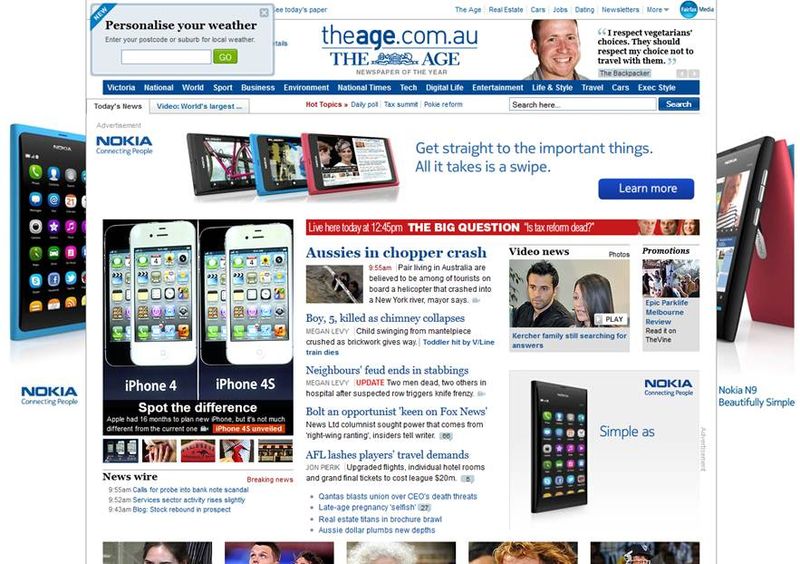
getting tactical – Nokia’s takeovers which appeared across a range of titles today
thanks to Kate M who pointed me in the direction of the above earlier today; a great example of smart, relevant and appropriate tactical planning. no futurology, no zappy whizz bang interaction or engagement strategies … just a simple straight-forward ad for the Nokia N9 in dominant spaces on the day of Apple’s big (?) announcement.
whether or not Nokia knew the iPhone 5 was going to be an iPhone 4S is irrelevant – even with a more talked about iPhone model the placement was a smart move. the fact that Apple announced a 4S today makes the planning all the better…
the alignment of The Age’s ‘Spot the Difference’ item alongside the Nokia ad speaks for itself. future-gazing and predicting and innovating and challenging are important, but I was happy for the reminder that there is – more than ever – a place in our world for smart planners who spot and create credible cut-thru tactical placements for brand communications.
Yoruba ceremonial drums, Nigeria. picture from here.
so the lovely Emily got for me a signed copy James Gleick's The Information for my birthday (thanks Emily) and whilst I'm only a couple of chapters in, its already proving to be a bit of a treasure trove. the first chapter discusses the African Drums. when 18th Century Europeans first heard the drums, they had no idea that they were conveying information. yet the drumbeats contained detailed and what seemed to be superfluous information.
"Instead of "don't be afraid," they would say, "Bring your heart back down out of your mouth, your heart out of your mouth, get it back down from there" … the drums generated fountains of oratory"
the explanation for the elaboration is fascinating.
"in mapping the spoken language to the drum language, information was lost. the drum talk was speech with a deficit … the drum language began with the spoken word and shed the consonants and vowels. that was a lot to lose … consequently … a drummer would invariably add "a little phrase" to each short word. Songe, the moon, is rendered as songe li tange la manga – "the moon looks down at the earth" … the extra drumbeats, far from being extraneous, provide context"
James Gleick, The Information, Chapter One
there's a beautiful parallel with the world and brands and communication. the moments in which brands connect with people are fleeting and becoming more so. there is a very narrow opportunity in which a marketer can convey information. messages need context, and brands provide it.
so rather than someone hearing "we make cars" (the message) they hear "we make Jeeps" (the branded message). this context takes the message from a simple "this is what we do" to a more richly imbued communication embodying all the associations someone recalls when they hear "Jeep's cars".
this context is crucial … "we make cars", becomes:
we make Jeeps
we make Toyotas
we make Hondas
it's a useful thinking framework – to separate the context and the content. marketers work in challenging times. the potential opportunities to make meaningful connections with people have never been greater; but with opportunity has come complexity. how are communications cutting-through? how to create the most distinctiveness in market? how and when to engage audiences through media beyond which that I buy?
separating context and content helps to address some of those challenges.
creation of context is the creation of brand meaning. what does my brand stand for? why does it exist? what are the associations I want to create (or reinforce) when someone recalls my brand. this is a long-term process, and it's contribution to a brand's business not always easily measurable. but it's crucially important context – and the marketer is responsible for continuously creating it.
creation of content is the creation of the message. we're having a sale this weekend. new model now available. we've improved our fuel efficiency. the role of content is to influence and stimulate an action or a response. these are shorter term, and the extent to which they permeate and become salient in market are very measurable. they can also be spread with huge efficiency by media other than that which is bought.
separating these two elements helps navigate increasingly complex waters. how can I – as marketer – create context for my brand? a context unhindered by the need for immediate ROI in market. what platforms (through owned media) can I create to hold and communicate this context?
…and how can I efficiently and effectively deploy my messages into market? how can I inspire and encourage people to pass-on that message on my and their behalf?
the combination, like the African drums, are simple messages imbued with the richest of context … so that the content is un-mistakenly attributed to its brand. the add the pieces together you first have to separate them.
which brings us, of course, to Harry Potter – and this week's announcement that the upcoming Deathly Hallows Part 2 won't be the end of the Potter franchise.
Potter as brand is now established. seven books and eight movies have communicated the narrative and its characters, all of whom are now familiar memes in our culture. like Star Wars before it, Potter – because of the human stories it tells – is now firmly embedded in the popular psyche. but context and content have hereto been one and the same; the experience absolutely binding the two together. books and movies as one-directional communication of story. around this controlled narrative a user-generated culture arose, but it never penetrated back into nor influenced the context or content coming from JKR, Bloomsbury and Warner Bros.
that's about to change. Potter is about to undergo a context content split.
Potter as a brand is now evolving to have two distinct streams. the context will continue to be provided by JKR and co. both the ideological: what are the rules and conventions of the Harry Potter universe? and the physical: in the form of the Pottermore owned-media platform (which will also be the sales platform for HP eBooks).
but content will now, for the first time, be created by JKR and anyone else with the passion and energy to contribute. the long-term building of the Potter brand co-existing but separate to the short-term creation of Potter content.
the evolution is already apparant … the above announcement inviting and teasing its audience to "follow the owl" – an ARG element signalling a shift in the Potter brand to one that is co-created, crowdscourced and owned by everyone.
it may just be me, but I seem to have returned from my Easter adventures in TasVegas to a bit of a utility and relationship-building love in. generosity, it seems, is all around…
first up, as reported in Contagious, is a trailer (above) for mobile game The Nightjar, an experience which places you alone in space and challenges you to escape using only sound. the app will use 3D sound and will be voiced by Benedict Cumberbatch of the parish of Sherlock Holmes. all generously provided by the marketing efforts of Wrigley's 5 Gum and all very brilliant, but its what lies behind it that is even more intriguing…
AMV BBDO creative partner Thiago de Moraes explained to Contagious that The Nightjar is the first in a five-year (ie forever in marketing terms) effort to create 'The 5 Experience'. combining film, art, fashion and music, the project aims to "create a new and unique experience for participants at every single touch point. the idea of The 5 Experience is to turn Wrigleys into an entertainment company as much as it is a company that makes gum … [we're] going to create brilliant new sensorial experiences that people can take part in."
imagine that. a company that makes gum deciding that its not – as far as marketing is concerned – in the business of making gum. but is rather an entertainment company. imagine the combined available marketing spend of Wrigley's 5 Gum being invested in entertainment utility for it's target audience. if I was a competitor I'd be keeping the closest eye on how the 5 experience progresses.
next up, generosity knows no bounds from Turner's TruTV, who asked fans to rally to the 'Operation Repo' Facebook page. in return they got nothing less than an entire episode made just for them. AdAge reports that for the first time, a program has created a Facebook-only full-length episode as the fans' prize (for reaching 500,000 likes).
the Operation Repo facebook page. reward fans for liking the show? hell yeah!
it a significant gesture to existing and potential fans but also to Facebook. the economics of the exercise must have had to shift, with the cost per viewer on Facebook being significantly higher than the equivalent CPV on broadcast TV. but, as TruTV may have gathered, not all viewers are created equal. they have, quite rightly, decided that the increased cost per view for a dedicated and advocating audience is more than worth it.
but wait, there's more.
the spirit of generosity is also alive and well with new media megaliths Google and Facebook, who in recent days have both launched outreach programs to agencies of all people.
Mumbrella reports that the Google Engage For Agencies program will see agencies and consultants looking to help clients with products such as AdWords and the Google Display advertising network get preferential support including training and events.
meanwhile, this month saw Facebook launch Facebook Studio. the effort see's the social network create a platform on which creatives can share ideas, comment on (Facebook) campaigns and learn what it takes to create a successful FB brand page.
Facebook Studio – building bridges with agencies
aimed at ad agencies, PR firms and media strategy companies, creativityonline reports that the move is "a first step in a give-and-take dialogue between Facebook and the creative advertising world … until now, Facebook has been mostly hands-off with agencies, letting them navigate the frequently changing Facebook waters without a compass" … Blake Chandlee, head of Facebook's newly formed agency relations team commented that "we need to do a better job of engaging with agencies" … this from the new head of new agency relations team.
from Wrigleys' efforts to entertain the young people of our planet and Operation Repo's reward of it's show's fans, to Google and Facebook's generous agency outreach and support programs, the spirit love and understanding (as Cher so eloquently put it) does seem to be all around at the moment.
the cynic might observe that these are nothing more than veiled attempts to influence an audience. that Wrigleys just want to sell more gum. that TruTV want more fans. that Google and Facebook just want more ins with agencies to sell more of what they sell, to more clients, more often…
of course they do!
and that's absolutely fine. in fact it's great. because if a company want's me to buy more of their gum I'd rather they entertained me into it. if a TV show want's me to like them on Facebook I'd rather they rewarded me for doing so. and if Google and Facebook want me to be more effective at planning their wares by making me more familiar with what they have I'd rather they engaged me in and rewarded me for having a conversation about doing so.
because it's quid pro quo. and it always has been. and it always will be. the game hasn't changed, but the currency has. engagement and reward are the new reach and frequency. and thank goodness for that.
a couple of weeks ago I found myself in the fortunate position of being one of the delegates on Contagious Magazine's Crash Course, a one-day workshop in the company of @JessGreenwood and @gual_contagious in how to understand the changing landscape of communications, but more specifically on how to apply Contagious' observations of this landscape to my own strategy and thinking.
there was huge value in the day, but one particular exercise has stayed with me. one particular exercise that forced me to stop just admiring and enjoying other people's strategies and execution, and really think about them. as an exercise its elegance itself, and one that I've certainly forgotten to do of late.
the exercise consists of a simple question; on seeing or observing a case study or piece of creative communications, ask yourself a single question…
what was the insight?
what was the crystallised observation of humanity that led to the solution? what was the observation that sparked the execution, or experience, or application or movie or competition or retail space or book or course or race or tech or social media monitoring desk?
it's beautifully simple, and forces you to not just passively admire the work your looking at, but intellectually interrogate the work to understand how and why it was developed…
try it with these … for each example of work, ask yourself what the insight was? the answers – as suggested by Contagious, are beneath…
OK … now for the insights that led to the above:
you may think that some of the insights are obvious, but everything so gloriously is in retrospect. and in many ways the best insights are obvious; and whilst that doesn't make them any easier to spot, it makes it all the more enlightening – and for that matter fun – when to try to guess…
created by Michell Zappa, and sent to me by the awesome Mimi-ness of things, this speculative but intriguing visualisation of how technological developments could pan out presents an interesting question and exercise for brands and connections planning. how would you connect to people, given technological developments over the next year? what about in four years time?
perhaps a lot more social media, a bit less print? perhaps you'll have more sophisticated CRM management and real-time insight capture via social networks. so largely the same, but different.
the future may be more different than you currently imagine. Zappa's map suggests that within the next four years the following will be mainstream. not industry buzzed, geek adopted, first mover technologies. mainstream…
Social Graph, Tabs & Pads, and Multitouch. so far so Zuckerberg and Jobs. but what if you go a little further..? 3D printing, Linked data, Gesture and Speech Recognition, and Electronic Paper. within four years. this kind of technology – if adopted by the mainstream – would transform the retail environment. it would radically alter the opportunities we have to engage and interact with the conversations brands offer us.
it suggests a useful exercise. create a brand platform (I originally typed 'plan a brand campaign' but let's not go there right now) in 2015. imagine these technologies being on every high-street and in every home. how would it change what you create? what would be possible? what would you imagine for a world that could 3D print your product in their home? or interact with your communications by talking or gesturing to them?
then translate your ideas to right now… what could – at a stretch – be done in the next three months? what you do next is easy. you go do it.
Josh Spear is "from the internet". no really, he is. he put everything owned in the Internet and now has much of his possessions stored in the cloud.
his website, JoshSpear.com emerged in 2004 from the back of a Journalism 1001 class in which he was disappointed with the way academics ignored blogs as an emerging media. Josh describes his home as "a daily source of inspiration for marketers, brand managers, advertising executives, and a wide range of everyday people from around the world who love to stay ahead of the curve"…
which I guess more than qualifies Josh to be talking to us at Circus. his theme was 'the Fringes of the Internet', and the way the internet is affecting people and businesses.
he described how shortly after starting his blog he was approached by businesses who wanted to put ads on his site, this turned out to be a fine way to made money, and led to a conversation with advertisers about how effective the ads on his site were. very effective it turns out … they were seeing click-through rates of 2%…
two percent? asked Josh. yes, they replied. that's a 98% failure rate, said Josh. yes they replied, impressive isn't it!
Josh guessed then that the internet would have a major impact on businesses, and co-founded Undercurrent, a digital strategy firm that applies "a digital worldview to the challenges and ambitions of complex organizations"
"It's about the human behaviour we're going to talk about not the specific websites"
4chan is bad place on Internet but it's also important. it's anonymous. people respond to photos with photos. [it's a bit like the Abyssal plain of the internet; a deep, unexplored region rich in biodiversity that influences the rest of the ocean in ways that we're only just understanding] … it's where 'I can haz cheezburger?' began … the LOL-CAT meme. a meme which now results in tens of thousands of cats created every day. like this one:
the misuse of worlds isn't an accident, it's very deliberate. and globally consistent and understood. it's a language called LOL-Kitteh. the Bible has been translated into LOL-Kitteh.
Rick Rolling began on 4chan. in fact "anything funny that's unexplainable starts on 4chan". to the extent that a Time Magazine poll ranked Moot (4chan's creator) as the web's most influential person. only later was it noticed that the first letters of the ranked online poll spelt out a phrase. an incredibly sophisticated and advanced work of electoral engineering / hacking.
Time Magazine's 2009 online poll results. the first letters of the top 21 names spell out "marblecake also the game". marblecake is the name of the IRC channel where Anonymous started their campaign against Scientology, and "the game" is a reference to "The Game" meme source: Wikipedia
the rabbit-hole, it would seem, goes very deep indeed. "4chan is 'the bottom billion' pageviews on the Internet". Spear points out that two things consistently happen to Moot (who is called Charles) (1) he is forced to dump 4chan's data every 12 hours due to hard drive space and (2) every week he is served a subpoena for the information he holds (before it's dumped).
[this is all pretty mind-boggling I'd have thought for the average brand marketing manager, and you can see how they would be queuing up for the elvish Spear to safely have them gaze down the rabbit hole without falling down.] things used to be simple. then there was digital. which disrupted. everything. this is such a familiar phrase that it's beyond cliche, but Spear asks a very interesting question:
"is there a unit of disruption?' … and how do you stay on top of the disruption? which happens all around you all of the time and increasingly finds ways to impact on your sensory sphere. much as this blog discussed in a January 2010 post, Spear describes Tweetdeck as one way to control the disruption. he has "become an air traffic controller of my disruption"
we are our social graph. we're made up of our disruptions [connections], a point made wonderfully and elegantly with this map of the world, a map formed by nothing but the connections on Facebook.
What happens to a generation of people growing up in the world as drawn by this map and 4chan? a world populated by cat memes and Rick Rolling? a world in which gifts are given virtually. Spear pointed out that thousands of dollars are spent on things that don't exist. virtual economies are springing up everywhere. Farmville makes $50m a month. when Bear Stearns collapsed, a friend of his at Facebook didn't contemplate the collapse of the further banks but rather was promted to think that Facebook should start a bank.
Virtual economies are being used by brands – for example the number of tweets Uniqlo products received affected their price – a fascinating dance between buzz and value.
Radiohead invited people to pay what they thought their album was worth, an invitation that made more money than all other record sales combined. People's idea of money is changing.
the same goes for people's idea of location… take Foursquare, which introduced game mechanics in the form of mayors and badges. Foursquare also allowed tips to by left inside the check-ins, inside the game. tips linked to location so that they're readily available to those who enter the space. Foursquare allows reviewing in realtime on a geographical basis… Spears asked why people share all this information, and showed a slide outlining three reasons why we share adapted from MIT research and Henry Jenkins:
Strengthen my bond – you are what you share in your social graph
Define collective identity – you are based on the five people you spend most time with
Give me status
Viral = a bad thing, something you catch
Spears notes that 'pass-along' is made not of viral, it's made of people sharing something with more than one of their friends, and so on. reaching people is about tapping into cultural resonance. to test this, Spear's office put an image of a funny(ish) joke about Tiger Woods on the web. the pic got 30,000 views in first 48 hours, created a 'microblip' of cultural resonance … a map of interest, which could then be observed. so how, in Spear's opinion do you create cultural resonance?
group of people + unique culture = amplify to affect society
it's about tapping into a shared interest online because you can't rely on time and space, as shared interests are a way of creating cultural resonance. connect your brand to this. or don't. these interests are being shared whether brands get involved or not.
but be careful brands – angels fear to tread where P Diddy TV trod with Burger King. the video has long been removed, but fortunately for us Lisa Nova's spoof lives to remind us how it want down (nb Nova is now working in TV comedy – she got noticed because she understood the rules of the internet)
in Spear's opinion the fringe of the internet has a novelty scale:
the fringe's novelty scale, as presented by Spears
Spears says that agencies who want to use things like crowd sourcing or 'the fringe' to do their work need to either be the lowest cost option, or the best. if you're neither, you're stuck in the middle, and the middle is not a great place to be.
Spears asks what is the Internet good for? advertisers and agencies may answer that it's good for awareness [incremental] and persuasion. but Spear observes that this is not what the Internet is meant for. the internet is meant for sharing, cooperating and collective action. the latter of which is, in Spear's words, "the holy Grail of humans using technology"… at the fringe are the beginnings of these kinds of great examples…
the Copenhagen wheel collects data from your bike. one person doesn't generate enough data to paint a picture of a city, but eveyone's data does … and allows the aggregation and interrogation of usable data to generate insight and utility.
Ushahidi encouraged free and fair elections in Zimbabwe, and in the aftermath of Haiti and Christchurch interactive maps directed resources in realtime to where help was most needed. the US state dept now relies on this kind of information to coordinate relief efforts. crowd sourcing is used to collect and sort data. organisations no longer ask for money but for a little bit of time and effort. Alive in Egypt transcribes voice messages into tweets, allowing people to deploy messages and information even when access to the internet is being blocked.
So what has 4chan guy got to do with the fringe?! well what if all the people sending cats around every day gathered intelligence instead? they already have, it's called WikiLeaks, and "we can't yet imagine how this will affect the world"
Some challenges for brands:
how do you change from interrupting people into adding utility for people?
How can brand engage with born digital consumers in their language?
If you take a brand into the universe of the internet, ask yourself if you are following the rules of that universe?
Are you surrounding yourself with enough people that speak digital?
the contents of this post [unless in square parenthesis] is the content of a talk given by @JoshSpear at Sydney's Circus in February of 2011, thanks to Josh for his input in writing this post





 MEDIATION