advertising, awarding, celebrating, co-creating, collaborating, content creating, creating, marketing

Crafted to Win: Four Approaches That Delivered Media Lions at Cannes 2025

In my most recent post I shared some thoughts on the vibe from last week’s Cannes Lions festival, and noted that: “Along La Croisette and in the Palais and everywhere in between was an industry grappling not with the future to come, but with a future that now lies behind us. The current source of unfair advantage is being able to marshal your resources – be they marketing, agency, creator, or anything in between – to leverage better than your competitors the world around you.”

That idea of marshalling what’s possible to gain unfair advantage was on full display in the awards category perhaps closest to my heart – media.

Cannes 2025’s Media Lions recognized 66 pieces of work from over 2,000 entries, with the Grand Prix awarded to Dove’s “Real Beauty Redefined for the AI Era” from Unilever. The campaign tackled AI-driven beauty standards by retraining Pinterest’s algorithm to prioritize inclusive representations, delivering brand lift and widespread engagement.

Beyond the Grand Prix, twelve Gold Lions were awarded to campaigns that the jury believed best demonstrated what’s possible with media – showing contextual understanding, innovative media thining, and platform-native creativity.

My personal highlights include Streaming Bars by Heineken, which turned Netflix ads into real-time bar experiences; Coupon Rain for the formidable Mercado Livre by the equally impressive Gut, São Paulo, which transformed news coverage into shoppable coupon moments; and the Redditor Edit for Skoda by agencies including PHD (hurrah), which co-created car features with Reddit superfans. As well as Vaseline’s Verified campaign which co-opted creators to be part of the brands marketing by verifying and rewarding their hacks, and Waitrose’s Sweet Suspicion, by agencies including MG OMD (hurrah again), which leveraged some festive whodunnit storytelling to cut through the Christmas foodie clutter.

Overall, 2025’s winning media work signals a shift toward media experiences that blur entertainment, utility, and advocacy – where effectiveness is derived from earned engagement, tech-enabled storytelling, and brand bravery in reimagining how media is planned, shaped, and shared.

Across the Grand Prix and Golds, four themes emerge. They don’t just tell us where media thinking is now – they hint at what’s possible for brands and agencies aiming to gain competitive advantage by understanding and leveraging platforms, content, and communities.

So, let’s talk about

  1. Native Platform Innovation
  2. Media-as-a-Service (MaaS)
  3. Culture Hacking
  4. Collaborative Storytelling

Native Platform Innovation

This year’s highest-awarded Media Lions work didn’t just use media space – they re-engineered the platforms they were using.

Dove’s Grand Prix-winning campaign didn’t run ads on Pinterest; it partnered with the platform to rebuild its algorithm around inclusivity. Skoda used the upvote mechanic on Reddit, enabling users to collaboratively and collectively design a car. Heineken made Netflix ad breaks contextually relevant by mirroring the show you were watching.

What these ideas all have in common is that they don’t just think of platforms as media – but as media environments with logic, language, behaviours, and levers to be understood and hacked.

Dove Real Beauty Redefined for the AI Era (Grand Prix)

Redditor Edit for Skoda by PHD, London and Leo, London

Streaming Bars for Heineken by LePub, São Paulo

Want some of the action? Don’t think in terms of ‘placements’ but in terms of ‘platform logic’. Winning in contemporary media means understanding how people behave within platforms, and building the interventions that leverage, shift, or enhance those behaviours. If the media plan doesn’t ask, ‘What can this platform uniquely do for the idea?’ – there’s a danger that you’re undercooking the opportunity.


Media-as-a-Service (MaaS)

Many of the Gold Lion winners this year didn’t just run communications – they used those comms to deliver functional value. Coupon Rain transformed football coverage into real-time discount delivery. Ziploc dynamically revalidated expired coupons if the product was in a shopper’s cart. Tata’s Rewards Bag doubled as a QR-enabled shopping assistant.

In all cases, media wasn’t a message – it’s a service, a utility layer. These campaigns served value, solved problems, and made the experience deliver something of tangible value.

Coupon Rain for Mercado Livre by Gut, São Paulo

The Rewards Bag for Tata by VML, Montevideo

Preserved Promos for Ziploc by VML, New York

https://www.vml.com/work/preserved-promos

So, some ways in to building MaaS. Media that does something is more persuasive than media that just says something. Especially in an attention-fragmented world, marketers should treat media as a delivery system for value – not just as visibility for a message. Ask yourself: how can your media plan reduce friction, add convenience, or embed utility? Consumers increasingly reward brands that solve, not just sell.


Cultural Hacking

From Heinz’s Deadpool x Wolverine mashup to Skol’s retroinfluencer Instagram hack, many of this year’s big media winners didn’t wait for cultural permission – they inserted themselves into it. These campaigns exploited timing, tone, and trends to become instantly relevant and shareable. They were less about crafting traditional narratives, and more about inserting brands into the stories that culture was already telling, and cared about.

Can’t Unsee It for Heinz Ketchup & Mustard by Rethink, Toronto

Retro Influencers for Skol by Gut, São Paulo

https://gabimarcatto.work/retro-influencers

Sweet Suspicion for Waitrose by MGOMD, London and Saatchi & Saatchi, London

So, how to hack into culture? The opportunity here is no longer in owning the narrative – but in engineering and earning relevance. How can you build teams and approaches that pay attention to, are curious about, and have a point of view on culture? Ensure that your thinking and activities are explicitly reacting to or riffing off the current vibe. Equip teams – as well as senior leadership decision-makers with the tools and confidence to listen to and react to communities and ideas.


Collaborative Storytelling

Some of the strongest Golds this year weren’t broadcast ideas – they were co-performances. Vaseline co-opted into their marketing over 450 content creators who had created Vaseline hacks. Rocket Mortgage turned a Super Bowl ad into a live singalong experience. In Colombia, an insurer let viewers buy insurance for fictional characters – with real-world policy results. These ideas weren’t passive; they required something of the audience, and rewarded participation with narrative ownership or tangible rewards.

Vaseline Verified for Vaseline by Ogilvy, Singapore

First Ever Live Commercial Crossover for Rocket by Zenith, New York, Mirimar, Los Angeles

Fictional Insurance for RCN/Prime by DDB Colombia, Bogotá

So, how to you encourage collaboration with audiences and communities? The key is in building out engagement architecture. Brands that unlock collaborative storytelling build media experiences that invite audiences in, not just push messages out. Ensure that your approach includes moments where the audience can ‘play their part’, and are rewarded for doing so.


Awards are, of course, always subjective. You might agree with this year’s juries – or see things differently. Let me know in the comments below. Ultimately, it’s part of an important process that I once described as the industry’s ‘engines of objectivity’.

Because what matters is not so much what wins what (there, I said it), but rather that we are able to collectively surface and celebrate the thinking and ideas that inform, inspire, and empower us to do the best work we can. That’s the work of Cannes.
Standard
advertising, content creating, creator-ing, predicting, streaming

Streaming’s First Decade: Three Predictions I Got Right – and One I Called Totally Wrong

It’s been ten years to the month since Netflix launched in Australia (where I was lucky enough to be working at the time). A decade on, it’s worth reflecting on what’s changed, what I called right, and what caught me (and the industry) off guard.

There’s been some great commentary from Tim Burrowes both via Unmade (paywalled) and on the MediaLand podcast about the impact of the streamers on the broader media landscape down under. In a Mediation post back in 2014, I made some predictions about what the arrival of streaming would mean for marketing in Australia, and the broader media landscape.

I think I mainly called it right.

Three Out of Four Ain’t Bad: Three Predictions That Nailed It (and One That Didn’t)

Prediction one: “In the immediate term there is undoubtedly going to be a firestorm for views and scale – brace for plenty of press releases in the first quarter of 2015 about content deals, views and reach. in the medium term this will play out in a battle for content – with many shows already locked away in local deals, there will be fierce competition between the platforms as distribution rights cycle into play.”

Verdict: Totally called it. The fight for content has not only played out between the streamers, but more broadly across the industry as legacy broadcasters and streaming platforms battled for the content that will drive and retain subscribers. In Australia that battle continues to this day, with the launch of Max on Monday locking HBO’s content library onto the platform – and the arrival of ESPN on Disney+ introducing an additional potential bidder for many of the market’s upcoming sports rights negotiations. Content has, for the last decade, remained king and has been a key defining element of the success – and conversely the struggles – of the streaming platforms.

Prediction two: We’ll see “a radical shift in viewer expectations. more choice, more freedom to choose what we watch and where, how and when we watch it. This future has been a long-time coming and has been with some for much longer than others”.

Verdict: Two for two. If anything has defined streaming’s impact, it’s the expectation of choice, on demand. That expectation has spilled beyond streaming—into podcasts, and even cinema. The streaming age taught many of us that, for the typical movie, it was easier to wait and watch at home – a behaviour reinforced by ever-reducing windows between theatrical and home release.

As the Entertainment Strategy Guy put it in a recent post, we’re drawn to the cinema now for ‘events’; “the actual most popular “genre” isn’t really a genre, but a style: exciting. People go to the movies to see spectacle, which often means action or exciting set pieces …18 of the top 25 films [in the US 2024 box office] have a lot of action set pieces. (Even Wicked ends with one).”

Prediction three: “With increasingly fragmented and diverse platforms and viewing services, advertisers and their agencies will increasingly rely on programmatic solutions to build reach quickly.”

Verdict: Absolutely. Over the past decade, programmatic advertising has transformed the industry by enabling real-time bidding, automating media buying, and enhancing targeting capabilities. On one hand, this shift has driven greater efficiency, has undoubtedly improved ROI, and empowered marketers to deliver more personalised experiences. But it’s also led to concerns about transparency, data privacy, and brand safety – not to mention the broader impact of an over-reliance on short-term, performance-based media on brands and long-term brand-building. It’s all our jobs to ensure we build tech that will serve us better over the next – AI-powered – decade, than we did for the last.

Prediction four: “Many advertisers and ad agencies will finally be forced to break out of the ‘advert’ model – using instead platform-neutral content strategies that can adapt to platform and context more quickly – generating more relevance for brands’ comms. think native content in video form.”

Verdict: So this one is a lot less clear. I genuinely thought back in 2015 that the industry’s long-held affinity for the ‘advert’ would wane. I thought the classic ad, so effective in the broadcast age, wouldn’t survive in a streaming world; a world in which tolerance for content interruption would be significantly reduced.

I was genuinely wrong on that. The power of the ‘ad’ holds sway to this day. The industry didn’t wholesale move on from the ad. It didn’t predominantly leverage more diversified content and ideas-based marketing to create fewer, better, more transformative experiences for audiences.

Too expensive. To difficult to scale and measure. Too hard.

Only it wasn’t.

Because while the industry remained predominantly stuck in ad-land, the last decade has seen a content revolution that has more than delivered on my prediction of ‘native content in video form’.

Native Creators: The Creator Economy Delivered What Marketing Didn’t

In parallel to the growth of streaming over the last ten years, the creator economy had, by 2023, blossomed into a $250 billion industry. This expansion is projected to continue, with estimates suggesting the market could reach $480 billion by 2027.

A report last year (admittedly from YouTube) found that an astonishing 65 percent of Gen Z responders self-identified as video content creators. The number of content creators worldwide has surpassed 200 million, reflecting the increasing appeal of content creation as a profession. The market for global influencer content has more than tripled since 2020, reaching approximately $33 billion in 2025.

It seems trite to point-out that this incredible growth – and it is incredible – is largely down to the fact that creator-made content is typically significantly more engaging than traditional ‘adverts’; it feels authentic, personal, and tailored to specific communities … because it IS authentic, personal, and tailored to specific communities.

Audiences tend to trust creators they follow, viewing their recommendations as more genuine and relatable than polished brand messaging—leading to higher attention, interaction, and emotional connection.

The prediction I made a decade ago suggesting that the industry’s ad-venture would come to an end was correct, it just turned out to be a generation of creators – powered by platforms like YouTube and latterly TikTok – that delivered on that strategic opportunity of ten years ago. The great irony of course is that advertisers did end up being an integral part of this creative content revolution; they were the money.

In other words, it wasn’t the brands who changed the game—it was creators and their audiences. And it’s that shift – from ads to creator-audiences – that will define the next decade of streaming.

Standard
advertising, broadcasting, buying, machine learning, marketing, television

AI vs. AI: Why the Real Battle of Super Bowl LIX Wasn’t on the Field

The Super Bowl isn’t just America’s biggest sporting event—it’s the world’s most expensive marketing battleground. And in 2025, the message was clear: AI is no longer the future; it’s the present. In a year where ChatGPT, Gemini, and Llama competed not just for our attention but for market dominance, AI wasn’t just in the ads—it was the story.

It was December 2009, during my first full month living in Australia, that I penned a post commenting on the fact that Google was using broadcast (paper!) print to advertise to Britons the existence of its Chrome browser. At the time, the albeit new browser was sitting around at 3% (yes, 3%) market share versus Firefox’s 23% and Explorer at almost 60%.

How times have changed. Chrome did just fine in the end (perhaps too fine, as time will tell), and Google never did lose the broadcast advertising bug – yesterday taking part in one of the biggest broadcasts of them all.

Google clearly want to own the workspace. The tech giant used the Super Bowl to launch its “50 States, 50 Stories” campaign, showcasing how small businesses across America are leveraging Gemini within Google Workspace. The campaign features 50 businesses (including a now infamous Wisconsin Cheese Mart) – one from each state – highlighting their use of Gemini as well as Google’s commitment to supporting small businesses through AI integration.

They weren’t alone.

Super Bowl ads give us so much. One of the more valuable aspects is a snapshot of where the world’s largest economy is at when it comes to the evolution and adoption of technology. If in 1984 it was the little Mac that could, and in 2000 it was ecommerce, and if 2022 was very much the Crypto Bowl – then this year resolutely belonged to AI.

Super Bowl LIX saw a host of tech companies compete to showcase their latest artificial intelligence products.

OpenAI made its Super Bowl debut with a 60-second commercial titled “Evolution of Technology.”, using pointillism-inspired animation to depict humanity’s technological progress, from the discovery of fire and the invention of the wheel to modern AI applications like ChatGPT.

Under the direction of new CMO Kate Rouch, the ad aimed to present OpenAI’s technology as a transformative yet accessible tool for everyday life; and in doing so cement its position as the market leader in the space.

Meanwhile Meta made a play for fun and accessibility, promoting their new AI-integrated smart glasses in a spot featuring Milano alumni Chris Pratt and Chris Hemsworth, alongside Kris Jenner. The ad depicted Pratt and Hemsworth admiring then eating an expensive banana artwork in what at first, appears to be a museum.

After an eight-year hiatus from Super Bowl advertising, GoDaddy returned with a commercial promoting their AI-powered tool for small businesses, GoDaddy Airo. The ad featured actor Walton Goggins portraying various roles, emphasizing how GoDaddy Airo assists entrepreneurs in building and managing their online presence efficiently.

Taking a different approach, Perplexity AI ran a contest in which a lucky user could win $1 million. Eschewing the traditional commercial, they invited users to engage with their AI chatbot for a chance to win the jackpot. Participants were required to download the Perplexity mobile app and ask at least five questions between 1500 and 1930 PT during the game. This distinctive approach was clearly designed to more specifically boost user engagement and app downloads by leveraging the Super Bowl’s massive audience.

Whilst Perplexity seems to have taken the more direct route, all the AI advertisers in this year’s ad-fest are playing the same game – user adoption and usage of generative models and their evolving interfaces. The arms race now well underway by the owners and significant customers of LLMs may seem expensive – with a 30-second spot this year hitting a cool $8 million – but the rewards to the winners of the AI game far surpass that – just ask Google Chrome!

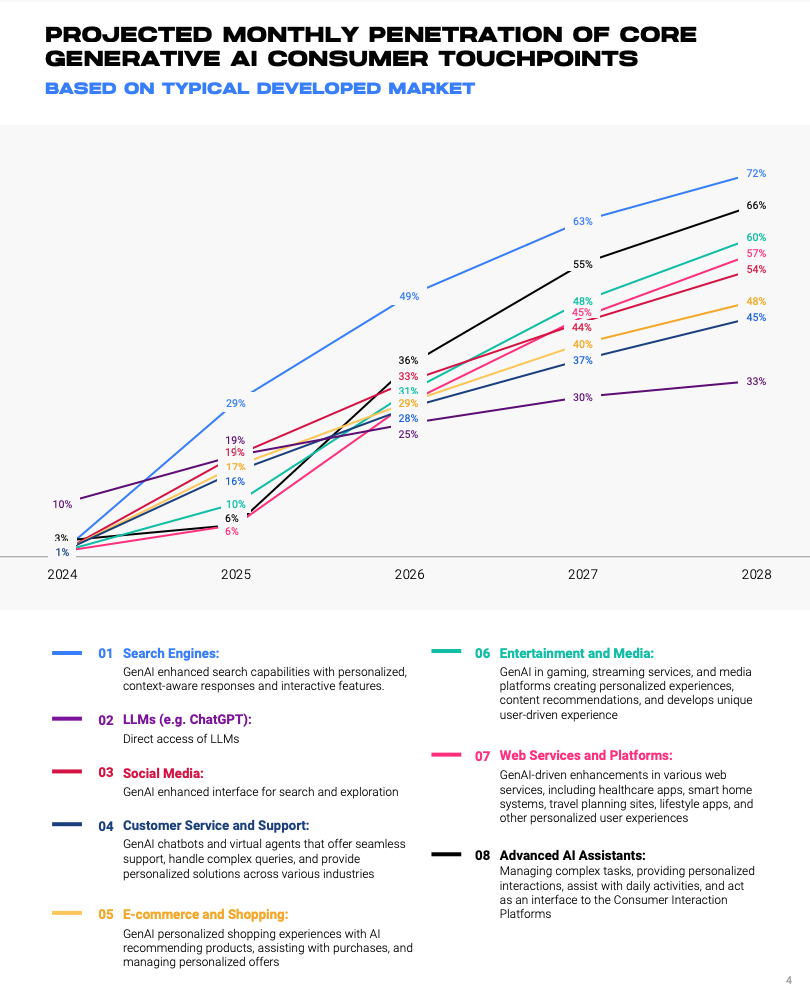
OMG projections led by the awesome JP Edwards (shout out to JP!) published in November demonstrated the huge potential for generative technologies and applications over the next three years. The Coming Wave: Generative AI (Gen AI) report projected the growth of core Gen AI services in a typical developed market from 2024 to 2028. Using expert predictions, it analysed current penetration rates, identified growth potential, and forecast key inflection points where market forces accelerate adoption.

Source: OMG’s ‘The Coming Wave: Predicted Penetration of GenAI Development 2024-2028’ Report – available to download here

This is the real game – and what Super Bowl LIX’s ads demonstrated was just how intense the competition is. My prediction is that whilst this year the models (Gemini, ChatGPT, Llama, Perplexity) took centre stage – by the start of 2026 we’ll be 12 months further into the Cambrian explosion of new utility now underway.

Expect next year’s Superbowl to be full to the brim not of the models, but new and emerging products and services vying for our adoption and usage. The question for brands and marketers won’t be just how they use AI – it’s how they will stand out in an AI-saturated world. Super Bowl LX won’t be about who has AI; it’ll be about who wields it best.

Buckle up people, we’re just getting started.

Standard
advertising, celebrating, community-building, innovating, marketing, responding

The five-point Covid-19 Response Playbook; according to the awesome Aesop’s Bangkok

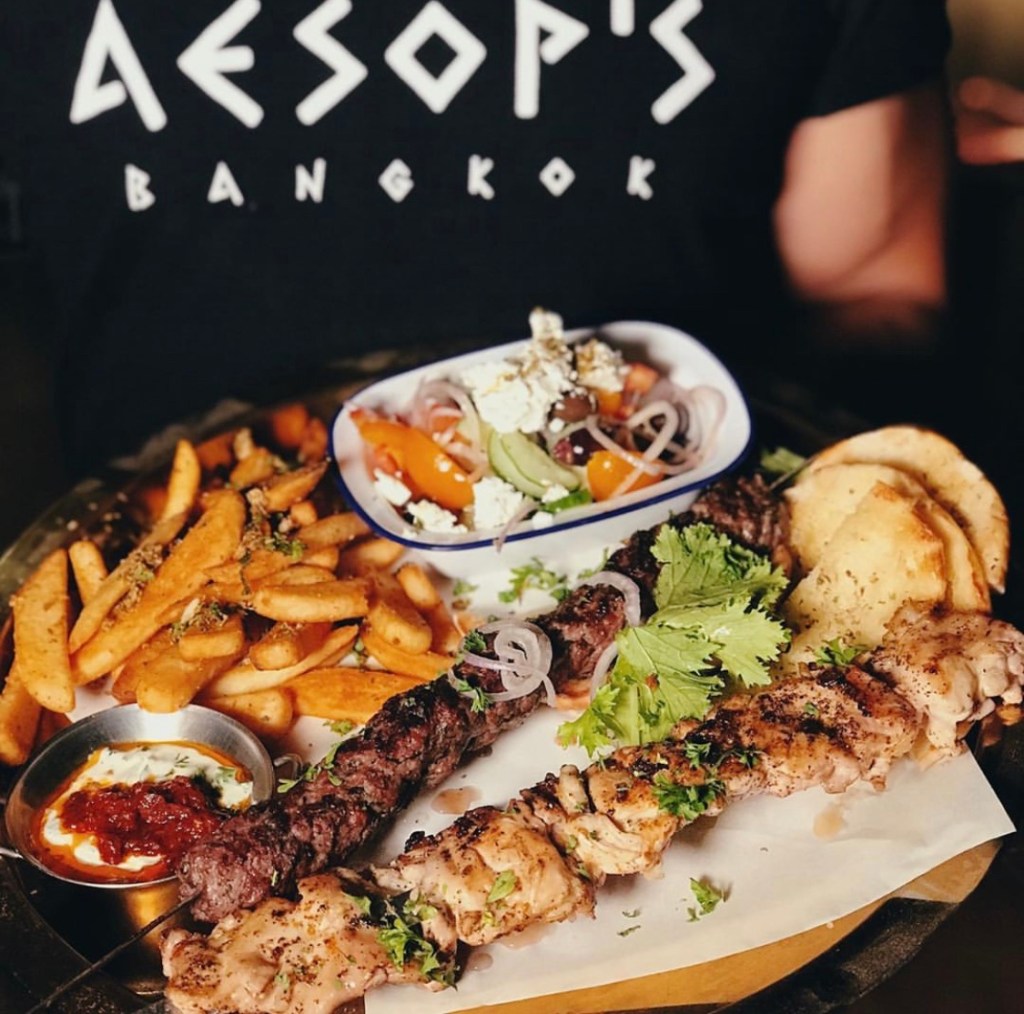
Back in the olden days when we used to get on aeroplanes and visit other countries, one of my favourite places to drop by was the awesome Aesop’s Greek restaurant in Bangkok’s Sathorn district.

The food is just the best, but so is the atmosphere, with owner (and PHD alumnus) John Gamvros, creating a shared social space with dancing, plate smashing, parties, quiz nights, and the occasional Queen singalong party (you can see why I didn’t mind stopping by occasionally).

Like many restaurants, Aesop’s Bangkok has been hugely impacted by this year’s pandemic and the shut-downs that have been introduced around the world to slow its spread.

The fall-out from the closures could be devastating to the industry: Forbes reports that – according to a study commissioned by the Independent Restaurant Coalition – the pandemic could force 85% of independent U.S. restaurants to close by the end of the year. Over on this side of the world in Japan, which is weathering the crisis better than many, that figure is reported to be around 20%.

It was most heartening then when I received, via the awesome Heather, a write up on Chope outlining how Aesop’s Bangkok responded to the challenge of Covid-19 – or, as John puts it – the ‘ronacoaster’.

The article outlines the innovative, creative and generous steps John and the team at the restaurant took to adapt and respond to the crisis. A little WhatsApp banter with John later, and I’d seen and heard what I thought was as great a Covid-19 Response Playbook as any that I’d seen.

I present to you then, the five-point Covid-19 Response Playbook – as inspired by the awesome approaches and actions of John and the Aesop’s Bangkok team.

Step One: Pivot and Operationalise, Fast

Like many restaurants, Aesop’s immediately kicked into gear re-launching their delivery product, creating a dedicated consumer-facing channel at orderaesops.com, as well as accelerating their digital marketing effort to support the platform. They also had to work with their staff to re-engineer the menu, change operations and back that up with training.

In the current moment you have to follow more then ever Nick Fury’s observation to The Cap in CA:TWS that you have to “… take the world as it is, not as we’d like it to be.” What do you realistically need to do right now to capitalise on the opportunities and overcome the barriers to driving revenues?

Now delivering Gyros

Step Two: Play To Your Strengths

Rather than reinventing the wheel, the restaurant found a way to deliver the added magical elements that made the Aesop’s dining experience so special. This included, for example, plate smashing. So the team found a way to deliver orders complete with smashable plates, so you can bring the Aesop’s dining experience to life in your own home (you presumably have to do you own in-home clearing up tho too).

Step Three: Do, Don’t Say

Actions really do speak much louder than words right now. The team built trust with the restaurant’s followers by communicating updates directly and regularly on our social media channels, and responding to specific queries and concerns.

The bigger the brand, the harder this is to do of course, but I couldn’t help but think of the contrast between the personal approach and the – much lambasted – generic response from big brands in the early stages of the crisis.

Film from YouTube creator Microsoft Sam’s supercut shows the striking similarities in the ads made in response to the crisis

Step Four: Pay It Forward

Some of the most heartening stories to have emerged from the crisis have been around brands and businesses retooling and responding by paying efforts forward, and Aesop’s were no exception. They partnered with Ramathibodi Hospital to launch Eat it Forward Fridays, providing much needed fuel to the hard working doctors and nurses on duty. For every order received, Aesop’s donates one meal to Ramathibodi hospital to feed the hospital heroes with fresh, healthy Greek food.

Step Five: Be Honest

As John describes: “… it actually takes a lot more work than you’d expect to maintain the same high standards we set in the restaurant. We have overcome it through teamwork, listening to customer feedback, and constantly tweaking things. I have been honest with my customers, I tell them we are on a journey and that we are learning as we go. More often than not they appreciate that honesty and reward it.”

I think most people would agree that we’ve all at times felt out of our depth over the last six months. Being honest with customers (and with each other) about what we are trying to achieve, along with an equally honest assessment of how we are doing in getting there, will be appreciated and rewarded in kind.

Big thanks to Heather for the share, and John and all the team at Aesop’s Bangkok for the inspiration. We’ll stop on by just as soon as we can.

Stay safe everyone.

Standard
advertising, data planning, debating, marketing, opinionating

The Un-Negotiated Contract: How the model changed, and why the fight for access to data and information has never mattered more

this post first appeared on Mumbrella

At some point in the last decade a long-established contract between people, media and brands fundamentally changed. What is gradually and incrementally replacing it is an un-negotiated contract – in which information is the new currency, insights and utility are the new value, and the fight for the control of data -whether you realise it or not – is one in which you are already engaged.

The nature of the contract we’re currently negotiating will have huge implications for consumers, brands, media businesses and governments. Whether its the strategies employed by brands, the deals made in market, or the data that’s shared with our governments – how this emerging contract nets out will affect us all, and is already shaping the industry around us.

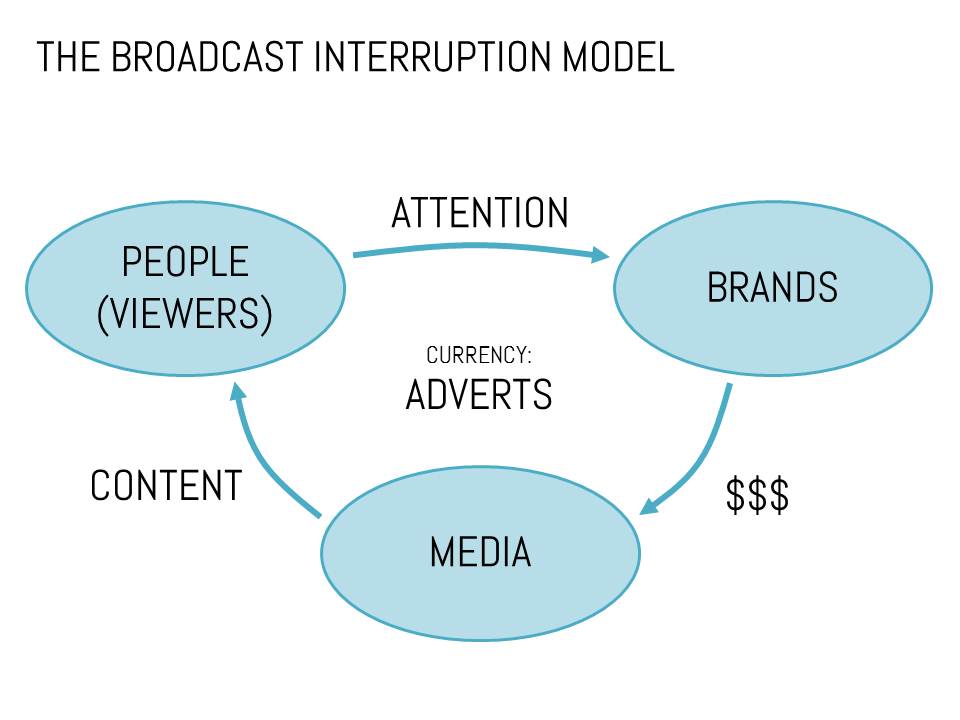
The broadcast interruption model that emerged in the 1950s was a ruthlessly effective and potent means of value exchange. Everyone involved (which was everyone) won. It was ruthlessly simple – brands gave broadcast media dollars which paid for content that people viewed, and which brands interrupted to get people’s attention.

mediation_broadcast_interruption_model

The model was so awesome that it even accommodated channel-neutrality – it worked as well for print and radio as it did for TV, but at some point in the last decade this ruthlessly simple and effective model started to break down. Fragmentation of channels led to fragmented viewing and audiences – necessitating more investment by brands to reach the same number of people. Set-top and on-demand technologies allowed viewers to skip brand messages (although the evidence is that this was largely off-set by higher viewing in PVR households), the internet changed, well, everything … and a new generation of media businesses and brands emerged that weren’t dependent on the broadcast interruption model – or more specifically the currency that drove it.

Because what sat at the heart of that model and the old established contract – its currency – was the ad. Adverts were what media organisations sold, what brands placed and what viewers watched. They were the centre of the contract’s gravity – so much so that the very concept of advertising became synonymous and interchangeable with its most predominant vehicle … the advert.

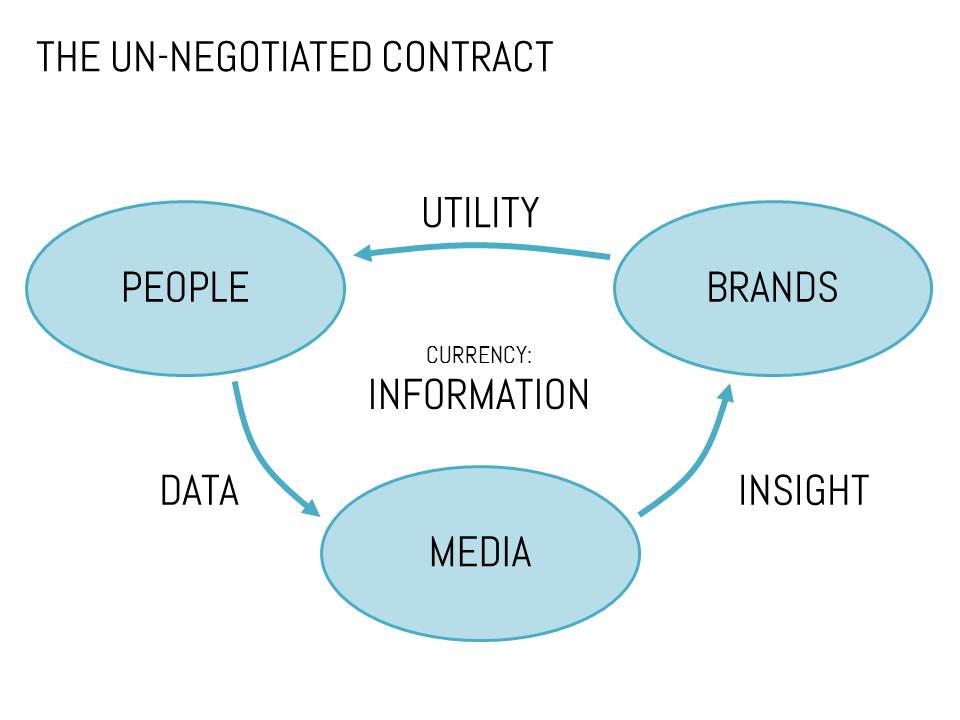
What has tacitly emerged over the last decade has been a fundamental reworking of the relationships between the various participants in the deal – to the extent that I now think we’re working with something that looks more like this:

mediation_unnegotiated_contract

The emergence of new media businesses built on data – rather than broadcast ad interruption – is one of the key drivers of this new as yet un-negotiated contract. Google, Facebook, Twitter are of course the obvious examples but so too are companies like Amazon and Ebay – they revenue-generate based on the data they accumulate, and the insight this subsequently generates for advertisers. Ads are still of course part of the equation but they are no longer the point of the model … rather information is.

Better information allows and enables brands to have better contacts and connections with people … something Will Collin discussed on Mumbrella back in October in a brilliant piece that made the case for a focus on reciprocity in how brands engage people – I’ve called it utility above but the point is the same. It’s about how data and information fuel better brand ideas – ideas that are not only increasingly necessary in our fragmented cluttered world, but which are also proven to generate disproportionate ROI versus optimisation of the channel plan.

So far so nice theory, but so what? Well, what this affords us is a framework to understand the various terms of engagement being played on in what will probably be come to be understood as the data wars. Early skirmishes and alliances in an emerging contract based not on ads, but on information.

New models are emerging between brands, media owners and agencies based on information and data rather than just ads media spend. For example this case of how Twitter data is delivering new targeting capabilities.

Ads are, of course, still in play but data and information is what the new contract is predicated upon. Expand ‘media’ in the above model to include (media) agencies and you understand why the positionings around Audience Management Platforms and audience data are so vital to those involved – its about who controls the insight (and therefore the revenues).

It’s also why brands are (1) increasingly asking why they shouldn’t retain full control and analysis of their own data and (2) why some brands are looking to cut media out all together and go direct to customers (existing or potential) based on the data and information they own. Nike have used this strategy with Fuel, whilst brands like Burberry use a hugely disproportionate amount of their own media to reach people direct. Its also why media businesses now ruthlessly collect and protect first party data, and why the sharing of that data with frememies to match the demand-scale generated by agency groups makes media owners so nervous.

But its between people and the media where the contract is perhaps most vociferously being negotiated. Between Google and the European Courts with legislation that allows people to force Google to delete their data (or at least the links to their information); Facebook’s privacy settings tidy-up was part of this negotiation, as is any site’s publication of it’s cookie and targeting policy.

The other huge players in this part of the negotiation are the telcos (and I include Apple in this bracket) – whose efforts to win the Triple Play wars were awesomely captured by Nic Christensen here last month. This is important for two reasons … first, the Telcos are emerging as some of the biggest accumulators of data – that makes them significant players in the emerging contract and secondly, like the big Bay Area media companies, the data they accumulate can be appropriated by government agencies without our explicit consent.

The fact is that it has been the emergence of this new model, and the concentration of such vast quantities of people’s data into new media businesses and telecoms companies, that has fueled US, UK and other government agencies desire and demand to acquire that data as part of their ambition to ‘master the internet’.

And yet despite all of this the contract remains un-negotiated.

The conversations and debates required to do so are fragmented and diverse, but there are huge implications for brands, agencies and media businesses depending on just how that negotiation pans-out. Who own’s people’s data? Who gets to sell or target and re-target based on that data? How aggressively should and could brands pursue collection of their own customer data? Should it be made more explicit that someone’s data is being captured for advertising or targeting purposes?

To be absolutely clear, it is my opinion that this new contract is an eminently good thing. It is the emergent data and information-based value model that has given all of us access to search, social media, online marketplaces, and a world of information, education and entertainment.

What the contract promises is awesome – but to deliver, it must first be negotiated.

Standard
advertising, branding, storytelling

What’s your Story?: a tale of two narratives, and a big lesson in the power of narrative via Jamie Oliver and Thank You Group

ah the power of the story.

take the above. a video from Thank You – an organisation that, on discovering that 900 million people didn’t have access to safe drinking water, came up with a bold idea to create a bottled water company that would exist for the sole purpose of funding safe water projects in developing nations.

that was 2008. and now, having diversified into muesli and body care products, an organisation faced with the job of communicating that change to new and potential customers. the solution … not the best video ever made, but a genuinely authentic, honest and transparent one. real people in a real situation with a little novelty, script and editing thrown in.

it comes only a week after B&T reported that struggling Aussie vegetable farmers were ‘pleading’ with Jamie Oliver to intervene on their behalf and encourage Woolies to refund the marketing levy they were being charged to fund his ad campaign for the supermarket.

where do you start? no really … the dominance of the supermarket oligopoly? the David and Goliath struggle of growers and distributors? the relevance of the UK-based Oliver (who is awesome and who has done genuinely amazing things for healthy eating efforts) in all of this? the scale of paid versus the engagement and authenticity of earned media?

well I guess like any good story you start at the beginning …

once upon at time there was the story. we told stories that saved our ancestors from being trampled by wildebeest or running off of a cliff. then our stories took on moral and ethical dimensions, they passed on information and knowledge and created archetypes to which we still relate.

… our stories became assimilated by nation states and groups of individuals to describe and define identity. they communicated our struggles and challenges and victories and journeys, on every media, in every society and community on the planet. language was our first technology, and communication – of our hopes, fears and ideas – has become a defining factor of the human condition.

and so we arrive at two very different brand and marketing stories, the dissection and evaluation of which is less important than the lesson their juxtaposition invites: stories are ancient, powerful, emotional and transformative things,

… make sure you’re part of a good one.

Standard
advertising, storytelling

Of BBQs, Basting and Bears: Lessons in the power of multi-channel storytelling from this year’s crop of festive campaigns

this week on the Addington Bugle-sponsored PHDcast we talk the future of retail and Christmas ads. obviously. it being five weeks(ish) out from the big day thoughts turn to Santa’s sack, goodwill amongst people, and GRPs – after all who wouldn’t want a healthy carryover of adstock into the week before Christmas.

and so it came to pass that this was the week that Aussie retailers launched the slings and arrows of their Chrimbo adverts. first up we have Coles and Woolies going head to head with Curtis Stone basting food porn in the red corner, and in the green corner newcomer Jamie Oliver throwing a BBQ for Aussies in London (a deliberate choice of location we’re sure).

meanwhile the department stores give us the art of giving from Myer and, well, I’m not sure what from David Jones (B&T go with ‘a DJ’s branded Christmas cracker exploding to reveal a colourful array of gifts’, which is good enough for me).

http://www.youtube.com/watch?v=Z45jy6I8jI0

of course the daddy of Christmas ads is John Lewis, who (as you’ll already know as the YouTube video is past 6.1m views already) this year unleashed a Lily Allen soundtracked Disney-inspired tale of the Bear who gets woken by a Hare for Christmas.

http://www.youtube.com/watch?v=XqWig2WARb0

its amazing. of course. but where John Lewis genuinely stands out is not the creative solution, but the media infrastructure build around their story. the Lily Allen soundtrack (which has the chance of keeping a reality-TV winner off the Chrimbo #1 spot), the interactive eBook narrated by Lauren Laverne, the digital Christmas card maker, and of course activation of the ideas in stores … all add up to a genuinely integrated effort to deploy a story into the pre-Christmas season rather than just an ad.

its a valuable and timely lesson in the power of story; told elegantly, across multiple platforms, both broadcast and demanded, which stretches from awareness and salience all the way through to retail engagement – and all without a hero product shot in sight.

Standard
advertising, branding, commenting, content creating, marketing, planning

From ZERO to Hero: its Joseph Jaffe versus the world as he shares his theory on surviving the Mediocalypse

“In a perfect world, the optimal paid media would be zero”

and there you have it. in sixteen short syllables Joseph Jaffe yesterday laid the gauntlet to, well, everyone.

in a Mumbrella Hangout with Tim and Nick, Jaffe took aim and didn’t hesitate in pulling the trigger as he took on the concept of paid media, it’s media agency proponents, media owner benefactors and client conspirators – all of whom are collectively woefully unprepared for the coming mediocalypse (that last word is totes all mine fyi).

Jaffe’s alternative vision is ZERO – a word that serves the dual purpose of being, in Jaffe’s opinion, the target investment a brand should make in paid media … and also an acronym for the elements that make up Jaffe’s counter theory … Zealots, Entrepreneurship, Retention and Owned assets (not media).

to say all this is brand new territory would be a stretch, but to say that it’s rarely been delivered with such zeal is not. Jaffe gleefully takes on Sorrell (“self-serving”), media owners (“complacency and mediocrity are not causes to be able to keep your job. being also to achieve … objectives and demonstrate proven value-add and utility and return on investment is a cause to keep your job”) and clients (“morons”). by the time Clive Burcham of The Conscience Organisation joins the conversation the platform is well and truly burning and we may as well all just run for the hills.

it’s easy to line up against Jaffe’s argument and theory: Ehrenberg Bass’ analysis would tackle the importance of Zealots, Entrepreneurship doesn’t offer the guarantee of exposure, success and ultimately growth that shareholders demand of businesses; on ‘Retention is the new Acquisition’ you can pick your counter-play, and there’s no client worth their salt that hasn’t developed and deployed an Owned asset strategy and plan. but here’s the thing … Jaffe is right.

the 30 second-shaped solution is to predominant. the ad venture is coming to an end. agencies and clients aren’t co-conspiring to create sufficient entrepreneurship and innovation. media is commoditised, and media thinking is undervalued. clients customers have become more important than their consumers, and despite billions of dollars of effort the scarcest commodity in the world remains human attention.

run for the hills indeed.

but despite Jaffe’s verging into hubris, he offers some wonderfully salient and sensible advice. his assertion that “the vision of ZERO is to move from being a tenant to a landlord” is a nicely articulated vision for how brands should increasingly approach their media planning; the idea of a “customer-employee ecosystem empowered by technology” makes total sense; that we should be advising our clients on how to redress the balance of their direct to indirect (media) investment is absolutely right; and to ask “why are we paying for attention, when we should be paying attention” is good enough to put on the t-shirt (should that be your inclination).

whatever side of the debate you’re on, you can’t deny that our negotiation of media’s future is the better for having Jaffe’s voice in the chorus. there will be heroes and outlaws aplenty in the coming mediocalypse, which one Jaffe turns out to be will be decided first by your perspective, and then by history.

PS if you want to skip to a couple of highlights in the above video jump to 13:17 to hear Tim deploy Nick to search for someone who has tattooed toilet paper onto themselves with the immortal words “Nick, to the Google …” or 13:44 to see’s Tim‘s earnest nodding and eyebrow raise at the news of Charmin’s acquisition of website ‘sit or squat’

Standard
advertising, broadcasting, marketing, mediating, opinionating, television

The Myopia of the 2020 Vision: Why we need a whole load more rational when we debate the merits of Television

Think TV, a marketing initiative of Free TV Australia (the body representing all of Australia’s free-to-air metropolitan and regional commercial television broadcasters), have released the latest in their 2020 Vision series. the episode – the first of series three – see’s industry heavy-weights including Jeff Goodby (Goodby, Silverstein and Partners) and Sir John Hegarty (BBH) discuss (in Think TV’s words) “the importance of broadcasting powerful, mass reaching, messages that connect with audiences”.

its a curious beast. but then communications about communications are always the most interesting of creatures … on the surface this is a straight-forward and very well produced piece of content which talks-up the role and power of TV. but take a closer look and a rather all-too defensive agenda emerges:

some highlights:

TV is till 60% of what we buy because it absolutely is the best place to be able to tell stories and connect people with your brand” … “we try to use video and television as a way to understand our customer … television is the only place you can do that” Kevin Mayer (Volkswagen of America Inc)

“the use of television is fundamental in telling a brand story and engaging with the audience in an intriguing and interesting way” Sir John Hegarty

“the great thing about TV … is that it allows you to go around the rational objections to a product … you have to find another emotional road to take people along so that they don’t think about the rational stuff anymore” Jeff Goodby

“if you’ve got the funding to do an ad, [TV is] still the one place you can get the biggest change in perception and appeal for your brand” Kevin Mayer

“there are two things brands have to do; they have to persuade and then they have to promote. digital technology has been brilliant at promotion, but if you’re not out there persuading, you’re not growing your brand … now, you can only do that with broadcast, because you don’t ultimately know where your audience is going to come from” Sir John Hegarty

“advertising expenditure globally is about $500bn a year. about $200bn of that goes on television. now, end of argument, alright?” Sir John Hegarty

“most of the money my clients spend is still on TV. I know that its very popular to think otherwise and go, you know, ‘what’s going on out there, there must be new things that we should be spending money on’ … and we end up spending on TV, just because it turns out to be the way to start something, the way to keep something going, the way to chance people’s minds” Jeff Goodby

“actually the internet kind of operates as an afterthought of the best TV commercials … people run to the internet to talk about them” Jeff Goodby

“as television evolves and becomes more targeted, I think you’re going to see an influx of dollars back into television because now you’re going to have efficiency and you’re going to have scale, and that’s where I think television is going to really see its second coming” Kevin Mayer

“we’re emotional creatures, and television is an emotional medium … it’s the most powerful selling tool advertisers have ever had at their disposal, and that ain’t changing – not for the foreseeable future” Sir John Hegarty

to say that some of those statements are subjective in the extreme is perhaps a bit of an understatement, and you could argue that’s fine if the piece was presenting itself as the subjective opinions of very respected industry professionals … but its not; Think TV’s description of the piece is “forward-thinking industry professionals reveal how television is rising to meet new marketing challenges with great success” (source) … which I actually think gets us into rather dangerous territory … because the success is pretty much ‘people saw my ad’, or ‘we emotionally engaged people’ or ‘lot’s of people spend lots of money on TV so it must work, alright’ …

now it’s easy to say that it’s “just a piece of video” or conversely that “these are the opinions of respected, and very successful, advertising men”, but don’t forget for a second this is just one grenade in an ongoing battle for communications revenues. this is about where brands invest marketing dollars – budgets that are increasingly under scrutiny by the companies that invest that money. and we’re not talking about spare change … the video’s own stats point out that $200bn is spent on TV – I think we’re going to have to do a little better to justify that than because television is “an emotional medium”.

it perhaps is no co-incidence that we receive this gem in the same week that online ad revenues overtook those for free-to-air TV. according to a report by the PwC for the AIB, (available to subscribers here), for the first six months of 2013 our industry in Australia invested $1,883m in online versus $1,805m investment in FTA TV.

the size of your spend isn’t of course everything. but it does count for a lot.

I like television. as a planner I value the role television can play in a plan. it delivers reach, often cost-effectively, and it delivers that scale quickly. and whilst, unlike Kevin Mayer, I probably wouldn’t describe the future of television as a “second coming”, I am excited by the opportunities that critical mass in connected TVs will bring.

but there’s a dangerous myopia in this 2020 Vision. statements like “digital technology has been brilliant at promotion, but if you’re not out there persuading, you’re not growing your brand” (Hegarty) or “the internet kind of operates as an afterthought” Goodby, do far less for TV’s case than embracing and exploring – say – the possibilities presented by digital storytelling and how they will be possible, with scale, in 2020 would have achieved.

a very wise man once told be to never let my strategy show. so when a video selling the benefits of TV says that “the great thing about TV … is that it allows you to go around the rational objections to a product … so that they don’t think about the rational stuff anymore” … I wonder whether we don’t need a whole load more rational as we mediate this ongoing debate.

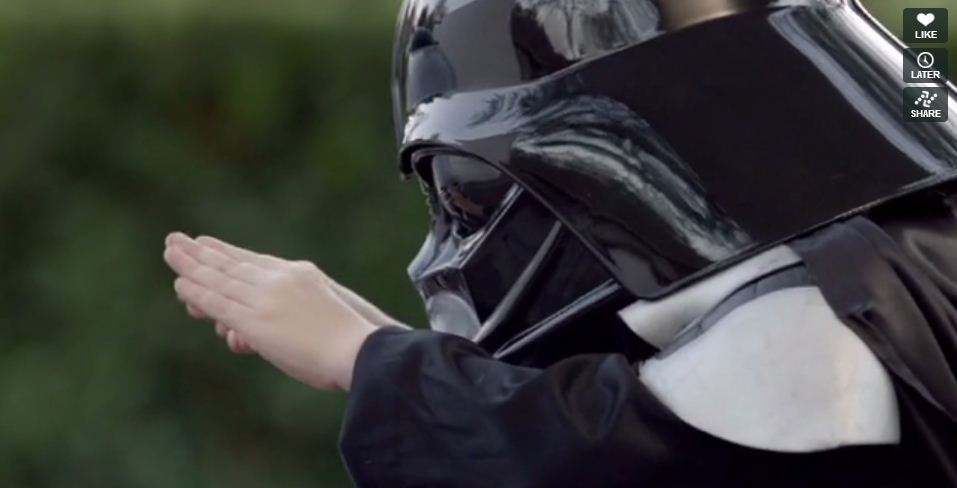
featured image is a still from the above video of Volkswagen’s Darth Vader spot in Super Bowl XLV

Standard
advertising, campaigning, integrating, voting

Calling to Action: What Australian Political Parties can learn from Marmite

so in this week’s PHDcast we’re talking Aussie election, which kicked off (officially) this week with a deluge of media and collateral, including these two efforts from the two leading parties, Labor offer us a New Way:

whilst the Liberals are offering us a New Hope:

http://www.youtube.com/watch?v=nk0E3lyx4EU

there will no doubt be other places and spaces where the ads themselves get debated and dissected, and aside from the observation that naming an election slogan after Star Wars Episode IV is just plain awesome, we’ll leave all that to one side for the moment.

there is one difference between the two ads though that I think is important. it’s a really subtle but I think significant difference in the dying moments of each. quite simply one has an embedded call to action and one doesn’t.

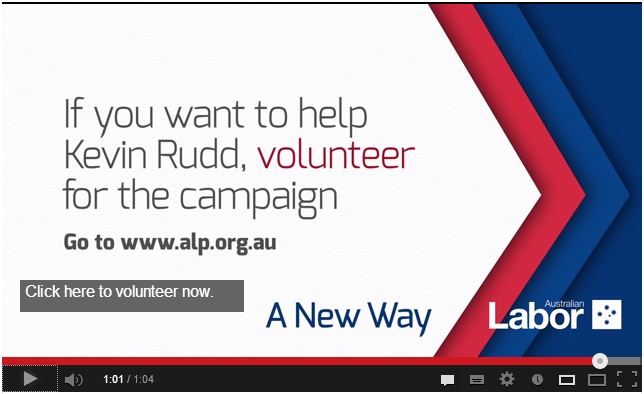
help_kevin

Labor’s video has not just a specific call to action in the copy, but an embedded ‘click to volunteer’ button in the video.

in the podcast, Stew (who anchored magnificently) asked me for the advice I would give the comms teams in the election, I commented that at the moment there isn’t one communications strategy, there are several (broadcast, social etc).

the big opportunity it seems to me is to join the dots … and identify very specific roles for comms, with all roads leading to getting people to act … if people act early, cognitive dissonance will kick in and people will act to maintain consistency with their perceived beliefs when they get into the booth.

that the Labor ad gets that its not just an ad may seem to be a simple and indeed obvious distinction, but its a simple and obvious distinction that its Liberal counterpart – nor a great many commercial brands for that matter – grasp. which brings us of course to Marmite, who this week unleashed this awesome little gem:

http://www.youtube.com/watch?v=mHjssdNNzP0

the predictable and ridiculous backlash has fortunately been met with a truckload of praise for the ad … but the sheer entertainment value that the ad provides aside, the communication is a gold-standard example of two really important aspects.

one, it doesn’t take too much pondering to work out that there is a very specific business issue being tackled here. the team have clearly done their homework and gone beyond ‘consideration’ or ‘like-ability’ to identify a specific issue that they’ve gone on to tackle head on.

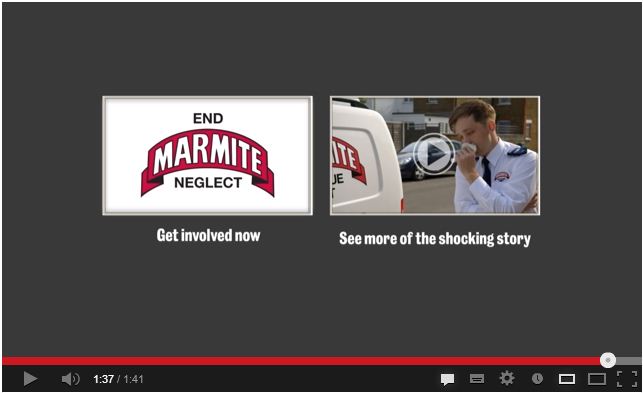
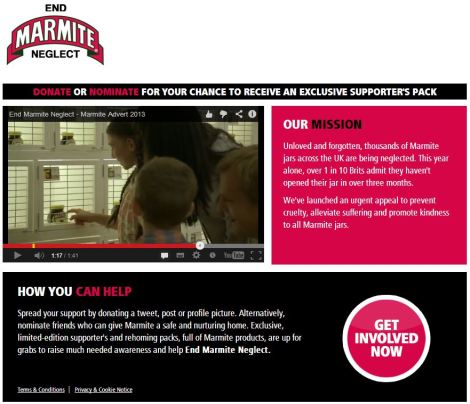
two – and this is where I’m making the tenuous link to Australian politics (because its my blog so I can) – there’s a clear and integrated call to action strategy. the video ends with a clear call to action that is an integrated and consistent extension of the creative construct of the ad:

marmite_cta

this then takes you through to an owned-media platform from where you can interact to your heart’s content:

marmite_cta_2

there’s one last aspect for both of these that I think bears repeating, and that’s the importance of cognitive dissonance – the first fundamental assumption of which is that “we all recognize, at some level, when we are acting in a way that is inconsistent with our beliefs / attitudes / opinions. In effect, there is a built in alarm that goes off when we notice such an inconsistency, whether we like it or not. For example, if you have a belief that it is wrong to cheat, yet you find yourself cheating on a test, you will notice and be affected by this inconsistency.” (source)

the really smart opportunity is that by getting people to act within a communications content (for a brand or a political party), you potentially establish and crystallise such a belief / attitude / opinion. when people subsequently come to a supermarket shelf or a polling booth they will – according to the theory – be more inclined to behave in a way that is consistent with said belief.

in short … a integrated, powerful and engaging call to action, far from being the tick-box exercise at the end of the ad, can be the linchpin of the whole communications operation. given the choice, you’ve got to love that.

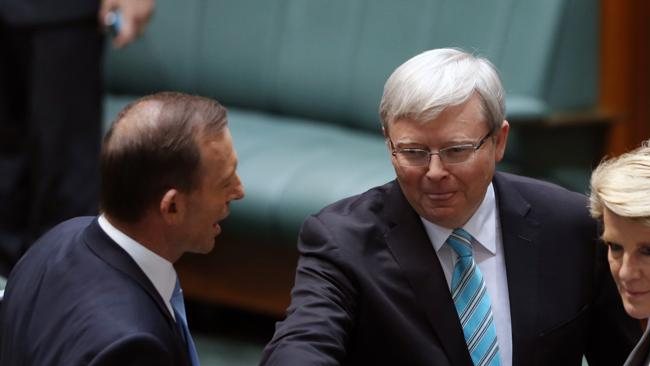
featured image via Herald Sun

Standard