option A: partner with a major TV network to secure access to the biggest pop group in the world and give customers the chance to win tickets to an exclusive extra show. communicate this through the competition’s own dedicated website, hashtag, and social media, supported by print, broadcast and PR.
option B: make a 90 second TV ad that talks about, well, I’m not sure exactly … but I think, the value of time?
it may be harsh to call this an abject lesson in new versus traditional media thinking, but this really is an abject lesson in new versus traditional media thinking. and just in case anyone is looking for a (far from exhaustive) checklist, here it is:
create new news (don’t assume people care)
integrated the channel approach (not single broadcast solution)
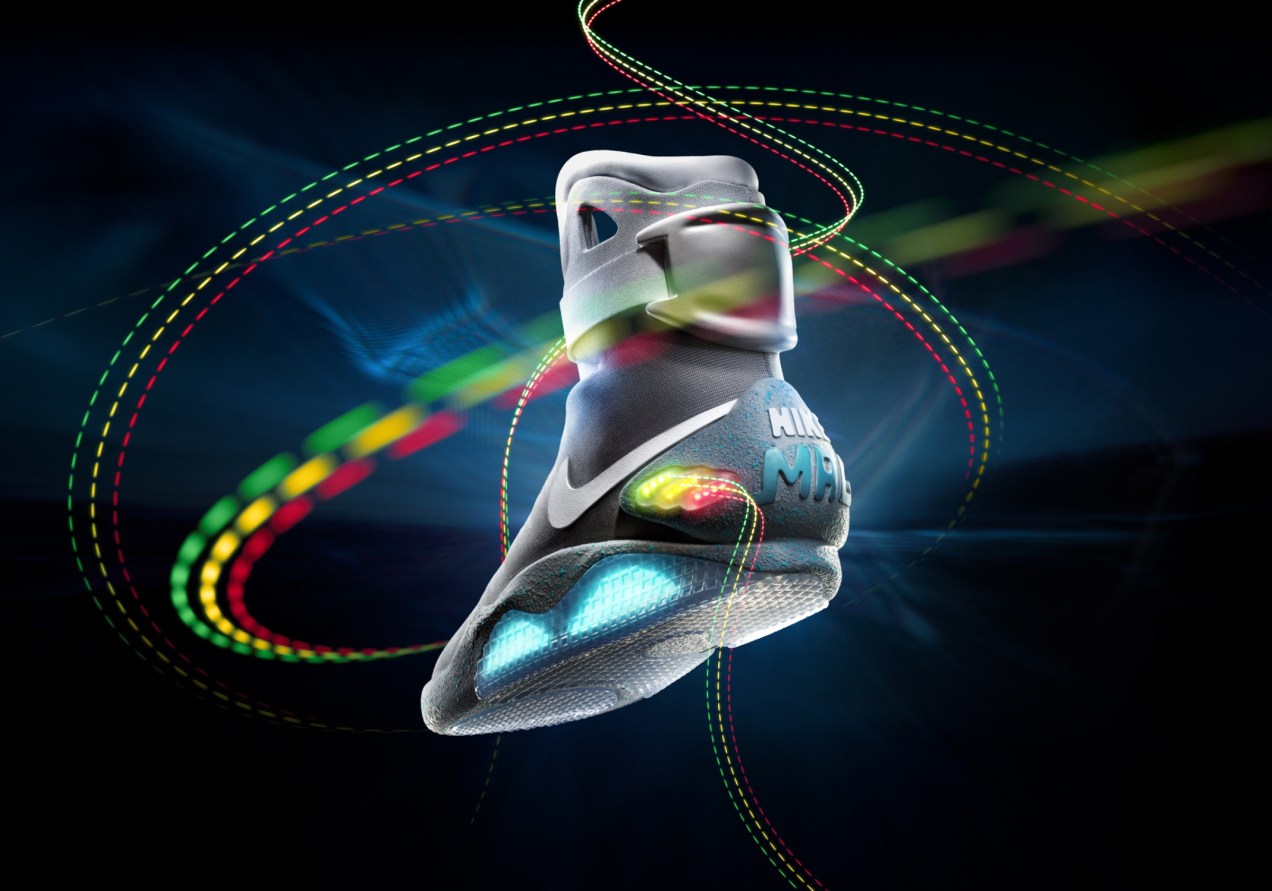
“Back To The Future Nike Air Mags Are Real And Glorious” was Gizmodo’s Geek Out’s take on today’s news. I couldn’t agree more
the world was awake, and had been alerted to the existence of The MAG, brought Back From The Future by Nike. as a post on Nike’s site explains:
“The NIKE MAG is no longer the “greatest shoe never made.” The mythical shoe that originally captured the imagination of audiences in Back to the Future II is being released – and they’re here to help create a future without Parkinson’s disease … 1,500 pairs of the 2011 NIKE MAG will be auctioned on eBay with all net proceeds going directly to The Michael J. Fox Foundation. Each day for the duration of the ten-day auction, one hundred and fifty pairs of the 2011 NIKE MAG shoes will be made available …”
as sneaks go it’s a stunning piece of work and – with the exception of power laces – is as fine a replica of Marty’s originals that you’ll find:
then and now – Marty’s original 2015 sneaks and the ones revealed today
it arrived with this beautiful teaser clip:
a clip which isn’t alone … a gamut of content and AV collateral has been released to support the arrival of the 1,500 pairs, and not a corner has been cut – Doc Brown himself is on board:
the distribution model is designed to extract maximum value from the shoes. by selling on Ebay, Nike ensure that – with such a strictly limited supply (there’s one pair for every 4.5 million people on the planet) – it doesn’t just find those individuals with the money to invest in these puppies, but engages those individuals in what is sure to be a fierce bidding war, with each other, to own their slice of the impossible.
everyone wins.
those of us who have been waiting since 1989 for “the greatest shoe never made” to arrive finally get to see it. a lucky few will even get to own it. the Michael J Fox Foundation for Parkinson’s Research will get a shedload of money to fight Parkinson’s (even if the average selling price is a conservative $5,000, the MAGs will generate over $7.5m in revenue).
Ebay get a burst of activity on their platform, part of which will no doubt fulfill the hugely valuable role of getting inactive registered users to engage with the site. and as for Nike … money can’t buy publicity, the adoration of sneaker fans everywhere, and a global bidding war to get a hold of their product…
winners all round – The Michael J Fox Foundation for Parkinson’s Research, Ebay and Nike
as marketing efforts go, its textbook best practice:
innovate and invest in creating products that have currency and will be in high demand
strictly limit supply
fewer bigger better partnerships to deliver and deploy the initiative
invest in credibility (Christopher Lloyd is in the ad for goodness sake)
sacrifice profits in favour of positive PR and goodwill
don’t buy media when you can earn it
invest in sharable high quality content
rigorously control timing to maximise interest and dominate news and conversation
product out, not advertising in
the awesomeness of these shoes is outdone only by the awesomeness of the marketing machine that has announced them to the world. what happens over the next ten days remains to be seen, but for now its all eyes on Ebay – where, only 4 1/2 hours into day one’s auction, bids for every pair of size 9s are sitting at between $3,500 and $4,000.
The more you tighten your grip, Woolies and Coles, the more brands will slip through your fingers
my return from a rather long winter blogging break has been greeted with the glad tidings that some brands have finally chosen to take a stand against the big two Australian supermarkets. Adnews reports today that Glenn Cooper, boss of Coopers Brewery has described Coles and Woolies as being the "killers of Aussie brands". Cooper went further:
“Blatantly, Coles and Woolworths are not brand builders, they are brand destroyers … it’s harsh, but they are not about building brands, they are just about turning over quickly.”
SMH only last week reported that this is an opinion recently echoed by no less than Heinz' chief financial officer and executive vice-president Arthur Winkleblack. in a briefing to US analysts on the company's first-quarter earnings, Winkleblack specifically name-checked the Australian supermarket sector and blamed them for an erosion of its margins. sentiments echoed by Heinz' chairman and chief executive Bill Johnson:
''There is no doubt that in terms of retail environment, the Australian market is the worst market, and ultimately the people that will pay the price over there are the consumers because products will ultimately be devalued to address the price points that customers are asking us to address … So the consumer is going to ultimately be the big loser in Australia.''
the supermarket's argument is manifold and includes the rationale that this is all in consumers' interest – a Coles spokesman, in response to Winkleblack's comments, stated that "We agree with Heinz's comments that companies need to be competitive to ensure the best outcomes for customers."
but consumers don't benefit from Supermarket competition. the concensus of an April opinion piece in the Sydney Morning Herald was that consumers – if they see any benefit at all – see it only in the short term. Academic Angela Paladino commented that:
"Price wars squeeze out marginal players and change the composition of the market. Here fewer competitors seek to enter an unattractive market that is dependent on low price for success, and smaller competitors exit the market as a result of the inability to make a profit. Others may be taken over, for example the 2009 acquisition of Macro Foods by Woolworths. This has a long-term impact on consumer choice, with shoppers left in a market comprised of fewer players with greater power."
Nick Stance, Chief Executive of Choice agreed:
"The market shares of Coles and Woolworths allow them to negotiate hard with their supply chain. In fact many suppliers report they have little choice but to accept terms offered even if that makes their business barely viable … Sometimes the benefit of lower costs is passed on to the consumer through promotions, but promotions are temporary and do not in themselves create sustainable competition … The ''price war'' is a phoney conflict, not least because the big players usually match each others' prices."
there are only two winners in Coles and Woolies' Store Wars; and that's Coles and Woolies. brands have and continue to exist at the mercy of these distribution Death Stars. now Coopers and Heinz have come out of the supermarket closet. it's just two brands. but that's two more brands than a few months ago.
Coopers and Heinz's coming out is important. brands standing up to Coles and Woolies is important, because the dominance of Coles and Woolies is hurting brands … not least in expectations of media investment…
I've sat in more meetings that I care to recall where there have been two invisible seats at the table. in discussions where the spectre of supermarket's expectations for media investment loom large over marketers, marketers dependent on these two Death Stars for significant – and often increasing – distrutions volumes.
it's a sweeping generalisation to say that Australian brands are too dependent on the broadcast interruption model (of which TV spot advertising is the main solution) for their marketing needs. never-the-less its a generalisation that I believe is true. a reliance on this 20th Century marketing model isn't just down to the pressures and expectations of Coles and Woolies on media spends, but they sure as hell play a very significant part: too many brands over-invest in broadcast interruption because its what supermarkets want and expect to see on those brands' media schedules. supermarkets' expectations are holding back brands' media innovation potential.
but the effect and influence isn't limited to consequences above-the-line (a term which I hate but I'll run with anyway). prices are down. great. but its not the supermarkets funding this price decrease – it's brands. manufacturers are paying for prices to be down with their below-the-line (ditto) budgets. and because prices are down for good manufacturers will be paying for them to be down … for good.
The Order of Coopers – owned and earned media curating a community for the brand
what is phenomenal in this context are the levels of innovation that do get out of markets and agencies' doors and into the world. despite the vast majority of bought media investment being diverted to an outdated (and actually never that well proven model), Coopers – for example – have built a hugely utilised online site and community. they are investing in owned and earned media that are building a community with direct links to their brand and business that side-steps the supermarkets' Death Stars.
brands, it would seem, are starting to have had enough. the Supermarket's weaponary have become simply too powerful to ignore. to paraphrase Senator Organa, 'the more you tighten your grip Coles and Woolies, the more brands will slip through your fingers'.
the rebellion, I very much hope, has begun.
full disclosure: I work as a media strategist for several brands that have distribution through Coles and Woolworths in Australia. the above comments reflect my, and my opinions alone. the advice and recommendations I make to brands take these – as well as other – opinions and considerations into account.
Yoruba ceremonial drums, Nigeria. picture from here.
so the lovely Emily got for me a signed copy James Gleick's The Information for my birthday (thanks Emily) and whilst I'm only a couple of chapters in, its already proving to be a bit of a treasure trove. the first chapter discusses the African Drums. when 18th Century Europeans first heard the drums, they had no idea that they were conveying information. yet the drumbeats contained detailed and what seemed to be superfluous information.
"Instead of "don't be afraid," they would say, "Bring your heart back down out of your mouth, your heart out of your mouth, get it back down from there" … the drums generated fountains of oratory"
the explanation for the elaboration is fascinating.
"in mapping the spoken language to the drum language, information was lost. the drum talk was speech with a deficit … the drum language began with the spoken word and shed the consonants and vowels. that was a lot to lose … consequently … a drummer would invariably add "a little phrase" to each short word. Songe, the moon, is rendered as songe li tange la manga – "the moon looks down at the earth" … the extra drumbeats, far from being extraneous, provide context"
James Gleick, The Information, Chapter One
there's a beautiful parallel with the world and brands and communication. the moments in which brands connect with people are fleeting and becoming more so. there is a very narrow opportunity in which a marketer can convey information. messages need context, and brands provide it.
so rather than someone hearing "we make cars" (the message) they hear "we make Jeeps" (the branded message). this context takes the message from a simple "this is what we do" to a more richly imbued communication embodying all the associations someone recalls when they hear "Jeep's cars".
this context is crucial … "we make cars", becomes:
we make Jeeps
we make Toyotas
we make Hondas
it's a useful thinking framework – to separate the context and the content. marketers work in challenging times. the potential opportunities to make meaningful connections with people have never been greater; but with opportunity has come complexity. how are communications cutting-through? how to create the most distinctiveness in market? how and when to engage audiences through media beyond which that I buy?
separating context and content helps to address some of those challenges.
creation of context is the creation of brand meaning. what does my brand stand for? why does it exist? what are the associations I want to create (or reinforce) when someone recalls my brand. this is a long-term process, and it's contribution to a brand's business not always easily measurable. but it's crucially important context – and the marketer is responsible for continuously creating it.
creation of content is the creation of the message. we're having a sale this weekend. new model now available. we've improved our fuel efficiency. the role of content is to influence and stimulate an action or a response. these are shorter term, and the extent to which they permeate and become salient in market are very measurable. they can also be spread with huge efficiency by media other than that which is bought.
separating these two elements helps navigate increasingly complex waters. how can I – as marketer – create context for my brand? a context unhindered by the need for immediate ROI in market. what platforms (through owned media) can I create to hold and communicate this context?
…and how can I efficiently and effectively deploy my messages into market? how can I inspire and encourage people to pass-on that message on my and their behalf?
the combination, like the African drums, are simple messages imbued with the richest of context … so that the content is un-mistakenly attributed to its brand. the add the pieces together you first have to separate them.
which brings us, of course, to Harry Potter – and this week's announcement that the upcoming Deathly Hallows Part 2 won't be the end of the Potter franchise.
Potter as brand is now established. seven books and eight movies have communicated the narrative and its characters, all of whom are now familiar memes in our culture. like Star Wars before it, Potter – because of the human stories it tells – is now firmly embedded in the popular psyche. but context and content have hereto been one and the same; the experience absolutely binding the two together. books and movies as one-directional communication of story. around this controlled narrative a user-generated culture arose, but it never penetrated back into nor influenced the context or content coming from JKR, Bloomsbury and Warner Bros.
that's about to change. Potter is about to undergo a context content split.
Potter as a brand is now evolving to have two distinct streams. the context will continue to be provided by JKR and co. both the ideological: what are the rules and conventions of the Harry Potter universe? and the physical: in the form of the Pottermore owned-media platform (which will also be the sales platform for HP eBooks).
but content will now, for the first time, be created by JKR and anyone else with the passion and energy to contribute. the long-term building of the Potter brand co-existing but separate to the short-term creation of Potter content.
the evolution is already apparant … the above announcement inviting and teasing its audience to "follow the owl" – an ARG element signalling a shift in the Potter brand to one that is co-created, crowdscourced and owned by everyone.
Groupons new ad … geotargeted realtime promotions never sounded so straight-forward
Priscilla, who sends tweets from @thoughtcloud, (thanks Priscilla) pointed me in the direction the above video from Groupon, which – as she neatly points out – can be described as mobile + scheduled coupons + mobile micropayments = awesomeness.
the whole proposition, of aggregating local promotions which are geotargeted and delivered in realtime, is in many ways the culmination of a host of recent developments in the mobile space… a culmination that Groupon – with a view to IPOness – are keen to amplify as much as possible. it's for perhaps this reason that the company – which has been built from a connections perspective hereto on peer-demanded communications and word of mouth, has put together … an ad.
both regular readers will be familiar with this blog's attitude towards 'the ad' – that 20th Century invention which came to be synonymous with advertising. our continued reliance on the broadcast interruption model that forms the media basis for adverts remains one of the key limiting factors in brands and marketers embracing a communications age of user-centricity, community and utility.
but Groupon's effort is perhaps a reminder that 'the ad' does have it's place in a 21st Century communications ecosystem. I can't imagine a neater or more compelling way to communicate realtime geotargeted promotions and offers… a simple, neat encapsulation of a message and a reminder of what made 'the ad' so predominant in 20th Century marketing communications.
and Groupon aren't alone. Starbucks have for several years now adopted a community and reward-based marketing approach. this blog noted in April 2009 that Starbucks were offering free syrup shots for life when you signed up to a Starbucks Card … why? because – and this was a direct paraphrase from the Bucks' call centre – the brand was looking to what it could, given the (then) current economic climate, for its existing customers.
the last two years have seen a plethora of offers and bonuses for existing customers be deployed in store. all of which are communicated on regular emails that I'm happy to receive. like this one that I got today…
one of the regular eDM's I receive from the Bucks
the mail contains the usual offers and updates, but also invites me to 'watch their new ad' and note that "We're excited that Frappuccino® is on the big screen" …which struck me as an unusual turn of phrase. excited that they're on the screen. they're Starbucks. that pretty big company that turned themselves around with a focus on customer service and involvement in their brand. why the excitement over an ad?
Starbucks' have a new frappuccino ad … and they're excited
but I guess that it's precisely that focus on daily delivery of quality and service that makes their presence in the broadcast stream an exception. it's a rarity and therefore a novelty for the brand. even one as big as Starbucks. and the way I see it both Groupon and Starbucks have this exactly the right way around…
for them, broadcast ads aren't the rule, they are the exception. and those ads are therefore all the better and more valuable for it. not for these brands the shout at the millions whether they're listening or not. not for these brands is broadcast interruption the modus operandi.
rather, daily delivery of value and service and utility and innovation … and when there is something genuinely new, or different, or compelling, they permit themselves to broadcast and interrupt. only then. conversation first and as default. adverts when, and only when, what they have to say is of sufficient value to those on the receiving end. if only all brands had their priorities in this so very correct order…
it may just be me, but I seem to have returned from my Easter adventures in TasVegas to a bit of a utility and relationship-building love in. generosity, it seems, is all around…
first up, as reported in Contagious, is a trailer (above) for mobile game The Nightjar, an experience which places you alone in space and challenges you to escape using only sound. the app will use 3D sound and will be voiced by Benedict Cumberbatch of the parish of Sherlock Holmes. all generously provided by the marketing efforts of Wrigley's 5 Gum and all very brilliant, but its what lies behind it that is even more intriguing…
AMV BBDO creative partner Thiago de Moraes explained to Contagious that The Nightjar is the first in a five-year (ie forever in marketing terms) effort to create 'The 5 Experience'. combining film, art, fashion and music, the project aims to "create a new and unique experience for participants at every single touch point. the idea of The 5 Experience is to turn Wrigleys into an entertainment company as much as it is a company that makes gum … [we're] going to create brilliant new sensorial experiences that people can take part in."
imagine that. a company that makes gum deciding that its not – as far as marketing is concerned – in the business of making gum. but is rather an entertainment company. imagine the combined available marketing spend of Wrigley's 5 Gum being invested in entertainment utility for it's target audience. if I was a competitor I'd be keeping the closest eye on how the 5 experience progresses.
next up, generosity knows no bounds from Turner's TruTV, who asked fans to rally to the 'Operation Repo' Facebook page. in return they got nothing less than an entire episode made just for them. AdAge reports that for the first time, a program has created a Facebook-only full-length episode as the fans' prize (for reaching 500,000 likes).
the Operation Repo facebook page. reward fans for liking the show? hell yeah!
it a significant gesture to existing and potential fans but also to Facebook. the economics of the exercise must have had to shift, with the cost per viewer on Facebook being significantly higher than the equivalent CPV on broadcast TV. but, as TruTV may have gathered, not all viewers are created equal. they have, quite rightly, decided that the increased cost per view for a dedicated and advocating audience is more than worth it.
but wait, there's more.
the spirit of generosity is also alive and well with new media megaliths Google and Facebook, who in recent days have both launched outreach programs to agencies of all people.
Mumbrella reports that the Google Engage For Agencies program will see agencies and consultants looking to help clients with products such as AdWords and the Google Display advertising network get preferential support including training and events.
meanwhile, this month saw Facebook launch Facebook Studio. the effort see's the social network create a platform on which creatives can share ideas, comment on (Facebook) campaigns and learn what it takes to create a successful FB brand page.
Facebook Studio – building bridges with agencies
aimed at ad agencies, PR firms and media strategy companies, creativityonline reports that the move is "a first step in a give-and-take dialogue between Facebook and the creative advertising world … until now, Facebook has been mostly hands-off with agencies, letting them navigate the frequently changing Facebook waters without a compass" … Blake Chandlee, head of Facebook's newly formed agency relations team commented that "we need to do a better job of engaging with agencies" … this from the new head of new agency relations team.
from Wrigleys' efforts to entertain the young people of our planet and Operation Repo's reward of it's show's fans, to Google and Facebook's generous agency outreach and support programs, the spirit love and understanding (as Cher so eloquently put it) does seem to be all around at the moment.
the cynic might observe that these are nothing more than veiled attempts to influence an audience. that Wrigleys just want to sell more gum. that TruTV want more fans. that Google and Facebook just want more ins with agencies to sell more of what they sell, to more clients, more often…
of course they do!
and that's absolutely fine. in fact it's great. because if a company want's me to buy more of their gum I'd rather they entertained me into it. if a TV show want's me to like them on Facebook I'd rather they rewarded me for doing so. and if Google and Facebook want me to be more effective at planning their wares by making me more familiar with what they have I'd rather they engaged me in and rewarded me for having a conversation about doing so.
because it's quid pro quo. and it always has been. and it always will be. the game hasn't changed, but the currency has. engagement and reward are the new reach and frequency. and thank goodness for that.
Ryan Kwanten in Griff The Invisible: invisible by name, invisible by nature
Robin has pointed me in the direction (thanks Robin) of a really interesting article in SMH describing how three Aussie movies failed to connect with local audiences, resulting in a dire performance for home-grown movies at the box office. what really surprised me though was that if I hadn't have read the article, I'd have no idea that any of these movies even existed.
I wrote a post back in August celebrating recent marketing initiatives for Scott Pilgrim and The Expendables. initiatives that weren't necessarily expansive nor expensive. just smart ways to market and communicate the existence of a movie to a relevant audience. movies and spoilt for (rich) content that they can use and deploy to engage and nudge an audience into attending.
marketing seems to have been a non (let alone second) thought to the movies that failed to cause a stir last week. Griff the Invisible (above), The Reef and A Heartbeat Away all seem to have relied solely on being in cinemas to encourage viewing – which is simply no longer enough (if it ever was).
there's simply too much distraction now. too many other options. too much to distract you from the planned cinema trip on the off chance that there's something on that you'll be up for seeing.
making movies means marketing movies.
at it's worst this means investing in a commodity media buy to get the trailer in front of as many people as possible (this will usually take the form of a TV campaign although for super light TV viewers for me a jot of outdoor will help too). but at it's best this can mean creating marketing that becomes an extension of your movie. AI and The Beast anyone? or Dark Knight and Why So Serious?
perhaps if marketing was seen as a storytelling and engaging extension of the movie product, it would be higher up the agendas of people who make movies. perhaps if marketing wasn't a bought (and relatively expensive) commodity buy it would be invested with the same creativity with which the movie was made. perhaps if these movies had been intelligently marketed they wouldn't have all vanished without a trace. perhaps, perhaps, perhaps.
a couple of weeks ago I found myself in the fortunate position of being one of the delegates on Contagious Magazine's Crash Course, a one-day workshop in the company of @JessGreenwood and @gual_contagious in how to understand the changing landscape of communications, but more specifically on how to apply Contagious' observations of this landscape to my own strategy and thinking.
there was huge value in the day, but one particular exercise has stayed with me. one particular exercise that forced me to stop just admiring and enjoying other people's strategies and execution, and really think about them. as an exercise its elegance itself, and one that I've certainly forgotten to do of late.
the exercise consists of a simple question; on seeing or observing a case study or piece of creative communications, ask yourself a single question…
what was the insight?
what was the crystallised observation of humanity that led to the solution? what was the observation that sparked the execution, or experience, or application or movie or competition or retail space or book or course or race or tech or social media monitoring desk?
it's beautifully simple, and forces you to not just passively admire the work your looking at, but intellectually interrogate the work to understand how and why it was developed…
try it with these … for each example of work, ask yourself what the insight was? the answers – as suggested by Contagious, are beneath…
OK … now for the insights that led to the above:
you may think that some of the insights are obvious, but everything so gloriously is in retrospect. and in many ways the best insights are obvious; and whilst that doesn't make them any easier to spot, it makes it all the more enlightening – and for that matter fun – when to try to guess…
it has been many moons since Mediation bemoaned Michael Bay's tirade against Paramount's marketing for the dire Transformers 2. you can relive the magic of those crazy days here, but the point of the post was that advertising can't turn a bad product into a good one…
we all have instant access to what the world knows. we can research, reveal and review products and services in a second. no one takes a punt on anything anymore – why would you when everything has been reviewed and rated by the crowd… we don't rely on the promise of a glitzed up poster any more.
I made the point that some of the best marketing stories emerge when communications are a natural extension of product. and that no one knows this better than movies… Transmedia storytelling via the The Matrix, Cloverfield's Mystery Box marketing, The Dark Knight's Vote Harvey Dent ARG to name a few.
the last few weeks have continued the theme of the best of marketing initiatives emerging from Hollywood. the above is for Universal's Scott Pilgrim vs. The World, an adaptation of the comic book series. the whole marketing effort is pretty much text book. there's an incredibly immersive iTrailer (you can put an i in front of anything these days) above, leading to an awesome website which – via its socialrama – is social to the extreme and which actively encourages remixing of the marketing material to propagate content and word of mouth.
the Scott Pilgrim movie website, or is it a comic book? or a mash-up of both?
the socialness of Scott… a plethora of ways to share and engage across you nearest available social network
other recent marketing efforts have continued the innovative theme… this glorious 'Call To Arms' trailer for The Expendables directly takes on the competition that is Julia Roberts' Eat, Pray, Love …
the trailer observes that the likes of Twilight, Sex and the City and now Eat, Pray, Love, are taking over the cinema, and that this is men's last collective chance to take cinema back. it makes the delightfully honest observation that the place to see The Expendables isn't "off your torrents but in a f***ing theatre (where violence belongs) …if this loses to Eat, Pray, Love you don't deserve to be a man" – in the spirit of the movie, no punches pulled then.
Hollywood seem to be learning fast. illegal file sharing and the rise of better-than-cinema home entertainment (where you can enjoy movies sans other people talking and on a sofa) continue to threaten box-office revenues. Hollywood need to innovate to keep people in cinemas.
but there's a further interesting angle on all of the above examples of Hollywood entertainment… in that they all start to slash the required marketing budget. they all take advantage of the studios' owned and – predominantly via activation in social networks – earned media.
it's not unusual for a $150m movie to have a marketing budget of $100m+ … anything that the studios take off their marketing budget goes straight back to the bottom line. movies also have the double advantage of being content rich and very topical, there's a new and shininess which adds to their social appeal.
movie marketing is increasingly getting that marketing isn't about ensuring that as many of the target audience as possible are aware of a movie, rather its about creating value for enough of the right people and encouraging them to propagate your message. the implicit promise… that the product you buy will live up to the marketing, is made explicit by marketing that adds value to a movie's audience before they've ever entered the cinema.
slash your marketing budget via content and sociability that adds value to potential customers. sounds so easy that anyone could do it right? so why aren't you?
the cover of Daemon Group's calling card; THINK 02 Issue 2
you meet a lot of people in this business, most of whom leave you with a warm feeling, a couple of action points that you promise to yourself you'll do, and a business card. no so the Daemon Group, the day after a meeting with whom, I received a magazine designed, written and produced by the agency.
it's a collection of thoughts and analysis of everything from design concepts to social issues, taking in behaviour and international reportage on the way… and it's a pretty great read.
the stats on social, just one of several articles on the changing communications landscape
the idea of a more personal calling card isn't necessarily new; moo have been providing the best of ways to personalise and add character to your 'keep in touch' collateral… nor is the idea of the company magazine…
but what stand's Daemon Group's effort apart is the sheer commitment to quality… the quality of the not only thinking, writing, and production, but also the quality of contact… the magazine was delivered fresh to my desk the morning after my meeting with Richard, the group's chief executive. the commitment to following up the meeting with me was matched only by the commitment to the collateral delivered.
the two big implications for brands and the planning of marketing communications are clear. one, invest in quality collateral… don't say you're passionate about what you do, have collateral that proves it. don't gesticulate on the quality of your thinking, have collateral that demonstrates it… buying media space that tells people how good / fast / impressive / [insert USP here] you are, is for a time now long gone by…
we live in the age of evidence.
claims, counter claims, and statements no longer cut it. in the age of evidence it's what you do that counts, what you produce that get's noticed. in the age of evidence reputations are built on what you craft and deliver to make your case to the world.
the second implication for brands is to have good, considered connections planning. the too-often used phrase that means, simply, to have a plan for how you create and manage connections with people. Daemon Group's magazine means nothing to me whilst it's sat on their Chief Executive's coffee table. how much of what a brand actually does remains locked up? hidden behind policy doors and content management gates. brands that love their collateral set it free, fueling connections with people…
because that's what the best communications planning, at it's core, is… what evidence can we create that proves the truth about what our brand is and represents; and how can we ensure that the right people encounter that evidence in relevant and meaningful ways?
I'm grateful that in a complicated world, which sometimes seems to move faster than I can keep up, a magazine landed on my desk to remind me how elegantly simple it all really is. the challenge isn't to keep up with a changing communications landscape; the challenge is to remember that you can.
oh, and there's an article on Mr Potato Head too – who doesn't love that…

 MEDIATION